 24.
Surah An Noor (The Light)
24.
Surah An Noor (The Light)بسم الله الرحمن الرحيم
Sayyid Abul Ala Maududi - Tafhim al-Qur'an - The Meaning of the Qur'an
24.
Surah An Noor (The Light)
This Surah takes its name, An Nur, from verse 35.
The consensus of opinion is that it was sent down after the Campaign against Bani al-Mustaliq and this is confirmed by vv. 11-20 that deal with the incident of the "Slander", which occurred during that Campaign. But there is a difference of opinion as to whether this Campaign took place in 5 A. H. before the Battle of the Trench or in 6 A. H. after it. It is important to decide this issue in order to determine whether this Surah was sent down earlier or Surah Al- Ahzab(XXXIII), which is the only other Surah containing the Commandments about the observance of purdah by women. Surah Al-Ahzab was admittedly sent down on the occasion of the Battle of the Trench. Now if this Battle occurred earlier, it would mean that the initial instructions in connection with the Commandments of purdah were sent down in Surah Al-Ahzab and they were complemented later by the Commandments revealed in this Surah. On the other hand, if the Campaign against Bani al-Mustaliq occurred earlier, the chronological order of the Commandments would be reversed, and it would become difficult to understand the legal wisdom and implications of the Commandments of purdah.
According to Ibn Sa'd, the Campaign against Bani al Mustaliq took place in Shaban 5 A. H. and the Battle of the Trench in Zil- Qa'dah the same year. This opinion is based on some traditions from Hadarat Ayesha about the events connected with the "Slander" in which she refers to a dispute between Hadrat Sa'd bin 'Ubadah and Sa'd bin Mu'az. Hadrat Sa'd bin Mu'az, according to authentic traditions, died during the Campaign against Bani Quraizah, which took place immediately after the Battle of the Trench. It is, therefore, evident that he could not be present in 6 A. H. to take part in a dispute about the "Slander".
On the other hand, Muhammad bin Ishaq says that the Battle of the Trench took place in Shawwal 5 A. H. and the Campaign against Bani al-Mustaliq in Sha'ban 6 A. H. This opinion is supported by many authentic traditions from Hadrat Ayesha and others. According to these traditions, (1) the Commandments about purdah had been sent down in Surah Al-Ahzab before the incident of the "Slander", (2) the Holy Prophet had married Hadrat Zainab in Zil-Qa'dah 5 A. H. after the Battle of the Trench, (3) Hamnah, sister of Hadrat Zainab, had taken a leading part in spreading the "Slander", just because Hadrat Ayesha was a rival of her sister. All this evidence supports the view of Muhammad bin Ishaq.
Now let us consider the two opinions a little more closely. The only argument in favor of the first opinion is the mention of the presence of Hadrat Sa'd bin Mu'az in a dispute connected with the incident of the "Slander". But this argument is weakened by some other traditions from Hadrat Ayesha, in which she mentions Hadrat Usaid bin Hudair instead of Hadrat Sa'd bin Mu'az in this dispute. It may, therefore, be assumed that there has been some confusion regarding the two names in reporting the traditions. Moreover, if we accept the first opinion, just because of the mention of the name of Hadrat Sa'd bin Mu'az in some traditions, we encounter other difficulties that cannot be resolved in any way. For, in that case, we shall have to admit that the revelation of the Commandments of purdah and the Holy Prophet's marriage with Hadrat Zainab had taken place even earlier than the Battle of the Trench. But we learn from the Qur'an and many authentic traditions that both these events happened after that Battle and the Campaign against Bani Quraizah. That is why Ibn Hazm, Ibn Qayyim and some other eminent scholars have held the opinion of Muhammad bin Ishaq as correct, and we also hold it to be so. Thus, we conclude that Surah Al Ahzab was sent down earlier than Surah An-Nur, which was revealed in the latter half of 6 A. H. several months after Surah Al Ahzab.
Now let us review the circumstances existing at the time of the revelation of this surah. It should be kept in mind that the incident of the "Slander", which was the occasion of its revelation, was closely connected with the conflict between Islam and the disbelievers.
After the victory at Badr, the Islamic movement began to gain strength day by day; so much so that by the time of the Battle of the Trench, it had become so strong that the united forces of the enemy numbering about ten thousand failed to crush it and had to raise the siege of Al Madinah after one month. It meant this, and both the parties understood it well, that the war of aggression which the Disbelievers had been waging for several years, had come to an end. The Holy Prophet himself declared: "After this year, the Quraish will not be able to attack you; now you will take the offensive."
When the disbelievers realized that they could not defeat Islam on the battlefield, they chose the moral front to carry on the conflict. It cannot be said with certainty whether this Change of tactics was the outcome of deliberate consultations, or it was the inevitable result of the humiliating retreat in the Battle of the Trench, for which all the available forces of the enemy had been concentrated:They knew it well that the rise of Islam was nor due to the numerical strength of the Muslims nor to their superior arms and ammunition nor to their greater material resources; nay, the Muslims were fighting against fearful odds on all these fronts. They owed their success to their moral superiority. Their enemies realized that the pure and noble qualities of the Holy Prophet and his followers were capturing the hearts of the people, and were also binding them together into a highly disciplined community. As a result of this, they were defeating the mushriks and the Jews both on the peace and on the war front, because the latter lacked discipline and character.
Under the above mentioned circumstances, the wicked designs of the disbelievers led them to start a campaign of vilification against the Holy Prophet and the Muslims in order to destroy the bulwark of morale that was helping them to defeat their enemies. Therefore the strategy was to attain the assistance of the hypocrites to spread slanders against the Holy Prophet and his followers so that the mushriks and the Jews could exploit these to sow the seeds of discord among the Muslims and undermine their discipline.
The first opportunity for the use of the new strategy was afforded in Zil-Qa'dah 5 A. H. when the Holy Prophet married Hadrat Zainab (daughter of Jahsh), who was the divorced wife of his adopted son, Zaid bin Harithah. The Holy Prophet had arranged this marriage in order to put an end to the custom of ignorance, which gave the same status to the adopted son that was the right only of the son from one's own loins. The hypocrites, however, considered it a golden opportunity to vilify the Holy Prophet from inside the community, and the Jews and the mushriks exploited it from outside to ruin his high reputation by this malicious slander. For this purpose fantastic stories were concocted and spread to this effect: "One day Muhammad (Allah's peace be upon him) happened to see the wife of his adopted son and fell in love with her; he maneuvered her divorce and married her." Though this was an absurd fiction it was spread with such skill, cunning and artfulness that it succeeded in its purpose; so much so that some Muslim traditionalists and commentators also have cited some parts of it in their writings, and the orientalists have exploited these fully to vilify the Holy Prophet. As a matter of fact, Hadrat Zainab was never a stranger to the Holy Prophet that he should see her by chance and fall in love with her at first sight. For she was his first cousin, being the daughter of his real paternal aunt, Umaimah, daughter of Abdul Muttalib. He had known her from her childhood to her youth. A year before this incident, he himself had persuaded her to marry Hadarat Zaid in order to demonstrate practically that the Quraish and the liberated slaves were equal as human being. As she never reconciled herself to her marriage with a liberated slave, they could not pull on together for long, which inevitably led to her divorce. The above mentioned facts were well known to all, yet the slanderers succeeded in their false propaganda with the result that even today there are people who exploit these things to defame Islam.
The second slander was made on the honor of Hadrat Ayesha, a wife of the Holy Prophet, in connection with an incident which occurred while he was returning from the Campaign against Bani al-Mustaliq. As this attack was even severer than the first one and was the main background of this Surah, we shall deal with it in greater detail.
Let us say a few words about Abdullah bin Ubayy, who played the part of a villain in this attack. He belonged to the clan of Khazraj and was one of the most important chiefs of Al-Madinah. The people had even intended to make him their king a little before the Holy Prophet's migration there, but the scheme had to be dropped because of the changed circumstances. Though he had embraced Islam, he remained at heart a hypocrite and his hypocrisy was so manifest that he was called the "Chief of the Hypocrites". He never lost any opportunity to slander Islam in order to take his revenge.
Now the main theme. When in Sha'ban 6 A. H. the Holy Prophet learned that the people of Bani al-Mustaliq were making preparations for a war against the Muslims and were trying to muster other clans also for this purpose, he fore- stalled and took the enemy by surprise. After capturing the people of the clan and their belongings, the Holy Prophet made a halt near Muraisi, a spring in their territory. One day a dispute concerning taking water from the spring started between a servant of Hadrat Umar and an ally of the clan of Khazraj, and developed into a quarrel between the Muhajirs(immigrants) and the Ansar(Muslims of Madinah), but was soon settled. This, however, did not suit the strategy of Abdullah bin Ubayy, who also had joined the expedition with a large number of hypocrites. So he began to incite the Ansar, saying, "You yourselves brought these people of the quraish from Makkah and made them partners in your wealth and property. And now they have become your rivals and want domination over you. If even now you withdraw your support from them, they shall be forced to leave your city." Then he swore and declared, "As soon as we reach back Al-Madinah, the respectable people will turn out the degraded people from the city."
When the Holy Prophet came to know of this, he ordered the people to set off immediately and march back to Al-Madinah. The forced march continued up to noon the next day without a halt on the way so that the people became exhausted and had no time for idle talk.
Though this wise judgment and quick action by the Holy Prophet averted the undesirable consequences of the mischief, Abdullah bin Ubayy got another opportunity for doing a far more serious and greater mischief, i. e. by engineering a "Slander" against Hadrat Ayesha, for that was a mischief which might well have involved the young Muslim Community in a civil war, if the Holy Prophet and his sincere and devoted followers had not shown wisdom, forbearance and marvelous discipline in dealing with it. In order to understand the events that led to the incident of the "Slander", we cite the story in Hadrat 'Ayesha's own words. She says :
"Whenever the Holy Prophet went out on a journey, he decided by lots as to which of his wives should accompany him. Accordingly, it was decided that I should accompany him during the expedition to Bani al Mustaliq. On the return journey, the Holy Prophet halted for the night at a place which was the last stage on the way back to Al- Madinah. It was still night, when they began to make preparations for the march. So I went outside the camp to ease myself. When I returned and came near my halting place, I noticed that my necklace had fallen down somewhere. I went back in search for it but in the meantime the caravan moved off and I was left behind all alone. The four carriers of the litter had placed it on my camel without noticing that it was empty. This happened because of my light weight due to lack of food in those days. I wrapped myself in my sheet and lay down in the hope that when it would be found that I had been left behind, a search party would come back to pick me up. In the meantime I fell asleep. In the morning, when Safwan bin Mu'attal Sulami passed that way, he saw me and recognized me for he had seen me several times before the Commandment about purdah had been sent down. No sooner did he see me than he stopped his camel and cried out spontaneously : "How sad! The wife of the Holy Prophet has been left here!" At this I woke up all of a sudden and covered my face with my sheet. Without uttering another word, he made his camel kneel by me and stood aside, while I climbed on to the camel back. He led the camel by the nose-string and we overtook the caravan at about noon, when it had just halted and nobody had yet noticed that I had been left behind. I learnt afterwards that this incident had been used to slander me and Abdullah bin Ubayy was foremost among the slanderers.(According to other traditions, when Hadrat Ayesha reached the camp on the camel, led by Safwan, and it was known that she had been left behind, Abdullah bin Ubayy cried out, 'By God, she could not have remained chaste. Look, there comes the wife of your Prophet openly on the camel led by the person with whom she passed the night.')
"When I reached Al-Madinah, I fell ill and stayed in bed for more than a month. Though I was quite unaware of it, the news of the "Slander" was spreading like a scandal in the city, and had also reached the Holy Prophet. Anyhow, I noticed that he did not seem as concerned about my illness he used to be. He would come but without addressing me directly, would inquire from others how I was and leave the house. Therefore it troubled my mind that something had gone wrong somewhere. So I took leave of him and went to my mother's house for better nursing.
"While I was there, one night I went out of the city to ease myself in the company of Mistah's mother, who was a first cousin of my mother. As she was walking along she stumbled over something and cried out spontaneously, 'May Mistah perish!' To this I retorted, 'What a good mother you are that you curse your own son -- the son who took part in the Battle of Badr.' She replied, 'My dear daughter, are you not aware of his scandal mongering?' Then she told me everything about the campaign of the "Slander".(Besides the hypocrites, some true Muslims also had been involved in this campaign, and among them who took leading part in it, were Mistah, Hassan bin Thabit, the famous poet of Islam, and Hamnah, daughter of Jahsh and sister of Hadrat Zainab). Hearing this horrible story, my blood curdled, and I immediately returned home, and passed the rest of the night in crying over it.
"During my absence the Holy Prophet took counsel with Ali and Usamah bin Zaid about this matter. Usamah said good words about me to this effect:'O Messenger of Allah, we have found nothing but good in your wife. All that is being spread about her is a lie and calumny.' As regards Ali, he said, 'O Messenger of Allah, there is no dearth of women; you may, if you like, marry an other wife. If, how- ever, you would like to investigate into the matter, you may send for her maid servant and inquire into it through her.' Accordingly, the maid servant was sent for and questioned. She replied, 'I declare on an oath by Allah, Who has sent you with the Truth, that I have never seen any evil thing in her, except that she falls asleep when I tell her to look after the kneaded dough in my absence and a goat comes and eats it.'
"On that same day the Holy Prophet addressed the people from the pulpit, saying:'O Muslims, who from among you will defend my honor against the attacker of the person who has transgressed all bounds in doing harm to me by slandering my wife. By God, I have made a thorough inquiry and found nothing wrong with her nor with the man, whose name has been linked with the "Slander". At this Usaid bin Hudair (or Sa'd bin Mauz) according to other traditions) stood up and said, 'O Messenger of Allah, if that person belongs to our clan, we will kill him by ourselves, but if he belongs to the Khazraj clan, we will kill him if you order us to do so.' Hearing this Sa'd bin 'Ubadah, chief of the Khazraj clan, stood up and said, 'You lie you can never kill him. You are saying this just because the person belongs to our clan of Khazraj. Had he belonged to your clan, you would never have said so.' Hadrat Usaid retorted, 'You are a hypocrite: that is why you are defending a hypocrite.' At this, there was a general turmoil in the mosque, which would have developed into a riot, even though the Holy Prophet was present there the whole time. But he cooled down their anger and came down from the pulpit."
The remaining details of the incident will be cited along with our commentary on the Text, which honorably absolved Hadrat Aishah from the blame. But here we would only want to point out the enormity of the mischief that was engineered by Abdullah bin Ubayy: (1) It implied an attack on the honor of the Holy Prophet and Hadrat Abu Bakr Siddiq.(2) He meant to undermine the high moral superiority which was the greatest asset of the Islamic Movement (3) He intended to ignite civil war between the Muhajirs and the Ansar, and between Aus and Khazraj, the two clans of the Ansar.
This Surah and vv. 28-73 of Surah Al-Ahzab(of which this is the sequel) were sent down to strengthen the moral front, which at that time was the main target of the attack, vv. 28-73 of Al-Ahzab were sent down concerning the Holy Prophet's marriage with Hadrat Zainab, and on the occasion of the second attack (the "Slander" about Hadrat Aishah), Surah An-Nur was sent down to repair the cracks that had appeared in the unity of the Muslim Community. If we keep this in view during the study of the two Surahs, we shall understand the wisdom that underlies the Commandments about purdah. Allah sent the following instructions to strengthen and safeguard the moral front, and to counteract the storm of propaganda that was raised on the occasion of the marriage of Hazrat Zainab:
The wives of the Holy Prophet were enjoined to remain within their private quarters, to avoid display of adornments and to be cautious in their talk with other persons (vv. 32, 33).
The other Muslims were forbidden to enter the private rooms of the Holy Prophet and instructed to ask whatever they wanted from behind the curtain.(v. 53).
A line of demarcation was drawn between the mahram and the non-mahram relatives. Only the former were allowed to enter the private rooms of those wives of the Holy Prophet with whom they were so closely related as to prohibit marriage with them.(v. 55).
The Muslims were told that the wives of the Prophet were prohibited for them just like their own real mothers; therefore every Muslim should regard them with the purest of intentions.(vv. 53, 54).
The Muslims were warned that they would invite the curse and scourge of Allah if they offended the Holy Prophet. Likewise it was a heinous sin to attack the honor of or slander any Muslim man or woman.(vv. 57, 58).
All the Muslim women were enjoined to cover their faces with their sheets if and when they had to go out of their houses.(v. 59).
On the occasion of the second attack, this Surah was sent down to keep pure and strengthen the moral fiber of the Muslim society, which had been shaken by the enormity of the slander. We give below a summary of the Commandments and instructions in their chronological order so that one may understand how the Qur'an makes use of the psychological occasion to reform the Community by the adoption of legal, moral and social measures.
Fornication which had already been declared to be a social crime (IV: 15,16) was now made a criminal offense and was to be punished with a hundred lashes.
It was enjoined to boycott the adulterous men and women and the Muslims were forbidden to have any marriage relations with them.
The one, who accused the other of adultery but failed to produce four witnesses, was to be punished with eighty lashes.
The Law of Li'an was prescribed to decide the charge of adultery against his own fife by a husband.
The Muslims were enjoined to learn a lesson from the incident of the "Slander" about Hadrat Aishah, as if to say, "You should be very cautious in regard to charges of adultery against the people of good reputation, and should not spread these; nay, you should refute and suppress them immediately." In this connection, a general principle was enunciated that the proper spouse for a pure man is a pure woman, for he cannot pull on with a wicked woman for long, and the same is the case with a pure woman, as if to say, "When you knew that the Holy Prophet was a pure man, nay, the purest of all human beings, how could you believe that he had experienced happiness with a wicked woman and exalted her as the most beloved of his wives? For it was obvious that an adulterous woman could not have been able to deceive, with her affected behavior, a pure man like the Holy Prophet. You ought also to have considered the fact that the accuser was a mean person while the accused was a pure woman. This should have been enough to convince you that the accusation was not worth your consideration; nay, it was not even conceivable.
Those who spread news and evil rumors and propagate wickedness in the Muslim Community, deserve punishment and not encouragement.
A general principle was laid down that relations in the Muslim Community should be based on good faith and not on suspicion: everyone should be treated as innocent unless he is proved to be guilty and vice versa.
The people were forbidden to enter the houses of others unceremoniously and were instructed to take permission for this.
Both men and women were instructed to lower their gaze and forbidden to cast glances or make eyes at each other.
Women were enjoined to cover their heads and breasts even inside their houses.
Women were forbidden to appear with make-up before other men except their servants or such relatives with whom their marriage is prohibited.
They were enjoined to hide their make-ups when they went out of their houses, and even forbidden to put on jingling ornaments, while they moved out of their houses.
Marriage was encouraged and enjoined even for slaves and slave girls, for unmarried people help spread indecency.
The institution of slavery was discouraged and the owners and other people were enjoined to give financial help to the slaves to earn their freedom under the law of Mukatabat.
Prostitution by slave girls was forbidden in the first instance, for prostitution in Arabia was confined to this class alone. This in fact implied the legal prohibition of prostitution.
Sanctity of privacy in home life was enjoined even for servants and under age children including one's own. They were enjoined not to enter the private rooms of any man or woman without permission; especially in the morning, at noon and at night.
Old women were given the concession that they could set aside their head covers within their houses but should refrain from display of adornments. Even they were told that it was better for them to keep themselves covered with head wrappers.
The blind, lame, crippled and sick persons were allowed to take any article of food from the houses of other people without permission, for it was not to be treated like theft and cheating, which are cognizable offenses.
On the other hand, the Muslims were encouraged to develop mutual relationships by taking their meals together, and the nearest relatives and intimate friends were allowed to take their meals in each other's house without any formal invitation. This was to produce mutual affection and sincere relationships between them to counteract any future mischief. Side by side with these instructions, clear signs of the Believers and the hypocrites were stated to enable every Muslim to discriminate between the two. At the same time the Community was bound together by adopting disciplinary measures in order to make it stronger and firmer than it was at the time so as to discourage the enemies from creating mischief in it.
Above all, the most conspicuous thing about this discourse is that it is free from the bitterness which inevitably follows such shameful and absurd attacks. Instead of showing any wrath at this provocation, the discourse prescribes some laws and regulations and enjoins reformative commandments and issues wise instructions that were required at the time for the education and training of the Community. Incidentally, this teaches us how to deal with such provocative mischiefs coolly, wisely and generously. At the same time, it is a clear proof that this is not the word of Prophet Muhammad (Allah's peace and blessings be upon him) but of a Being Who is observing all human conditions and affairs from the highest level, and guiding mankind without any personal prejudices, feelings and leanings. Had this been the word of the Holy Prophet; there would have been at least some tinge of natural bitterness in spite of his great generosity and forbearance, for it is but human that a noble man naturally become enraged when his own honor is attacked in this mean manner.

In the name of Allah, the Compassionate, the Merciful.
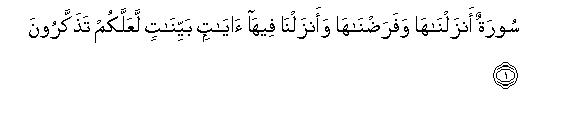
[1] This is a Surah which We have sent down and We have made it mandatory, and We have sent down clear Commandments in it1 so that you may learn lessons.
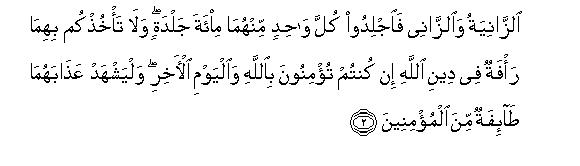
[2] The woman and the man guilty of fornication, flog each one of them with a hundred stripes2 and let not any pity for them restrain you in regard to a matter prescribed by Allah, if you believe in Allah and the Last Day,3 and let, some of the believers witness the punishment inflicted on them.4
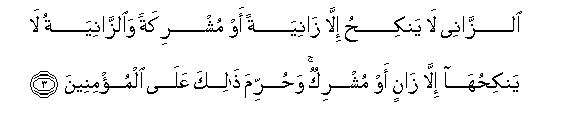
[3] A man guilty of adultery (or fornication) shall not marry any but the woman guilty of the same or a mushrik woman, and none shall marry a woman guilty of adultery (or fornication) but the man guilty of the same or a mushrik man: such marriages are forbidden to true believers.5
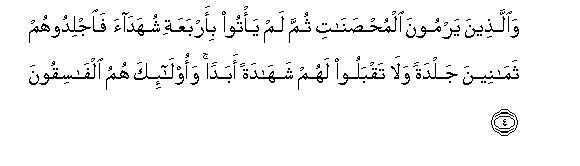
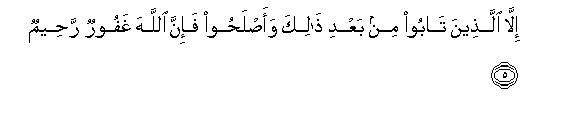
[4-5] As for those persons who charge chaste women with false accusations but do not produce four witnesses, flog them with eighty stripes and never accept their evidence afterwards, for they themselves are transgressors, except those who repent and reform themselves; Allah is Forgiving and Merciful.6
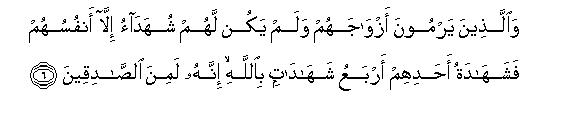

[6-7] As for those who accuse their own wives but have no witness except themselves, the evidence of one of them is that he shall swear four times by Allah and declare that he is true (in his charge). Then the fifth time he shall declare that Allah's curse be upon him if he be false (in his charge).
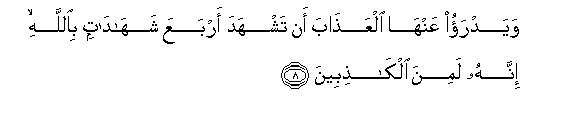


[8-10] (As for the woman), it shall avert the punishment from her if she swears four times by Allah that the man is false (in his charge) and the fifth time she invokes Allah's wrath upon herself, if he be true (in his charge).7 If Allah had not shown you His grace and mercy and if Allah had not been most Forgiving and All-Wise, (you would have been in a great fix because of accusing your wives).
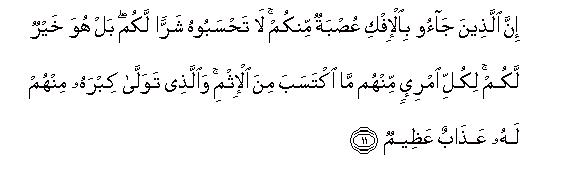
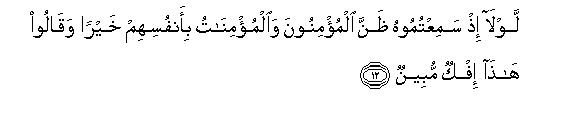
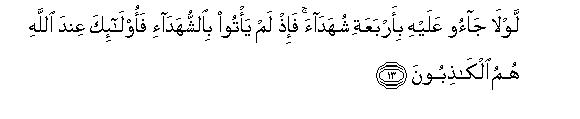
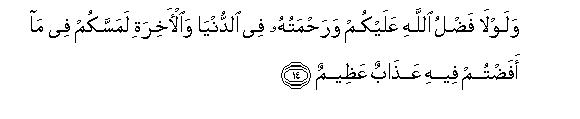
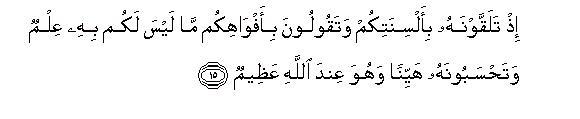
[11-15] Those who have invented the slander,8 are some of your own people.9 You should not, however, regard this matter as evil for it has good in it for you.10 Whoso took any part in this, he earned his share of the sin accordingly, and the one, who had the greatest share of responsibility in it,11 shall have a terrible punishment. When you heard of it, why didn't the Believing men and the Believing women have a good opinion of themselves,12 and why did they not say, "This is a manifest slander?"13 Why did the slanderers not bring four witnesses (to prove their charge)? Now that they have not brought witnesses, they themselves are liars in the sight of Allah.14 Were it not for Allah's grace and mercy towards you in this world and in the Hereafter, a painful scourge would have visited you because of the things in which you were involved. (Just think how erroneous you were,) when you passed this lie on from one tongue to the other and uttered with your mouths that of which you had no knowledge. You took it as a trifling matter whereas it was a grave offense in the sight of Allah.


[16-18] Why did you not, as soon as you heard of it, say, "It is not proper for us to utter such a thing ? Glory be to Allah! This is a great slander." Allah admonishes you that in future you should never repeat a thing like this, if you are true Believers. Allah makes His Revelations clear to you, and He is All-Knowing, All-Wise.15

[19-20] As for those, who like that indecency should spread among the Believers, they deserve a painful punishment in this world and in the Hereafter,16 for Allah knows and you do not know (its consequences).17 If Allah had not shown His grace and mercy to you, (this scandal would have produced very evil results): Allah is indeed very Kind and Merciful.
[21] O Believers, do not follow in Satan's footsteps, for he will incite to indecency and wickedness any who will follow him. If Allah had not shown His Brace and mercy to you, none of you would have been able to cleanse yourself,18 for it is Allah alone Who cleanses whom He wills, and Allah is All-Hearing, All-Knowing.19
[22] Those among you, who are bountiful and persons of means, should not swear on oath that they would withhold their help from their relatives, the indigent and those who have left their homes for the cause of Allah: they should forgive and forbear. Do you not wish that Allah should forgive you? and Allah is Forgiving and Merciful.20
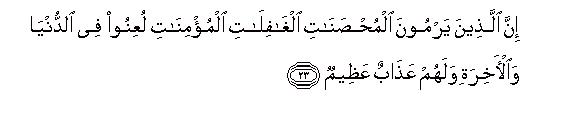


[23-25] Those who charge with slander those Believing women, who are chaste but simple souls,21 are accursed in this world and in the Hereafter: there is a great punishment for them. They should not forget the Day when their own tongues and their own hands and test will bear testimony in regard to their misdeeds.21a On that Day Allah will give them the full recompense they deserve, and they will realize that Allah is the very Truth, Who makes the Truth manifest.
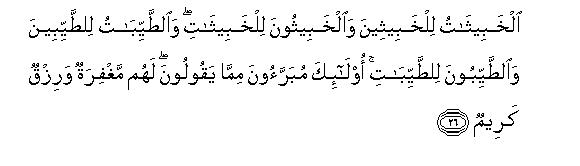
[26] Impure women are for impure men and impure men for impure women, and pure women are for pure men and pure men for pure women. They are free from those scandals which the slanderers utter.22 There is forgiveness for them and honorable provision.
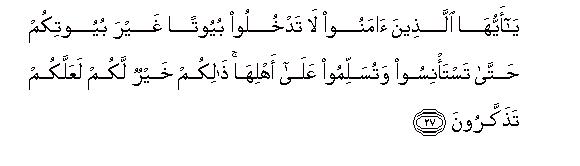
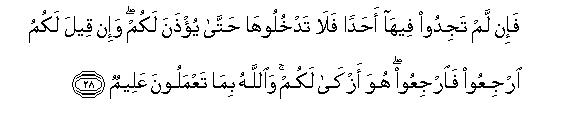
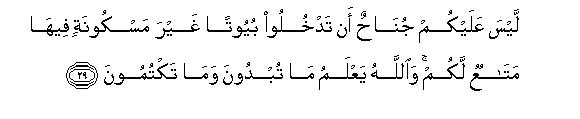
[27-29] O Believers,23 do not enter other houses than your own until you have the approval of the inmates24 and have wished them peace; this is the best way for you: it is expected that you will observe it.25 Then, if you do not find anyone therein, do not enter until you have been given permission,26 and if you are told to go back, you should go back. This is a purer way for you;27 and Allah has full knowledge of what you do. There is, however, no harm if you enter houses which are not dwelling places, but contain something useful for you;28 Allah knows what you disclose and what you conceal.
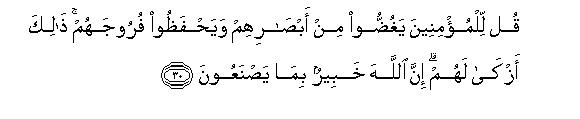
[30] And O Prophet, enjoin the Believing men to restrain their gaze29 and guard their private parts.30 This is a more righteous way for them: Allah has knowledge of what they do.
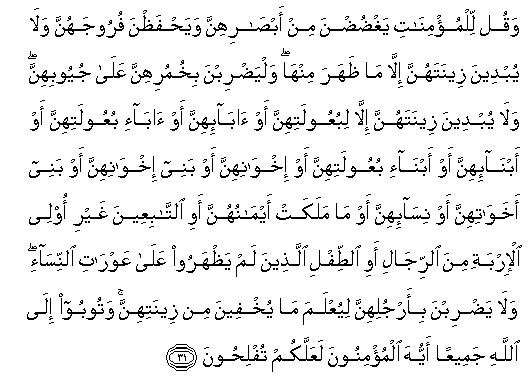
[31] O Prophet, enjoin the Believing men to restrain their gaze31 and guard their private32 parts.33 and not to display their adornment34 except that which is displayed of itself,35 and to draw their veils over their bosoms36 and not to display their adornment except before their husbands,37 their fathers, the fathers of their husbands,38 their sons and the sons of their husbands39 (from other wives), their brothers,40 their brothers' sons,41 their sisters' sons,42 their female associates43 and those in their possession44 and male attendants incapable of sex desire45 and those boys who have not yet attained knowledge of sex matters concerning women;46 also forbid them to stamp their feet on the ground lest their hidden ornaments should be displayed.47 O Believers, turn all together towards Allah:48 it is expected that you will attain true success.49
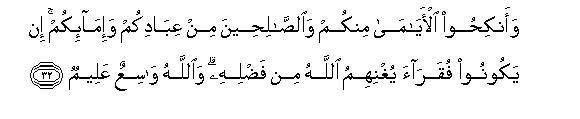
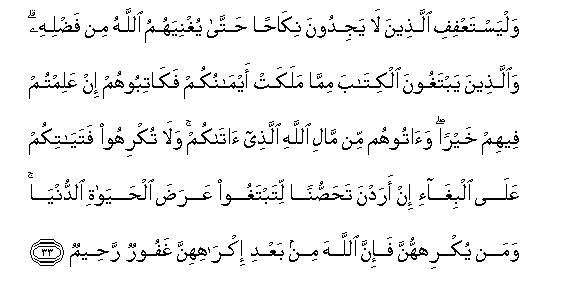
[32-33] Arrange marriages between the single men and women among you50 and between your slave men and slave women, who are righteous,51 52 if they be indigent, Allah will provide means for them out of His bounty:53 Allah has boundless resources and He is All Knowing. And those, who cannot find a match, should observe continence till Allah provides them with means out of His bounty54 And if those who are in your possession, ask for a deed of emancipation, execute the deed of emancipation55 with them,56 provided that you find some good in them;57 and give them something out of the means Allah has given you.58 And do not force your slave-girls into prostitution for your own worldly gains when they themselves want to keep chaste;59 and if anyone forces them into it, after such a compulsion Allah will be forgiving and merciful for them.
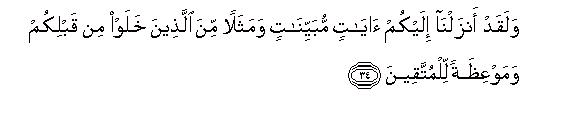
[34] We have sent down to you Revelations giving clear guidance and cited examples of the peoples who went before you to serve as warning and We have imparted admonitions for the God-fearing.60
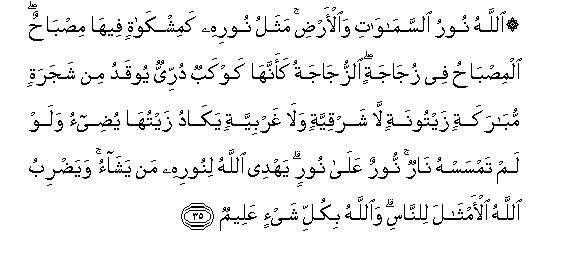
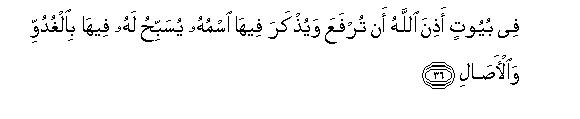
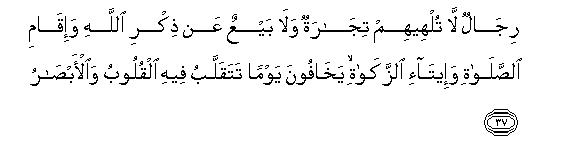
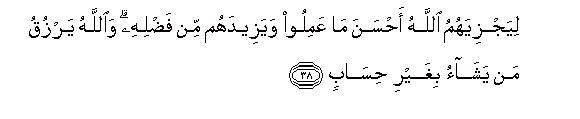
[35-38] Allah61 is the light of the heavens and the earth:62 His light (in the universe) may be likened (to the light of) a lamp in a niche: the lamp is in a glass shade: the glass shade is like a glittering star and lamp is lit with the olive oil of a blessed tree63 which is neither eastern nor western:64 its oil is (so fine) as if it were going to shine forth by itself though no fire touched it (as though all the means of increasing) light upon light (were provided65 ); Allah guides to His light whomever He wills.66 He cites parables to make the Message clear to the people; He has perfect knowledge of everything.67 (Those who obtain guidance to His light are found) in the houses which He has enjoined to raise up and to mention His name therein.68 In them such people glorify Him morning and evening as are not diverted by trade and merchandise from remembering Him and from establishing Salat and paying Zakat, for they fear the Day when the hearts will be overturned and the eyes will become petrified. (And they behave like this) so that Allah may reward them for their excellent deeds and, in addition to it, show His favor to them out of His bounty: Allah provides without stint69 for anyone He pleases.
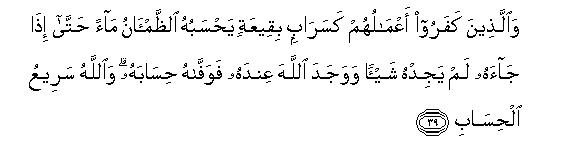
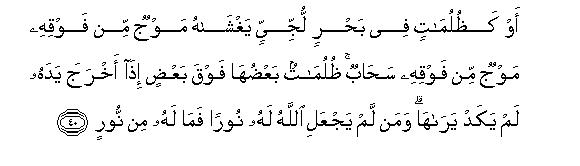
[39-40] (On the other hand,) the deeds of those who disbelieved,70 maybe likened to a mirage in a waterless desert, which the thirsty one took for water; but when he reached there he found nothing to drink; nay, he found there Allah Who settled his full account, and Allah is very swift at reckoning.71 Or (their efforts may be likened to those of a man trying to swim in) a deep dark ocean, covered with billows, one over the other, and above it a cloud: darkness upon darkness: so much so that if he stretches out his hand, he cannot see72 it. There is no light for the one whom Allah does not give light.73

[41-42] Do74 you not observe that all those who are in the heavens and the earth, and the birds with outspread wings, glorify Allah ? Each one knows the mode of its prayer and glorification, and Allah has full knowledge of all they do. The kingdom of the heavens and the earth belongs to Allah alone, and all shall have to return to Him.

[43-44] Do you not observe that Allah makes the cloud move gently then joins its pieces together: then gathers it into a mass of thick cloud: then you see that rain-drops fall down from its midst: and He sends down hail out of the high up mountains in the heaven:75 then He smites with it whom He wills and turns it away from whom He pleases: then a flash of lightning from it dazzles the eyes. He alternates the day and the night: there is indeed a lesson in it for those who have observing eyes.
[45] And Allah created every creature from a sort of water: of them some one crawls upon its belly: another walks on two legs and still another on four; Allah creates whatever He wills for He has power over everything.
[46] We have sent down Revelations that make the reality quite plain; however, Allah guides to the straight path whomsoever He pleases.
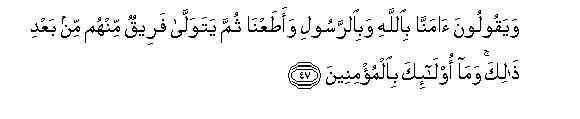
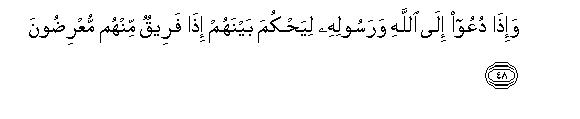

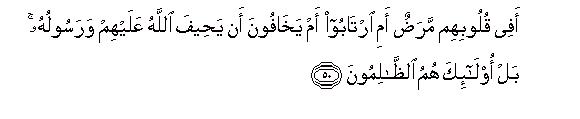
[47-50] These people say "We have believed in Allah and the Messenger and we have submitted"; but soon after this, some of them turn away (from obedience): such people are not true Believers.76 When they are called to Allah and His Messenger so that the Messenger may judge between them,77 a party of them turns away.78 However, if the truth be on their side, they come towards the Messenger in all obedience.79 Are their hearts afflicted with the disease (of hypocrisy)? Or, are they in doubt? Or, do they fear that Allah and His Messenger will be unjust to them? In fact, they themselves are unjust.80
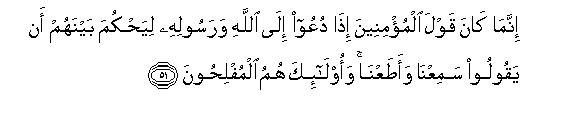
[51-52] As regards the Believers, when they are called towards Allah and His Messenger so that the Messenger may judge between them, they say, "We have heard and obeyed"; such are the people who attain true success, and only those attain true success who obey Allah and His Messenger and fear Allah and refrain from His disobedience.
[53-54] They (the hypocrites) solemnly swear by Allah and say, "If you order us, we will leave our homes." Say to them, "Do not swear oaths for your “obedience” is well known;81 Allah is fully aware of what you are doing."82 Say, "Obey Allah and obey the Messenger, but if you turn away, you should note it well that the Messenger is responsible for the duty entrusted to him and you are responsible for the duty entrusted to you. If you obey him, you will be rightly guided, for the responsibility of the Messenger is only to convey the Message clearly to you.

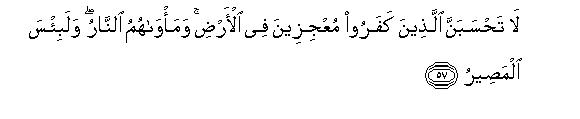
[55-57] Allah has promised to those among you who believe and do righteous deeds, that He will make them successors in the land just as He made those who passed away before them, and that He will establish their religion, which He has approved for them, on strong foundations and will change their (present) state of fear into peace and security. Let them worship Me and associate none with Me;83 and the one who disbelieves after this,"84 shall be of those who are perverse transgressors. Therefore, establish Salat, pay the Zakat dues and obey the Messenger; it is expected that you will be shown mercy. Do not think about those who have disbelieved that they will be able to frustrate Allah in the land; their abode is Hell and it is a very evil abode.
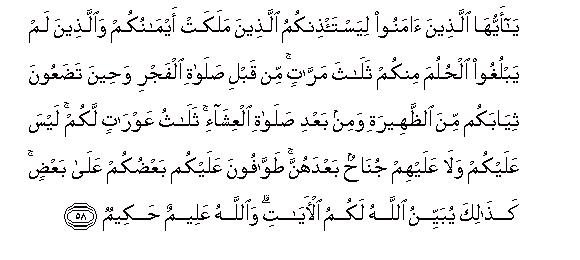
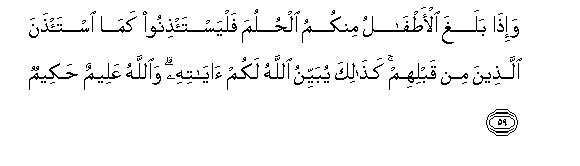
[58-59] O Believers,85 your slaves86 and those of your children, who have not yet become sex conscious,87 must ask your permission before coming in to see you on three occasions: before the Fajr Prayer and at noon when you put off your clothes and after the `Isha' Prayer. These are your three times of privacy.88 There is no sin for you or for them89 if they come without permission at other times than these, for you have to visit one another over and over again.90 In this way Allah makes His Commandments clear to you for He is All-Knowing, All-Wise. And when your children have grown sex conscious,91 they should receive your permission for this just as their elders get permission. In this way Allah makes His Revelations plain to you for He is All-Knowing, All Wise.
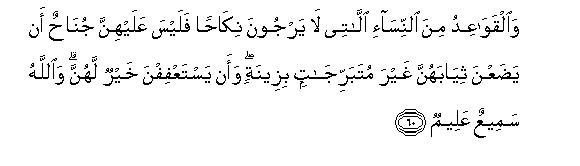
[60] There is no sin for such elderly women as are past the age of marriage,92 if they lay aside their outer garments93 provided that they do not mean to display their adornment.94 Nevertheless, if they behave modestly, it would be better for them: for Allah hears everything and knows everything.
[61] There is no harm if a blind or a lame or a sick person (takes a meal at another's house): nor is there any harm for yourselves if you take meals at your own houses or at the houses of your fathers and grandfathers or at the houses of your mothers and grandmothers or at your brothers' houses or at your sisters' houses or at the houses of your paternal uncles or at the houses of your paternal aunts or at the houses of your maternal uncles or at the houses of your maternal aunts or from the houses whose keys are in your possession or at the houses of your friends.95 There is no harm if you take your meals together or separately;96 however, when you enter the houses, you should send greetings of peace on your people, for the prayer of greetings prescribed by Allah is blessed and pure. Thus Allah makes His Revelation's clear to you. It is expected that you will use your common sense to grasp these.
[62] True Believers97 are those who sincerely believe in Allah and His Messenger and who do not leave him without permission when they are with the Messenger for some common good;98 only those who ask your permission sincerely believe in Allah and His Messenger. Therefore, when they ask your permission for a private business,99 you may give permission to whomever you like,100 and ask Allah's forgiveness for such people.101 Allah is indeed Forgiving and Merciful.
[63-64] O Believers, do not consider the summoning by the Messenger like the summoning among you by one another.102 Allah knows well those of you who steal away, concealing themselves behind others.103 Let those who disobey the order of the Messenger beware lest they should be involved in some affliction,104 or are visited by a woeful scourge. Beware! whatever is in the heavens and the earth belongs to Allah. He knows whatever you are doing. On the Day you shall return to Him, He will let you know what you have . done: He has full knowledge of everything.
1In all these sentences the emphasis is on "We", which implies that it is Allah Who has revealed this and none else; therefore, "You should not treat these instructions lightly like the word of an ordinary preacher. You should note it well that these have been sent down by One Who controls your lives and destinies and from Whom you can never escape even after your death.
The second sentence emphasizes that the instructions sent down in this Surah are not of the nature of advice which you may accept or reject at will. These are mandatory Commandments which must be obeyed. If you are a believer and a true Muslim you are obliged to act upon them.
The third sentence states that the instructions given in this Surah are free front any ambiguity and are couched in clear and plain words. Therefore, you cannot put up the excuse that you could not act upon them as you did not understand them.
This is the 'Preamble' of this blessed Message after which the specific Commandments follow. The cone of the preamble itself indicates the great importance which Allah has attached to the Commandments contained in Surah An-Nur. The preamble of no other Surah containing Commandments is so forceful as this.
2There are various legal, moral and historical aspects of this problem which need explanation, for if these are not clarified in detail, the modern man will find it difficult to understand the Divine Law concerning it. Accordingly, we shall discuss the various aspects of the problem below:
(1) The common meaning of zinc which everyone knows is: "Sexual intercourse between a man and a woman without the legal relationship of husband and wife existing between them." There has been complete unanimity of view among all the social systems from the earliest times to this day that this act is morally wicked, religiously sinful and socially evil and objectionable, and there has been no dissenting voice except from those stray individuals who have subordinated their moral sense to their lust, or who in their misguided notions try to be "original" and "philosophical" in their approach. The universal unanimity of view in this respect is due to the fact that man by nature abhors zinc. In fact, the future of human race and civilization depends on this that the relationship between the husband and wife should be built upon the basis of an enduring and everlasting bond of fidelity, which should not only be fully recognized in the social life but should also be guaranteed by the existing social structure. Without this the human race cannot survive. This is because the human child requires years of tender care and training for as survival and development and a woman alone cannot bear the burden without the cooperation of the man who became the cause of the birth of the child. Similarly human civilization itself is the product of the corporate life of a man and a woman, their setting up a home, bringing up a family, and establishing mutual relationships and inter-connections between families. If men and women were to lose sight of this essential fact, that is, the establishment of a home and raising a family, and were to meet freely just for pleasure and lust, the entire structure of human society would crumble. In fact, the very foundations on which the structure of human civilization and culture has been built will topple down and the whole basis of the concept of a social life will disappear. It is for these reasons that free mixing of men and women, without any recognized and stable bonds of fidelity, is abhorrent to human nature, and it is for this reason that in every age zina has been considered as a moral evil and, in religious terminology, a grave sin. Accordingly, the social systems in every age recognized and adopted the institution of marriage and also adopted preventive measures against adultery or fornication. The forms of the measures adopted in this direction have, however, differed under different social, cultural and religious systems. This difference has been the result of the realization of the disastrous effects of adultery (or fornication) in varying degrees: some societies have considered it to be more heinous than others, and some have conceived it clearly and some others not so clearly and confused it with other problems.
(2) Though adultery (or fornication) has always been accepted as an evil, opinion has differed as to whether it is legally a punishable offense or not, and this is where Islam differs from other religions and systems of law. Social systems which have been akin to human nature have always considered illicit intercourse between man and woman a serious crime and prescribed severe punishments for it. But with the deterioration in moral standards, this morality grew weaker and weaker and the attitude towards this crime became more and more tolerant.
The first common lapse in this connection was caused by the invidious distinction between fornication and adultery. The former as such was taken as an ordinary offense while the latter only was held as a punishable crime.
Zina, as defined under various laws, means "sexual intercourse between a man (whether married or bachelor) and a woman, who is not the wife of anybody." This definition takes into account the position of the woman rather than of the man. If a woman is without a husband, the illicit intercourse with her amounts to fornication irrespective of the fact whether the man is married or not. The ancient laws of Egypt, Babylon, Assyria and India provided very light punishments for it, and the same were adopted by the Greeks and the Romans,which finally influenced the Jewish attitude. According to the Bible, only monetary compensation is payable for such an offense. The Commandment on the subject is as follows:
"And if a man entice a maid that is not betrothed, and lie with her, he shall surely endow her to be his wife. If her father utterly refuses to give her unto him, he shall pay money according to the dowry of virgins." (Exod. 22: 16,17)
The same Commandment is repeated in different words in Deuteronorny, which is as below:
"If a man finds a damsel that is a virgin, which is not betrothed, and lay hold on her, and lie with, and they be found; Then the man that lay with her shall give unto the damsel's father fifty shekels of silver (about fifty-five rupees), and she shall be his wife; because he hath humbled her." (Deut. 22: 28, 29).
Under the Jewish law, if a priest's daughter acts immorally, she is to be sentenced to burning and the man with whom she was alleged to have acted immorally was to suffer strangulation. (Everyman's Talmud, pp. 319, 320).
To judge the extent to which this conception resembles that of the Hindus, it will be worthwhile to compare it with the laws of Manu. According to him, "Anybody who commits illicit intercourse with an unmarried girl. of his own caste with her consent does not deserve any punishment. If the father of the girl is willing, the man should compensate him and marry the girl. But if the girl happens to belong to a higher caste and the man belongs to a lower caste, the girl should be turned out from her parents' house and the limbs of the man should be cut off." (Adhiai 8. Ashlok 365, 366). This punishment may be changed into burning him alive, if the girl happens to be a Brahman. (Ashlok 377).
Under all these laws, illicit intercourse with a married woman only was the real and major crime. The deciding factor for treating it as a crime was not the illicit relationship between the man and the woman but the likelihood of an awkward situation under which a child might have to be reared up by a man (the real husband of the woman), who was not its father. It was therefore not the act of zinc itself but the danger of the mixing up of progenies and the problem of rearing up somebody else's child at the expense of another and a possibility of its inheriting his property, that was the :eat basis of treating it as a crime and holding both the man and the woman as criminals. Under the Egyptian law, the man was to receive a severe beating with sticks and the nose of the woman was to be cut off. Similar punishments existed in Babylon, Assyria and Iran. According to the Hindus, the woman was to be thrown to the dogs to be torn apart and the man was to be put on a hot iron bed with fire all around him to burn him alive. At first the Greek and the Roman laws gave a man the right to kill his wife if he found her involved in adultery. He had also the option to demand monetary compensation. In the first century B.C. Augustus Caesar enacted that half the property of the man should be confiscated and he should be exiled. In case of the woman, half her dowry should be written off and one-third of her assets confiscated, and she should also be sent out to a distant part of the country. Constantine changed this law and imposed death penalty both for the tnan and for the woman. In the times of Leo and Marcian, this punishment was changed to imprisonment for life. Justinian further reduced the punishment and ordered that the woman should be flogged with stripes and sent to a monastery and the husband should be given the right to take her out within two years if he liked, otherwise she was to remain there for ever. Under the Jewish law, the orders for illicit intercourse with a married woman are as under:
"And whosoever lieth carnally with a woman, that is a bond maid, betrothed to an husband, and not at all redeemed, nor freedom given her, she shall be scourged; they shall not be put to death, because she was not free." (Leviticus 19: 20).
"And the man that committeth adultery with another man's wife, even he that committeth adultery with his neighbour's wife, the adulterer and the adulteress shall surely be put to death." (Leviticus 20: 10).
"lf a man be found lying with a woman married to an husband, then they shall both of them die, both the man that lay with the woman, and the woman: so shalt thou put away evil from Israel." (Deuteronorny 22: 22).
"If a damsel that is a virgin be betrothed unto an husband and a man find her in the city, and lie with her; Then ye shall bring them both out unto the gate of that city, and ye shall stone them with stones that they die; the damsel, because she cried not, being in the city, and the man, because he had humbled his neighbor's wife: so thou shalt put away evil from among you. But if a man find a betrothed damsel in the Held, and the man force her, and lie with her: then the matt only that lay with her shall die: But unto the damsel thou shalt do nothing; there is in the damsel no sin worthy of death: for as when a man riseth against his neighbor, and slayeth him, even so is this matter." (Deuteronorny 22: 23-26).
However, long before the advent of Christ, the Jewish jurists and scholars, the rich and the poor, had practically ceased to observe these laws. Though it was written in the Old Testament, and it was considered as a Divine Commandment, nobody was inclined to apply it practically; in the entire Jewish history, there is not a single instance where this commandment was ever enforced. When Jesus Christ embarked upon his prophetic mission, and invited the people to the eternal truth, the learned Jews, seeing that there was no way to stop the tide, brought a woman guilty of adultery before him and asked him to decide her case. (John 8: 111). Their object was to create a dilemma for Christ and to tempt and embarrass him. If he decided in favour of any punishment other than stoning, they would vilify him saying, "Here comes a strange Prophet who has changed the Divine Law for the sake of worldly considerations." And if he were to give the verdict of stoning, this would, on the one hand, bring him in direct clash with the Ron Ziad law, and on the other, give them the opportunity to tell the people, "Look! What you believe in a Prophet who will expose you to all the severities of the Torah? But Jesus turned the tables on them with one sentence, saying: "He that is without sin among you, let him first cast a stone at her. " This put the jurists to shame and they departed one by one in humiliation, and the moral degeneration of the learned in law was totally exposed. When the woman was left alone, Jesus admonished her and after her repentance let her go. Jesus did this because he was neither a judge of any court competent to decide the case, nor any evidence had been produced against her, nor was there any government to enforce the Divine Law.
On the basis of this incident and some miscellaneous sayings of Jesus on different occasions, the Christians formed an utterly erroneous conception about the crime of zina. According to them, illicit intercourse between an unmarried man and an unmarried woman is a sin but not a punishable offence. But if either of them (or both) is married, adultery is treated as a crime. It is so not because of the illicit intercourse as such but because of the vow of fidelity taken by each of them before the priest at the altar. Nevertheless, there is no punishment even for this, except that the wife has the right to sue her adulterous husband and claim separation for having violated the vow of fidelity. On the other side, the husband of the adulterous woman can also sue his wife for separation and can also claim compensation from the man who had illicit intercourse with his wife. This is the punishment in the Christian law for adultery. The irony is that even this punishment is a double-edged sword, because a woman, though entitled to separation from her husband by proving his infidelity and getting rid of him cannot remarry under the Christian law. Similarly the husband who sues his wife for infidelity can obtain judicial separation, but cannot remarry. Both the man and the woman who accuse each other of infidelity in a Christian court, will be deprived of the right of remarriage for the rest of their lives.
The Western laws of the modem times, which have also been adopted by the Muslims in various countries, are based on such conceptions. According to them, zina may be an evil, and an immoral and sinful thing, but it is not a crime. It becomes a crime only when illicit intercourse is committed without the consent of the other party. As for adultery by a married man, this only provides a cause for complaint to his wife who may, if she likes, prove it and get a divorce. Similarly in the case of an adulteress, her husband can lodge a complaint against her and also against the man with whom adultery was committed and can sue both of them to claim divorce from the woman and monetary compensation from the man.
(3) The Islamic Law, in contrast to all these conceptions, holds zina as a punishable crime and its committal by the married person enhances the guilt all the more. This is not so because of the violation of the oath of fidelity taken by the man or the woman nor because of the encroachment on the conjugal rights of the other, but because the criminal resorted to an unlawful method when there existed a lawful method for satisfying his sex desires. The Islamic Law views zina as an act which, if allowed to be indulged in freely, will strike at the very roots of both human race and human civilization. In the interest of the preservation of the human race and the stability of human civilization, it is imperative that relationship between man and woman should be regulated only through lawful and reliable means. And it is not possible to restrain this relationship if opportunities for free mixing of the sexes are allowed to exist, for it cannot be expected from a man or a woman to be prepared to bear the onerous responsibilities of the family life if he or she has the opportunities for the gratification of the sex desires without this. For in that case it will be as meaningless as buying a ticket for a railway journey when people can travel without a ticket as well. A ticket is essential only when travelling without a ticket is declared to be an offense. If somebody is found traveling without a ticket because he cannot afford to buy it, he is a criminal though in a lesser degree. But if a rich man resorts to this, his guilt becomes all the more serious.
(4) Islam dces not rely on punitive law alone for saving humanity from the menace of zina. It employs both reformatory and prohibitory measures on a large scale. It has provided legal punishment only as a last resort. Islam does not want that the people should go on committing this crime and getting flogged with stripes day and night. Its real aim is that the people should not commit this crime at all and there should be no occasion to resort to the extreme punishment. For this purpose Islam first of all purifies man: it imbues him with the fear of All-Powerful and All-Knowing Allah: it inculcates in him the sense of accountability for his actions in the Hereafter from which even death cannot release him. It fills him with obligation of obedience to Divine Law which is sure to follow true Faith. Then, it repeatedly warns him that zina and unchastity are heinous crimes, which Allah will call to account with a severe reckoning. This theme occurs again and again in the Qur'an. Moreover, Islam provides all possible facilities for a man to marry. if he is not satisfied with one wife, he is allowed to take up to four. If the husband and the wife cannot pull on amicably, there are provisions for separation. In case of a dispute between the two, provision exists for reconciliation through the intervention of the members of the family and failing that through the judicial courts so that they should either reconcile or separate and then remarry wherever they like. All this has been explained in Surahs AIBaqarah, An-Nisa and At-Talaq. In this Surah too, it is not considered good and right to remain unmarried and a clear Commandment has been given that marriages should be arranged between unmarried persons and even slaves (men and women) should not be allowed to remain unmarried. Then Islam puts an end to all those factors which allure a man to zina or provide occasions for it. A year before the punishment for zina was prescribed, women were commanded (in Surah Al-Ahzab) to cover themselves with sheets and lower their head-covers over their faces when going out of their houses. The wives of the Holy Prophet (Allah's peace be upon him), who were a model for every Muslim family, were ordered to restrict themselves to their houses with decorum and dignity and not to display their charms and adornments. Moreover, they were required to communicate with men from behind the curtain if there be any need for that. This was a model which was followed by all the believing women who considered the Prophet's wives and daughters patterns of virtue and not the immodest women of the age of 'ignorance'. Similarly, the free mixing of the men and women was discouraged before it was declared as a criminal offense and women were prohibited from going out openly in make-up.
After adopting such measures zina was declared to be a punishable offense and spreading of indecency in any way was also prohibited. Prostitution was legally banned and severe punishment was prescribed for charging men and women with adultery and propagating it without proof. Men were enjoined to restrain their gaze so that unrestricted feasting of eyes should not lead to lust for beauty and further on to illicit love. At the same time women were also enjoined to differentiate between mahram and non-mahram relatives.' This enables one to understand the entire scheme of reform, a constituent part of which is the prescribed punishment for zina. This extreme punishment is for those incorrigible persons who persist in resorting to the illegal course for the gratification of their sex desires in spite of all the treasures adopted to reform the individual and society. They certainly deserve to be flogged. Punishment of a wicked person serves as a, psychological deterrent for those who have similar tendencies.
Mahram relatives are those between whom marriage is not permissible under the Islamic Law, e.g. father and daughter, uncle and niece, nephew and aunt, and so on. Non-mahram are those between whom marriage is permissible e.g. cousins, etc. punishment is not merely a punishment for the criminal but is a declaration of the policy that the Islamic society has no room for debauchery and people cannot be allowed to live lives of indulgence and pleasures without restraint. If one tries to understand the Islamic scheme of reform from this point bf view, one will realize that not a single part of the law can either be dispensed with or amended. Only a tool who assumes the role of a self-styled reformer, without understanding this Divine Law, will ever think of changing it, or a mischievous person, who deliberately wants to alter the very object of the social order designed by Allah, will try to tamper with it.
(5) Zina was declared a culpable act in the third year of Hijrah, but, it was not a "legal" crime at that time; as such the police and the courts were not competent to initiate legal proceedings. It was considered as a social crime against the institution of family. Accordingly the members of the family themselves were competent to punish the accused. The Commandment at that time was that if four men should bear witness to having seen a man and a woman committing zina, both the culprits should get a beating and the woman should be imprisoned in the house. But at the same time there was a suggestion that this Commandment would apply till further orders and that the real law was yet to follow. (See 1V: 15). After about two to three years the present Commandment was revealed which canceled the previous Commandment and declared zina to be a cognizable offense.
(6) The punishment prescribed in this verse (2) is for sexual intercourse between unmarried persons; it does not apply to illicit intercourse after marriage, which is a much graver offense under the Islamic Law. This thing is implied in verses 15 and 25 of An-Nisa (IV}that the punishment being prescribed is for the unmarried offenders:
"If any of your women are guilty of indecency, call four witnesses from among yourselves to testify this. If they give evidence and prove the guilt, then confine them to their houses until death comes to them, or Allah opens some other way out for them." (IV: 15). "Whoso cannot afford to marry free Muslim women, he should marry one of the Muslim slave-girls in your possession; Allah has full knowledge of your Faith. You all belong to one and the same Community; therefore you may marry them with the permission of their guardians and give them their dowries so that they may live a decent life in wedlock and not in licentiousness nor may have secret illicit relations. Then if they are guilty of indecency, after they have been fortified by wedlock, they shall be given half the punishment prescribed for free women." (IV: 25).
Verse 15 held out a hope that Allah would open some other way out for those adulterous women who were to be imprisoned according to the Commandment contained in it. Thus, the Commandment in verse 2 of this Surah is the same which was promised in IV: 15. Then in IV: 25 the punishment for a married slave-girl guilty of adultery has been prescribed. The word muhsanat has been used twice in the same verse in the same context and one will have to concede that it has been used in the same sense at both the places. Now let us consider the sentence: "Whoso cannot afford to marry free Muslim women (muhsanat).... " Obviously a muhsanah cannot mean a married woman; it can only mean an unmarried woman of a free family. Then at the end of the verse it has been enjoined that if a slave woman commits adultery after her marriage, she should be given half the punishment prescribed for a free unmarried woman. The context clearly indicates that in this sentence the word muhsanat has the same meaning as in the first sentence, i.e. an unmarried woman, who enjoys the protection of a free family. Thus it is concluded from these two verses of An-Nisa that the Commandment contained in this verse of An-Nur is the same that was promised in v. 15 of An-Nisa and it prescribes punishment for sexual intercourse between unmarried persons. (Also see E. N. 46 of An-Nisa).
(7) As regards the punishment for adultery after marriage, the Qur'an does not mention it, but it has been prescribed in the Traditions. We learn from many authentic Traditions that not only did the Holy Prophet prescribe the punishment of stoning to death for it verbally but also enforced it practically in several cases. Then after him his successors not only enforced this punishment during their caliphates but also declared repeatedly that this was the legal punishment. The Companions and their followers were unanimous on this point and there is not a single saying of anyone to suggest that anybody doubted the authenticity of this law during that period. After them the jurists of all ages and countries have been unanimous that this is the legal punishment prescribed by the Sunnah, for there have been so many strong and continuous proofs of its authenticity that no scholar can refute them. In the entire history of the Muslims nobody ever denied this except the Kharijites and some Mu'tazilites and even they did not deny it on the ground that there was some weakness in the proof of its having been enjoined by the Holy Prophet, but because they considered it to be "against the Qur'an". This was, however, due to their lack of understanding the Qur'an. They argued that by using the words AZ zani waz-zaniyatu in their general sense the Qur'an has prescribed a punishment of one hundred stripes for this crime. Therefore, according to them, the only punishment for adultery (or fornication) prescribed in the Qur'an was this, and to prescribe a different punishment for the married persons who committed adultery would be against the Divine Law. But they forgot that the explanation of the Qur'anic verses by the Holy Prophet carries the same weight and authority in law as the words of the Qur'an itself, provided that the explanation is proved to be from the Holy Prophet. The Qur'an has used As-sariqu was-sariqatu in similar general terms and prescribed the punishment of amputation of hands for the thief, both male and female. Now if this Commandment were to be interpreted literally without the limitations authentically emanating from the Holy Prophet, the generality of the words used would demand that every man or woman, who steals a needle or a plum, should be declared to be a thief and his or her hand cut off from the shoulder. On the other hand, if a thief, who has stolen a million rupees, declares on his arrest that he has reformed himself and has repented of theft, he should be let off in accordance with: "But whoso repents after his iniquity and reforms himself, Allah will surely turn towards him with His favour." (IV: 39).
Likewise the Qur'an forbids marriage only with a foster mother and a foster sister. According to their argument, such a ban should not apply to a foster daughter. The Qur'an forbids a person to keep two sisters as wives at one and the same time; therefore if a person keeps the aunt (paternal or maternal) and her niece together as wives, he should not be charged with violating the Qur'anic injunction. Again, the Qur'an forbids marriage with a step-daughter only when she has been brought up ' in the house of her step-father; therefore, according to their way of reasoning, the absolute prohibition of marriage with a step-daughter should be regarded as against the Qur'an. Similarly the Qur'an allows mortgage only when a man is on a journey and nobody is available to prepare the loan documents; therefore if a person is at home and a scribe is also available, mortgage should be regarded as un-Qur'anic. Then, the Qur'an enjoins in general terms: "You should have witnesses whenever you buy or sell goods." Therefore, according to them, all sales and purchases taking place in the markets without witnesses should be unlawful.
These few instances should suffice to prove the error in the reasoning of those who hold the Commandment of stoning to death as against the Qur'an. Nobody can deny the position and authority of the Prophet in the legal system of Islam. It is he alone who can explain the underlying intention of a Divine Command, its procedures and in what cases it will be applicable and in what there is another injunction. To deny this position and authority of the Prophet is not only against the principles of Islam but it also entails innumerable complications in practice.
(8) There is a difference of opinion among the jurists about the legal definition of .zina. According to the Hanafis, it means frontal sexual intercourse of a man with a woman who is neither his wife nor his bondwoman, nor is there any valid reason to believe that the sexual act was committed under the misapprehension that the woman was his own wife or his own Bondwoman According to this definition, sexual act with a woman in the rectum, or sodomy, or sex gratification with animals, does not constitute zina. It is confined only to the frontal sexual intercourse with a woman without any legal right or any doubt thereof. According to the Shafi`is, zina means insertion of the male sexual organ into the female sexual part, which though forbidden by law may be quite natural: According to the Malikis, zina means the entry of the male sexual organ into the frontal sexual part, or in the rectum of a woman or man, without legal right or any doubt about its being legal. According to these two definitions, sodomy also will be included in zina. The correct position, however, is that these definitions are removed from the common meaning of zina. The Qur'an always employs words in their ordinary meaning and according to their common usage, unless it uses a certain word as a term. In such a case the Qur'an itself makes plain the particular sense of the term. In the context in which the word zina occurs, there is no indication that it has been used in any particular sense. Accordingly the word will have to be taken in the sense in which it is commonly understood. It is, therefore, confined to an illicit intercourse with a woman in the natural way and does not extend to other forms of sexual gratification. Besides, it is well known that there was a difference of opinion about the punishment for sodomy among the Companions of the Holy Prophet. Had sodomy been included in zina according to the Islamic terminology, there would have been no occasion for such a difference of opinion.
(9) Penetration of the glans of the penis is a sufficient legal ground for punishing the act of Zina. It is not essential that the penetration should be full or the sexual intercourse should be complete. On the other hand, if there is no penetration of the glans of the penis, mere lying of the couple in the same bed or their caressing each other or their being found naked, is not a sufficient ground for declaring them to be guilty of Zina; so much so that the Islamic Law does not bother to get the couple medically examined to establish their guilt of illicit sexual intercourse and then to get them punished according to the law. Those who are found in such an indecent condition are offenders and punishable according to the circumstances. The competent authority to determine the nature of the punishment is either a court or the legislature of the Islamic State. If the punishment is to be given in the form of flogging with stripes, it should not exceed ten stripes as specified in a Tradition: "Except in cases where a specific punishment has been prescribed by Allah, none should be flogged with more than ten stripes for any offense." (Bukhari, Muslim, Abu Da'ud). However, if a person is not caught red-handed but confesses his guilt himself, he should only be admonished to repent. According to a Tradition reported by `Abdullah bin Mas'ud, a man came to the Holy Prophet and said, "I did everything with a woman except the sexual intercourse, outside the city. Now you may give me any punishment you may deem fit." Hadrat `Umar said, "When Allah had concealed it, you also should have kept it concealed." The Holy Prophet, however, remained silent and the man went away. Then the Holy Prophet called him back and recited 'the following verse to him:
"Establish salat the two ends of the day and in early part of the night; indeed virtues remove evils." (XI: 114) At this a man asked, "Does the Commandment apply to him alone?" The Holy Prophet replied: " No, it is for all." (Muslim, Tirmizi, Abu Da'ud, Nasa`i).
Not only this: The Islamic Law does not permit that in cases where a man confesses his guilt without specifying his offense, any investigation be made to find out what the actual offense was. A man came to the Holy Prophet and said, "O Messenger of Allah, I deserve the prescribed punishment, so enforce the punishment on me." The Holy Prophet did not ask him what punishment he deserved. After the man had offered his prayers, he again came and said, "I am guilty: please punish me." The Holy Prophet asked: "Have you not offered your prayer with us?" When he replied in the affirmative, the Holy Prophet said: "Well Allah has pardoned your sin." (Bukhari, Muslim, Ahmad).
(10) The mere fact that a person (man or woman) has committed zina, is not enough to declare him guilty of it. For this there are certain conditions which must be satisfied. These conditions are different for fornication and for adultery. In the case of fornication, the offender should be of age and possessing normal common sense. If a child or a lunatic is guilty of it he does not incur the punishment prescribed for zina. In the case of adultery, there are some additional conditions which are as under:
(a) There is unanimity of opinion that the offender must be a free person and not a slave. The Qur'an itself has indicated that a slave shall not be stoned to death on the charge of zina. As has already been stated, a slave-girl, if found guilty of adultery after marriage, shall get half the punishment prescribed for -a free unmarried woman. The jurists are agreed that the same Qur'anic Law will apply to a slave.
(b) The criminal must be a legally married person. This condition has also the unanimous support of all the jurists. According to this condition, a man who has had sexual intercourse with a stave-girl, or whose marriage was performed in an illegal manner, will not be treated as married and shall not be stoned to death but will be flogged with stripes if he commits zina.
(c) Such a person should not only have been legally married but must have had.sexual intercourse with his wife after marriage. The mere ceremony of marriage does not entitle a man or a woman to be regarded as a muhsin or a muhsanah and be stoned to death in case of zina. Most of the jurists are agreed on this condition. However, Imam Abu Hanifah and Imam Muhammad have added a supplementary condition to the effect that a man or a woman will be treated as married only when he or she is a free person and is of age and possesses normal common sense at the time of marriage and sexual intercourse. According to this supplementary condition, if a man is married to a slave-girl, or to a minor or mad girl, and even has had sexual intercourse with her, he will not be punishable by stoning to death if found guilty of zina. The same applies to the case of a woman who may have had intercourse with a slave or a mad or immature husband. She will not be stoned to death if found guilty of zina. This is a very reasonable addition by these two far-sighted scholars.
(d) The criminal should be a Muslim. But Imam Shafi`i, Imam Abu Yusuf and Imam Ahmad have disputed this. According to them, even if a non-Muslim married person, who is a protege of the Islamic State, is found guilty of zina, he will be stoned to death. But Imam Abu Hanifah and Imam Malik have concurred that the punishment of stoning to death for adultery after marriage, applies only to the Muslims. The most weighty argument advanced in this connection is that a man, who is to be given the extreme punishment of stoning to death, should be the one who, in spite of enjoying the complete state of ihsan dces not refrain from committing adultery. The Arabic word ihsan means "moral fortification," which has three essential components. First, the man should be a believer in Allah and in the accountability after death and should owe allegiance to Divine Law. Second, he should be a free member of society and not a slave of somebody, which might hinder him from satisfying his desires in a lawful manner, and his helplessness and indigence should make him commit a sin when there is no family to help him in protecting his morality and honour. Third, he should be married and should have the means of statisfying his sex desires lawfully. Where these three components exist, the moral fortification would be complete and anybody who breaks through these three fortifications for the sake of illicit sex gratification, would really deserve the extreme penalty of being stoned to death. But in a case where the very first and foremost component of belief in Allah, in the Hereafter and in Divine Law, dces not exist, the fortification is not complete, and accordingly, the gravity of the guilt is not such as to entail the extreme punishment. This is supported by a Tradition related by Ibn `Umar and cited by Ishaq bin Rahaviah in his Musnad and Daraqutni in his Sunan: "Whoever is guilty of shirk, he is not muhsan (morally fortified)". There is, however, a difference of opinion whether Ibn `Umar has quoted this as a saying of the Holy Prophet or as his own verdict. In spite of this lacuna, the principle is very strong and sound in its theme.
It will not be correct to counteract the above argument by a deduction from the case brought by the Jews to the Holy Prophet in which he ordered the stoning of a person guilty of zina. This is because all the authentic reports about the case show that it was not the Islamic Law of the land which was applied, but the punishment was awarded on the basis of the Jewish personal law itself. According to a Tradition cited by both Bukhari and Muslim, when this case was brought before the Holy Prophet, he asked: "What is the punishment for this offence in your Torah?" When it was confirmed that the Torah prescribed stoning, the Holy Prophet said: "I pass the same judgment as has been prescribed in the Torah." According to another Tradition, at the time of the judgment the Holy Prophet remarked: "O Allah, I am the first man to revive Thy Commandment which they (the Jews) had rendered null and void." (Muslim, Abu Da'ud, Ahmad).
(11) In order to hold a person guilty of Zina as punishable, it is necessary to prove that he committed the act of his own free will . If a person is forced to commit the act under compulsion or pressure, he or she is neither an offender nor liable to any punishment. This is not only based on the general principle of the Shari`ah that a person cannot be held responsible for acts done under compulsion, but this is also in accordance with the Qur'anic Law. In the subsequent verses of this Surah the Qur'an proclaims pardon for those women who are forced into prostitution. It has also been made clear in the various Traditions that in a case of rape only the man was punished and the woman, who had been violated, was let off. According to a Tradition cited by Tirmizi and Abu Da'ud, a woman went out in darkness for prayers when on the way she was overpowered by a man and raped. She raised a hue and cry and the adulterer was caught red-handed and stoned to death by the order of the Holy Prophet, but the woman was let off.According to a Tradition in Bukhari, a man raped a girl, during the Caliphate of Hadrat 'Umar, who had the man flogged with stripes and let the girl off. It is clear from these instances that there is unanimity of opinion about the law in regard to the case of a woman raped or forced into prostitution. However, there is a difference of opinion in respect of the man who commits the act under compulsion and coercion. Imam Abu Yusuf, Imam Muhammad, Imam Shafi`i and Imam Hasan bin Salih express the opinion that the man too, who is forced to commit zina under pressure, will be pardoned. Imam Zufar is of the opinion that he will not be let off because the act of zina could not have been performed unless the male organ was fully excited, which means that his own lust and sex desire had urged him to commit the act. Imam Abu Hanifah says that if the act is done under coercion, of the government or any of its officials, the man will not be punished because when the government itself compels a man to commit it, it has no right to punish him. But if somebody else compels him to it, the adulterer will be punished because he could not have committed this without his own desire for it, as sexual lust cannot be aroused by coercion. Of the three opinions, the first one is convincing. This is because even if erection of the male organ is a proof of the sexual urge of the man, it is not necessarily a proof of his willing participation- in the act. Suppose, for example, that a tyrant imprisons a simple God-fearing man and puts a beautiful young woman stripped naked in the same cell and does not want to release him until he commits zina and the tyrant brings four witnesses to prove it in the court, it will not be justice to stone them to death or flog them with stripes in utter disregard of the circumstances. This is because there is a probability that circumstances may be created whereby sexual desire tray overpower a man even though he may not be a willing partner. Supposing a man were imprisoned and not given anything to drink except wine; then if he drinks it, will he be punished simply because not a single drop of wine could have gone down his throat if he did not intend it, even though he was forced by the circumstances to drink it? For in order to establish a guilt, mere existence of intention is not enough, but it is also necessary to see that the person was in a position to exercise his free will. Therefore, if a person is placed in such circumstances that he is compelled to commit a crime, he will not be a real culprit in some cases, and in some his offence will be very light.
(12) The Islamic Law does not confer on anybody the authority except the government to sit in judgment against the man or the woman accused of 'zina and none except an Islamic court has the authority to punish them. There is a complete consensus of all the jurists that in verse 2 the Commandment, "flog them with stripes", is not addressed to the common people but to the officials and judges of an Islamic government. There is, however, a difference of opinion whether the owner of a slave is competent to punish him or not. According to the Hanafi scholars, he is not, but according to the Shafi is he is. The Malikis hold that the owner has no right to cut the hand in case of theft, but in case of zina, calumny and drinking of wine, he can enforce the prescribed punishments.
(13) Under the Islamic Law the punishment for Zina is a part of the law of the land. Accordingly it will apply to all people in the Islamic State whether they are Muslims or non-Muslims. Probably none of the jurists except Imam Malik has differed with this opinion. As regards the opinion of Imam Abu Hanifah that a non-Muslim guilty of zina should not be stoned to death, it is not based on the reason that a non-Muslim is not a complete muhsin, which is one of the conditions of stoning for Zina, for this condition is not satisfied unless one is a Muslim. On the other hand, Imam Malik says that a non-Muslim should not be stoned to death because the Commandment is a part of the Muslim personal law and the addressees are the Muslims and not the non-Muslims. As for the foreigner who has entered an Islamic State with due permission and is found guilty of Zina, he should also be stoned according to Imam Shafi`i and Imam Abu Yusuf, but according to Imam Abu Hanifah and Imam Muhammad he cannot be given the prescribed punishment.
(14) The Islamic Law does not make it obligatory that a person must confess his guilt of zina, or those who have knowledge of it must inform the authorities about it. But in case his guilt comes to the notice of the authorities, there is then no room for pardoning the guilt. This is based on a Tradition of the Holy Prophet: "If any of you is guilty of any immorality, he should better remain hidden under the curtain of Allah, but if he discloses it to us, we shall certainly enforce the Law of Allah on him." According to a Tradition of Abu Da'ud, when Ma'iz bin Malik Aslami; committed the crime of zina, he, on the advice of Hazzal bin Nu`aim, went before the Holy Prophet and confessed his guilt. The Holy Prophet ordered that he should be stoned to death, but at the same time he said to Hazzal: "Would that you had kept the matter hidden: this would have been better for you." In another Tradition cited in Abu Da'ud and ' Nasa'i, the Holy Prophet said: "Yeti should yourselves pardon the crimes which merit prescribed punishments because when a crime which calls for such a punishment comes to my notice, it will become obligatory on me to award the punishment."
(15) Under the Islamic Law Zina is not a compoundable crime. This is based on a Tradition which has been cited in almost all the collection of Hadith. A boy who was working as a labourer in a certain house committed Zina with the wife of his employer. The father of the boy gave 100 goats and one slave-girl to the tnan and made a compromise with him. But when the case came before the Holy Prophet, he said: "The goats and the slave-girl are yours and they are returned to you." Then he awarded the prescribed punishment to both the guilty ones. This shows that the crime of zina is not compoundable and that under the Islamic Law, an outraged chastity cannot be compensated in terms of money. This shameless conception of monetary compensation for outraged modesty is a part of Western laws only.
(16) The Islamic government shall not take action against anybody for zina unless it is fully proved. If the guilt is not proved, the authorities cannot pass orders for punishment even if they have the knowledge of the crime through many other sources. There was a woman in AI-Madinah who openly practised prostitution according to Traditions cited in Bukhari and Ibn Majah, but in spite of this no punishment was given to her as there was no proof of zina against her; so much so that the Holy Prophet once uttered the following words about her:
"lf I were to stone anybody to death without a proof, I would have certainly got this woman stoned. "
(17) The first possible proof of Zina is that proper evidence should be established against the criminal. The important components of the law are:
(a) The Qur'an explicitly ordains that there should at least be four eyewitnesses to prove the guilt. This has been stated in An-Nisa (IV): 15, and in this Surah An-Nur too, it has been reiterated twice (vv. 4, 13). A judge is not authorized to decide the case on the basis of his own knowledge even if he has seen with his own eyes the couple committing the crime.
(b) The witnesses should be reliable according to the Islamic Law of Evidence, which requires that they should not have been proved to be false witnesses on any previous occasion: they should not be dishonest, they should not be previous convicts, and there should be no proof of their having any personal grudge against the accused, etc. In short, no one can be stoned nor flogged with stripes on the basis of unreliable evidence.
(c) The witnesses should give evidence to the effect that they saw the man and the woman in the actual state of intercourse, i.e. the union was complete such as a piston in a cylinder, and a rope in a well.
(d) The witnesses should be unanimous in regard to the time, the place and the persons committing the crime. Any difference in these basic things will nullify their testimony.
These conditions amply indicate that the Islamic Law does not intend to punish people as a matter of course. It inflicts severe punishment only when, in spite of all the measures to reform and eradicate the evil, there still exists a shameless couple in the Islamic society who commits the crime in a way as to be witnessed by as many as four men.
(18) There is a difference of opinion as to whether pregnancy by itself in a free woman, when she has no known husband, or in a slave-girl, when she has no known master, is a sufficient circumstantial evidence for the establishment of the crime of Zina. According to Hadrat 'Umar; this is a sufficient evidence, and the Malikis have adopted it. But the majority of the jurists are of the opinion that mere pregnancy is not a sufficient ground for stoning or flogging anybody with a hundred stripes. It is imperative that such a serious punishment should be based either on the evidence or on the confession of guilt. One of the basic principles of the Islamic Law is that the benefit of doubt should go to the accused. This is supported by a Tradition of the Holy Prophet: "Avoid punishments wherever you find scope for it. " (Ibn Majah). In another Tradition, he said: "Try to avoid punishing the Muslims wherever possible and if there is a way for an accused to escape punishment, let him off. An error of judgment in letting off an accused is better than in punishing him." (Tirmizi) According to this principle, the existence of pregnancy is not a definite proof of zina, however strong it may be for doubt. For there is a possibility that in one out of a million cases the semen of a man may enter the womb of a woman somehow or other without any sexual intercourse and make her pregnant. Even such a slight possibility of doubt should be enough to spare the accused of the horrible punishment for zina.
(19) There is also a difference of opinion as to whether the witnesses will be punished for falsely accusing a person in,case their evidence differs from one another, or if they are not able to prove the guilt. According to a section of the jurists they will be regarded as gazif (one who makes a false accusation as a slanderer), and will be punished with 80 stripes each. Others say that they should not be punished because they came as witnesses and not as plaintiffs, Moreover, if the witnesses are to be punished like this, nobody will, come forward as a witness in cases involving zina. This is because in that case no one will volunteer to appear as a witness at the risk of punishment, for nobody can be certain that all the four witnesses will be unanimous in their evidence We consider this second opinion as more rational, for the benefit of doubt should also accrue to the witnesses as it does to the accused. Therefore, if lapse in their testimony cannot result in the extreme punishment to the accused, it should also not result in any punishment to the witnesses branding them as false witnesses, unless of course, their falsehood is clearly proved. In support of the first opinion, two strong arguments are offered:
First, the Qur'an holds false accusation about zina as a punishable offense. But this argument is incorrect because the Qur`an makes a distinction between the qazif (the slanderer) and the shahid (one who appears in a court as an eye-witness). An eye-witness cannot be branded as a slanderer merely because the court did not hold his evidence as a sufficient proof of the crime.
The second argument is based on the case of Mughirah bin Shu`bah, in which Hadrat `Umar punished Abu Bakrah and the other two eye-witnesses on the charge of false accusation. A critical study of the entire case shows that this precedent is not applicable to every case where the crime is not proved by proper evidence
The facts of the case are that Mughirah bin Sh u`bah, the Governor of Basrah, did not have good relations with Abu Bakrah, whose house was opposite to his house across the same street. One day the windows of the two houses were opened by a strong current of wind. When 'Abu Bakrah got up to close his window, he saw through the opposite window across the street Mughirah in a state of actual sexual intercourse. He asked three of his friends (Naf`i bin Kaladah, and Shibl bin Ma`bad) who were also sitting with him to stand up and witness w Mughirah was doing. The friends asked him who was the woman. Abu Bakrah. said that she was Umm Jamil. The next day a complaint to this effect was sent to Hadrat `Umar, who immediately suspended Mughirah and appointed Abu Musa Ash`ari as Governor of Basrah. Mughirah along with the witnesses was called to AI-Madinah. When they were asked about the case, Abu Bakrah said that they had seen Mughirah actually committing sexual intercourse with umm Jamil, but Ziad said that the woman was not clearly visible and that he could not say definitely whether it was Umm Jamil or not. During the cross examination, Mughirah proved that they could not have seen the woman distinctly from the place where they were standing. He also proved that there was a close resemblance between his wife and Umm Jamil. Besides this, circumstantial evidence also showed that during the Caliphate of Hadrat `Umar, the governor of a province could not have committed this crime in his official residence, especially when his wife was also living with him. Thus the supposition of Abu Bakrah and his companions that Mughirah was having sexual intercourse with Umm Jamil, instead of his own wife, was nothing but a misplaced suspicion. It was for this reason that Hadrat `Umar not only acquitted the accused but also punished Abu Bakrah, Naf`i and Shibl as slanderers. It is obvious that this isolated decision was based on the specific circumstances of the case and not on the principle that the witnesses must be' punished when they are not able to prove the charge by their evidence. (For details of this case, see Ahkam al-Qur'an, Ibn al-`Arabi, Vol. II, pp. 88, 89).
(20) Besides the evidence, the other thing by which the offense of zina can be established, is the confession of the accused himself. This confession must be in clear and plain words and the guilty one must confess that he committed zina with a woman who was unlawful for him, He should also admit that the act of zina was complete in every respect, 'The court must satisfy itself that the guilty person is confessing his guilt voluntarily without any external pressure and that, at the time of confession, he is in his right senses. Some jurists hold that one confession is not enough and that the guilty one must make four separate confessions. This is the view of Imam Abu Hanifah, Imam Ahmad, Ibn Abi Laila, Ishaq bin Rahaviah and Hasan bin Salih. But according to Imam Malik, Imam Shafi`i, `Uthman al-Batti, only one confession is enough. In cases where the conviction is based on the confession of the guilty person himself without the support of any other proof, the infliction of punishment should be suspended if during the course of punishment the guilty one retracts his confession. It does not matter even if it is quite evident that he is retracting his confession in order to escape the torture of punishment. This entire law is based on the precedents which have been cited in the Traditions in the various cases of Zina.
The most important case is that of Ma`iz bin Malik Aslami, which has been related by a large number of reporters on the authority of many Companions of the Holy Prophet (Allah's peace be upon him) and almost all books of Traditions contain details with regard to it. Ma`iz was an orphan boy from the clan of Aslam who had been brought up by Hazzal bin Nu'aim. He committed zina with a freed slave-girl. Hazzal said to him, "Go to the Holy Prophet and inform him of your sin; may be he prays for your forgiveness." Ma`iz went before the Holy Prophet in ,the Mosque and said, "I have committed zina; please purify me " The Holy Prophet turned his face away from him and said, "Woe be to you, go back and pray to Allah for forgiveness." But the boy again appeared before the Holy Prophet and said the same thing and the Holy Prophet again turned his face away. The boy then repeated his offense for the third time and the Holy Prophet again turned his face away. Hadrat Abu Bakr warned the boy that if he confessed the crime for the fourth time, the Holy Prophet would get him stoned. But the boy persisted and repeated the same thing again. At this the Holy Prophet turned to him and said: "You might have only kissed or embraced or caressed her, or you might have looked at her with lust (and you thought it was an act of Zina." The boy said, "No." The Holy Prophet asked, "Did you lie with her in the same bed?" The boy replied in the affirmative. The Holy Prophet again asked: "Did you have sexual intercourse with her? The boy again replied in the affirmative. The Holy Prophet then inquired in the most explicit Arabic expression specifically used for this act. Such a naked expression had never before been heard nor was ever heard afterwards from him. Had it not been the question of the life of an individual, the Holy Prophet would never have uttered such words. But the boy again replied in the affirmative to this explicit question. The Holy Prophet then asked: "Did you commit the act in such a manner that your male organ disappeared in her female part'?" The boy answered, "Yes." Again he was asked whether the act was as Complete as is a piston in a cylinder and a rope in a well. The boy again answered in the affirmative. Again he was asked whether he really understood what zina meant, and the boy said, "Yes, I have committed the same act with her illegitimately which a husband commits legitimately with his wife." The Holy Prophet asked: "Are 'you married?" He said, "Yes". Again the Holy Prophet asked whether he had taken any wine. He said, "No", and one of the Companions smelt his mouth and continued that he had not. After this the Holy Prophet inquired of his neighbors whether he was suffering from insanity. They replied that he had not exhibited any sign of insanity. Then the Holy Prophet said to Hazzal: "Had you kept it secret, it would have been better for you." Then he ordered Ma`iz to be stoned to death and he was stoned to death outside the city. When they began to throw stones at him, Ma`iz tried to escape, and said, "O people, take me back to the Holy Prophet. The people of my clan deluded me, assuring that the Holy Prophet would not condemn me to death. " But they did not let him escape. Afterwards when this incident was reported to the Holy Prophet, he said: "Why didn't you let him go? Had you brought him to me, he might have repented. and Allah might have accepted his repentance."
The second incident is of Ghamidiyyah,who was a woman from the clan of Ghamid, a branch of Juhainah tribe. She also confessed four times that she had committed zina and had become pregnant as a result thereof. At her first confession, the Holy Prophet said: "Woe be to you, go back and ask forgiveness of Allah and repent." But she said, "O Messenger of Allah, do you want to put me off like Ma'iz? I am pregnant as a result of zina. "As there existed pregnancy along with the confession, the Holy Prophet did not cross examine her in detail as he did in the case of Ma`iz. He said to her, "Well, if you do not accept my counsel, go back and come to me after the birth of the child." After delivery had taken place, she came along with the child and said, "Please purify me now." The Holy Prophet said: "Go and suckle your child, and come to me after the suckling is over. " She again came after the weaning of the child and brought a piece of bread with her. She fed the child with the piece of bread before the Holy Prophet and said, "O Messenger of Allah, now the child has been weaned and has started taking bread." At this the Holy Prophet entrusted the child to a person to bring it up and ordered the stoning of the woman.
In both these cases, four confessions have clearly been mentioned. According to a Tradition, cited by Buraidah in Abu Da'ud, the Companions of the Holy Prophet, in general, held the opinion that if Ma`iz and Ghamidiyyah had not confessed their guilt four times, they would not have been stoned to death. In the third incident of this nature (which has been mentioned in para 15 above), the only words used therein, as contained in other Traditions, were: "Go and inquire from his wife about this. If she confesses her guilt, stone her to death . There is no mention of four confessions here and it is on the basis of this that some jurists have argued that only one confession is enough.
(21) The three cases mentioned above clearly show that a guilty person, who confesses his sin, will not be questioned about the other person with whom he or she committed zina. This is because in that case two persons shall have to be punished instead of one. The Islamic Law is not anxious to punish people. But if the guilty person names the other party to the crime, then that party will be interrogated and also punished in case of confession. But if the other party denies it, only the person confessing the guilt, will be punished. However, there is a difference of opinion among the jurists as to whether such a person will be punished for zina or for false accusation. According to Imam Malik and Imam Shafi`i, he will be awarded the prescribed punishment for zina , because he has confessed that crime alone. According to Imam Abu Hanifah and Imam Auza'i, he shall be convicted as a false accuser, because the denial of the other party has made his crime of zina doubtful but his guilt of false accusation stands proved anyhow. According to Imam Muhammad and it is supported by a saying of Imam Shafi'i also, he will be punished for zina as well as for slander. This is because he has confessed the guilt of zina himself and has not been able to prove his accusation against the other party. A similar case was brought before the Holy Prophet. A Tradition to this effect cited in Musnad Ahmad and in Abu Da'ud by Sahl bin Sa`d contains these words: "A person confessed before the Holy Prophet that he had committed zina with such and such a woman." The Holy Prophet inquired of the woman but she denied it. Then he gave him the prescribed punishment but forgave the woman. This Tradition, however, does not specify the punishment that was awarded. In another Tradition cited in Abu Da'ud and Nasa`i from Ibn `Abbas, it has been stated that on the man`s confession the Holy Prophet gave him the prescribed punishment for zina. But when the woman denied it, the man was flogged with stripes for making a false accusation. But this Tradition is weak as regards its links, because one of its reporters, Qasim bin Fayyaz, is not considered as reliable by many scholars of Traditions. Moreover, this Tradition appears to be opposed to reason because it cannot be expected of the Holy Prophet that he would first punish the man for zina and then make an inquiry from the woman. Common sense and justice, which the Holy Prophet could not have overlooked, demanded that his case should not have been decided before making an inquiry from the woman. This is supported by a Tradition cited by Sahl bin Sa'd. Therefore, the second Tradition cannot be considered as reliable.
(22) There is a difference of opinion among the jurists as to what punishment should be given to the person who has been proved guilty of zina. The various opinions in this regard are as under: Punishment for married persons guilty of Zina:
(a) According to Imam Ahmad, Da'ud Zahiris and Ishaq bin Rahaviah they shall be flogged with 100 stripes and then stoned to death.
(b) All other jurists are unanimous that they shall be stoned to death; stoning to death and flogging will not be combined together.
Punishment for unmarried persons:
(a) According to Imam Ahmad, Imam Shafi`i, Da'ud Zahiri, Sufyan Thauri, Ibn Abi Laila and Hasan bin Salih; the punishment is flogging with 100 stripes and exile for one year both for the man and. the woman.
(b) According to Imam Malik and Imam Auza`i, the man should be flogged with 100 stripes and exiled for one year, while the woman should only be flogged with 100 stripes. (According to these jurists, "exile" means that the guilty one should be banished from his own habitation and sent to such a distant place where one has to shorten one's prayer. But according to Zaid bin `Ali and Imam Ja`far Sadiq, imprisonment also serves the purpose of exile.)
(c) Imam Abu Hanifah and his disciples-Imam Abu Yusuf, Imam Zufar and Imam Muhammad-are of the opinion that the "hadd" (prescribed punishment) for zina in such cases is only 100 stripes both for the man and for the woman. Any additional punishment, such as exile or imprisonment, is not "hadd" but ta `zir (discretionary punishment). If the judge feels that the guilty man is of immoral character, or that the illicit relations of the guilty ones are too intimate, he may exile or imprsion them as the occasion may demand. The difference between hadd and to `zir is that hadd is a specific punishment which must be inflicted provided that the guilt has been proved according to the conditions laid down in the Shari `ah, whereas to `zir is a punishment which has not been specified by the Shari `ah with regard to its nature and gravity, but is determined by the court in accordance with the circumstances of the case.
All the above different opinions have been based on various Traditions of the Holy Prophet, which are given below:
According
to a Tradition related by `Ubadah bin Samit and cited by Muslim, Abu
Da'ud, Ibn Majah, Tirmizi and Imam Ahmad, the Holy Prophet said: ;
Take it from me. Take it from me. Allah has prescribed the method
for dealing with women guilty of zina. An unmarried man committing
zina with an unmarried woman should get 100 stripes and one year's
exile. The married man committing zina with a married woman, should
get 100 stripes and stoning to death." Though this Tradition is
technically correct according to its authentic links, we learn from
a large number of correct Traditions that it was neither acted upon
during the time of the Holy Prophet nor during the rightly-guided
Caliphate nor 'any jurist ever gave any verdict strictly in
accordance with it. According to a Tradition from Abu Hurairah and
Zaid bin Khalid Juhani, which has been cited by Bukhari, Muslim, Abu
Da`ud, Tirmizi Nasa`i, Ibn Majah and Ahmad, a case was brought by
two Beduins before the Holy Prophet. One of them said, "My son,
who worked as a labourer in the house of this man, got involved with
his wife. I compromised with him by giving him 100 goats and one
slave-girl, but I have been told by the scholars that this is
against the Book of Allah. Please decide the case between us
according to the Book of Allah." The second man also said the
same thing and asked for the decision according to the Divine Book.
The Holy Prophet said: "I will decide according to the Divine
Book. You should take back your goats and the slave-girl. Your son
shall get 100 stripes and a year's exile." Then the Holy
Prophet said to a man from the clan of Aslam: "O Unais, go to
this man's wife and inquire from her about this. If she confesses
her guilt, stone her to death." The woman confessed the guilt
and was stoned to death. It should be noted that in this Tradition
there is no mention of flogging the married woman before stoning her
to death, whereas the unmarried man, guilty of zina with a married
woman, was punished with flogging and exile.
Besides this, the
accounts of the cases of Ma`iz and Ghamidiyyah, which have been
cited in the various books of Traditions, do not mention anywhere
that the Holy Prophet ordered flogging of the guilty person before
stoning him or her to death.
There is no Tradition in any book
of Traditions to the effect that the Holy Prophet, in any case,
combined flogging with stoning to death. In all the cases of zina by
married persons, he awarded the punishment of stoning to death only.
In his well-known address, cited by Bukhari, Muslim, Tirmizi,
and Nasa`i on the authority of various reporters, Hadrat `Umar
declared most emphatically that the punishment for zina after
marriage is stoning to death. Imam Ahmad also has cited various
Traditions regarding this but in none of these there is any mention
of flogging before stoning to death.
From among the
rightly-guided Caliphs Hadrat `Ali alone combined flogging with
stoning to death in one case. Imam Ahmad and Bukhari have cited this
case on the authority of `Amir Sha`bi that a woman named Shuaha
confessed being pregnant as a result of illicit intercourse. Hadrat
`Ali got her flogged on Thursday and stoned to death on Friday,
saying, "We flogged her according to the Book of Allah and
stoned her to death in accordance with the Sunnah of the Prophet. ".
There is no other case than this in which both the punishments were
combined during the rightly-guided Caliphate.
According to a Tradition cited in Abu Da'ud and Nasa`i on the authority of Jabir bin `Abdullah, a man committed zina and the Holy Prophet awarded him the punishment of flogging. Afterwards when it came to be known that he was a married man, he ordered that he should be stoned to death. Besides this, we have already cited several other Traditions showing that the Holy Prophet awarded the punishment of flogging only to the unmarried persons guilty of zina. For instance, the man who raped a woman while she was going out for prayers, and the man who confessed his crime of zina but the woman did not, were given the punishment of flogging.
As regards "exile", the authority may use its own discretion. Hadrat `Umar exiled Rabi`ah bin Umayyah bin Khalf on a charge of drinking and he fled and joined the Romans. At this Hadrat 'Umar said that in future he would not exile a man and a woman guilty of zina, because he feared that there was a risk of mischief in it. (Ahkam al-Qur 'an, AI-Jassas, Vol. III, p. 315).
In the light of these traditions and cases as a whole, it becomes quite plain that the view of Imam Abu Hanifah and his disciples is correct: the punishment for a married man or woman for zina is stoning to death alone while the punishment for unmarried persons is 100 stripes only. Flogging and stoning to death were never combined from the time of the Holy Prophet up to the Caliphate of Hadrat `Uthman. As for combining flogging and exile, it was practised on some occasions while on others it was not. This clearly establishes the correctness of the way of Imam Abu Hanifah.
(23) The first reference to the nature of flogging with stripes is implied in the word fajlidu of the Qur'an itself. The word jald is derived from jild, which means "skin". Accordingly all lexicographers and commentators have taken it to mean that flogging should be carried out in such a way that its effect should be confined to the skin only and should not reach the flesh under it. The flogging that causes deep wounds into the flesh or tears it up into pieces is against the Qur'an.
The whip or the cane used for the purpose of flogging should be medium in all respects: it should neither be thick and hard nor thin and soft. According to a Tradition cited by Imam Malik in Mu'atta, the Holy Prophet asked for a whip for flogging but as it had worn out owing to long use, he said: "Bring a harder one." Then a new whip was brought which was very hard because of lack of use. The Holy Prophet said: "Get me one between these two." Accordingly a whip was brought which had been used in riding and with it he gave the flogging. A similar tradition has also been cited by Abu `Uthman an-Nahdi about Hadrat `Umar that he always used a medium whip. (Ahkam al-Qur'an, AI-Jassas,Vol. III, p. 322). A whip with knots or one having two or three prongs is also prohibited.
Flogging should also be of average intensity. Hadrat `Umar used to instruct the flogger, "Strike in such a way that your armpit should not become visible during flogging," i.e., Do not stretch your arm fully to strike with full force. (Ahkam aI-Qur'an, Ibn al-`Arabi, Vol. II, p. 84, and Ahkam al-Qur'an, AIJassas, Vol. III, p. 322). All the jurists are agreed that:
(a) the stripe should not be such as may cause a wound;
(b) the flogging should not be confined to one and the same place but should be spread over the whole body;
(c) the face and the private parts, and, according to the Hanafis, the head also should be spared but all other parts should get some flogging. Hadrat `Ali once said to the flogger, "Let every part of the body get its due share except the face and the private parts." According to another tradition, he said, "Save the head and the private parts only." (Ahkam al-Qur'an, Al Jassas Vol. III, p. 321). The Holy Prophet has said: "When anyone of you is flogging, he should not strike on the face." (Abu Da'ud).
While flogging, a man should be made to stand and a woman to sit. In the time of Imam Abu Hanifah, Qazi Ibn Abi Laila of Kufah got a woman flogged while she was standing. The Imam took a strong objection to it and openly declared it to be a wrong thing. Incidentally, this also throws light on Imam Abu Hanifah's stand with regard to the law of the contempt of court. At the time of flogging, the woman should be in her full dress: her clothes should rather be tied down on her so that no part of her body might be exposed; her thick clothes only will be taken off; but in regard to a man, there is some difference of opinion. According to some jurists, he will be allowed to remain in his pyjamas only, and according to some others, the shirt will not be taken off. Hadrat Abu `Ubaidah bin al-Jarrah sentenced a person guilty of zina to be flogged. The man said, "This sinful body should get a severe flogging." Then he started taking off his shirt, but Abu `Ubaidah said, "Do not let him take off his shirt." (Ahkam al-Qur`an, AlJassas, Vol. III, p. 322). During the time of Hadrat `Ali, a man was flogged while he was wrapped in a sheet of cloth.
Flogging is prohibited in severe cold and in severe heat. In winter it should be done when it is hot and in summer when it is cool.
It is also not permissible to tie down a person at the time of flogging unless he tries to run away. According to `Abdullah bin Mas`ud, 'it is not permissible in the Islamic Community to flog anybody after stripping him naked or after tying him on a tripod.
Jurists have permitted that at least twenty stripes may be given daily but it is better to inflict full punishment at one and the same time.
Flogging should not be entrusted to uncouth, uncultured executioners, but it should be done by men of deep insight who understand how the flogging should be carried out in order to meet the requirements of the Shari `ah. Ibn Qayyim has cited in zad al-Ma ad that the Holy Prophet employed the services of such pious and respectable people as `Ali, Zubair, Miqdad bin `Amr, Muhammad bin Maslamah, `Asim bin Thabit and Dahak bin Sufyan for this purpose. (Vol. I, pp. 44, 45)
If the guilty person is suffering from some disease and there is no hope of his recovery or is too old, it is enough to strike him once with a branch of 100 twigs, or with a broom of 100 twigs in order to meet the requirements of the law. During the time of the Holy Prophet, an old man, who was suffering from some disease, was found guilty of zina and the Holy Prophet awarded him the same kind of punishment. (Ahmad, Abu Da'ud, Nasa`i Ibn Majah). In the case of a pregnant woman, the flogging will be postponed till the delivery and the complete discharge of blood after childbirth. But if she is to be stoned to death, the punishment will not be given till the child has been weaned.
If zina is proved by evidence, the flogging will be initiated by the witnesses themselves. If the punishment is based on confession, the judge himself will initiate the punishment. This is to make the witnesses and the judge realize the seriousness of the matter. In the case of Shuraha, when Hadrat `Ali decided to stone her to death, he said, "Had there been any witness to this crime, he should have initiated the stoning, but as she is being punished on the basis of confession, I will initiate it myself. " According to the Hanafis, this procedure is essential but according to the Shafi`is, it is not essential; it is, however, preferable according to all jurists.
After examining the above details of the law of flogging, just consider the audacity of those who hold this punishment as barbarous. This accusation becomes all the more ridiculous when the same people allow a harsher punishment in their jails. According to the existing law, not only the court but an ordinary superintendent of the jail also is authorized to award a punishment of 30 stripes to a prisoner for disobedience or insolence, and this flogging is carried out by a specialist who keeps himself ready and fit by regular practice and the canes are wetted beforehand so that they may cut through the body like a knife. The convict is stripped off his clothes and nothing but a thin cloth wetted with tincture of iodine is left to cover his private parts. Then he is tied down to a tripod to prevent him from making any movement at the flogging and the flogger comes running from a distance and strikes him with full force. Every time the same part (buttocks) is struck so hard that the flesh flies out like minced meat and often the bones become bare. Often it so happens that even the strongest man does not stand 30 canes and becomes unconscious and it takes a long time before his wounds are healed. It is an irony that those people, who are themselves enforcing this `civilized' Punishment in jails today, have the cheek to call the punishment enjoined by Islam as "barbarous". Then the horrible tortures which are inflicted by their police not only on proved criminals but on suspects, especially those suspected of criminal crimes, are well known to every one.
(24) After a convict has been stoned to death, he (or she) will be treated like any other Muslim: his (or her) body will be washed and shrouded: funeral prayer will be said in the Islamic way, and he (or she) will be buried with due respect in a Muslim graveyard. Prayers for his forgiveness will be offered and it will be improper for anyone to talk ill of him. According to Jabir bin 'Abdullah Ansari, as cited in Bukhari, when Ma'iz bin Malik was stoned to death, the Holy Prophet said good words about him and himself led his funeral prayer. A Tradition from Buraidah, as cited in Muslim, states that the Holy Prophet said: °Pray for the forgiveness of Ma'iz bin Malik: he has offered such a repentance that if it were to be distributed over a whole community, it would suffice for the forgiveness of all its people." In the same Tradition it has been mentioned that when Ghaimidiyyah died due to stoning, her funeral prayer was led by the Holy Prophet. When Khaid bin Walid talked ill of her, the Holy Prophet said: "Khalid, hold your tongue! I swear by Him Who controls my life that her repentance was such that even if a cruel tax-collector had offered such a repentance, he would have been forgiven." According to Abu Hurairah, as cited in Abu Da'ud, after the stoning of Ma`iz one day when the Holy Prophet was walking along, he heard two men talking ill of Ma`iz. When he had gone a few paces further, he saw the dead body of a donkey. He stopped there and asked the two men: "Come on and eat something out of it." They said, "O Prophet of Allah, who can eat a dead donkey?" The Holy Prophet replied: "Talking ill of your own brother was much worse than eating a dead donkey. "
According to a Tradition from `Imran bin Hunain cited in Muslim, when the funeral prayer of Ghamidiyyah was about to be offered, Hadrat `Umar said to the Holy Prophet, "Are we going to offer funeral prayer for this adulteress?" The Holy Prophet said: "She has offered such a repentance that if it were to be distributed .ever the whole of the population of Al-Madinah, it would suffice for their forgiveness." According to another Tradition from Abu Hurairah, cited in Bukhari; when a man was being punished for drinking, somebody said, "May God defame him!" The Holy Prophet said: "Do not utter such words and thus help Satan against him." In Abu Da'ud there is an addition to this, according to which the Holy Prophet said: "Pray like this: 'O Allah, pardon him and show mercy to him'." This is the true spirit of punishment in Islam. Islam dces not punish even the biggest criminal with vindictiveness but with the intention to reform him. That is why after the punishment, mercy and compassion are shown towards him. In contrast to this, the modern civilization adopts a very mean attitude towards those who are killed by the state military or police and whose death is upheld by a judicial inquiry. It is not tolerated that even somebody may carry his dead body to the graveyard or utter a good word about him. In the face of this behaviour, they have the "moral courage" (a euphemism for impudence) to preach tolerance to the world.
(25) As regards the law of punishment concerning zina with prohibited relations, see E.N. 33 of An-Visa (IV), and for the punishment of sodomy see E.N.'s 64-68 of A`araf (Vll). As regards the committal of this heinous act with animals, some jurists treat it as zina and hold that the guilty person deserves the prescribed punishment of this crime. But Imam Abu Hanifah, Imam Yusuf, Imam Muhammad, Imam Zufar, Imam Malik and Imam Shafi`i hold that it is not zina, and therefore, the offender should he given the discretionary punishment and not the prescribed punishment. We have already stated that the discretionary punishment has been left to the judge, or if necessary the state legislature can devise some appropriate form of punishment for it.
3The first thing that deserves attention in this verse is that the criminal law is being termed as the "Way of Allah". This shows that the "Way of Allah" does not merely consist in Salat, Fasting, Hajj and payment of Zakat dues, but the law of the land is also a part of the "Way of Allah". The establishment of the "Way" does not mean the establishment of Salat alone but it also includes the establishment of the Divine Law and the system of law based on it. If these things are not established, the mere establishment of the system of Salat will be regarded as partial implementation of the "Way". But when instead of this an un-Islamic system of law is adopted, it amounts to the total rejection of the Divine Way itself.
The second thing which deserves attention is the warning from Allah that no feeling of compassion or pity should restrain you from inflicting the prescribed punishment on the guilty person. The same thing has been further elaborated by the Holy Prophet in the following Tradition:
"On the Day of Judgment, a judge who had reduced the punishment by one stripe in a certain case, will be called to account. He will be asked: ' Why did you do so?' He will say, 'It was out of pity for your people.' Allah will say: 'Well, it means you were more compassionate towards those people than Myself.' Then it will be ordered: `Take him to Hell.' Another judge, who had enhanced the punishment by one stripe will be brought forth. He will be asked: 'Why did you do so?' He will say, `It was done to serve as a deterrent for others.' Allah will say: `Well, it means you were wiser than I with regard to them.' It will be ordered: `Take him to Hell.' (Tafsir Kabir, Vol. Vl, p. 225).
The above applies to the case when reduction or enhancement in the punishment was the result of compassion or some other factor. But if the quantum of punishments were to be changed according to the status of the culprit, it would constitute the worst type of crime. According to a Tradition related by Hadrat `A'ishah, the Holy Prophet (Allah's peace be upon him) said in an address: "The communities before you perished because whenever anyone from among their aristocrats committed a theft, he was forgiven but whenever an ordinary man committed the same offense, he was awarded the prescribed punishment. " According to another Tradition, the Holy Prophet said: "The enforcement of one prescribed punishment is more beneficial to the people than 40 days of rainfall." (Nasa`i, Ibn Majah)
Some commentators have interpreted this verse to mean that the culprit should neither be forgiven after his guilt has been proved nor his punishment reduced. He must be flogged with 100 stripes. Some others have taken it to mean that the flogging should not be so light that the culprit may not feel its effect at all. The verse covers both the above interpretations and, in fact, both are plausible. It also means that the one guilty of fornication should get the same punishment which has been prescribed by Allah and no other type of punishment. It is a sin to inflict any other type of punishment instead of flogging even for the sake of compassion or pity. But` if any other type of punishment is inflicted on the ground that flogging with stripes is a barbarous type of punishment, it amounts to kufr ; which should never be tolerated even for a moment by a true Believer. To believe in the Divinity of Allah and then to call Him a barbarian, suits only those who are the meanest of hypocrites.
4The punishment should be awarded publicly so that, on the one hand, the guilty one may feel disgraced and, on the other, it may serve as a deterrent for the other people. This throws light on the concept of punishment in Islam. In verse 38 of AI-Ma`idah (V), in connection with the punishment of theft, it was said:
".... it is the recompense for what they have earned, and an exemplary punishment from Allah."
And now here it is being enjoined that the adulterer should be given the punishment publicly. This shows that in Islamic Law punishment is awarded to meet three purposes:
(a) To inflict pain on the criminal for the excesses he committed against the other person or society,
(b) To stop him from repeating the crime,
(c) To serve as a deterrent for others, so that the people having evil inclinations in society may be deterred and dare not commit such crimes again.
Another advantage of awarding the punishment publicly is that the officials concerned should not be able to reduce or enhance the punishment at will while executing it.
5That is, only an adulterous woman is a fit match for an adulterous man who has not repented, or an idolatrous woman. No believing, virtuous woman can be a match for hull. It is forbidden for the Believers that they should give their daughters in marriage to such wicked people knowing them to be so. Similarly the tit match for adulterous women (who have not repented) can only be adulterous or idolatrous men; they are not fit for any righteous Believer. It is forbidden for the Believers that they should marry women who are known to possess immoral character. This thing applies to those men and women who persist in their evil ways, and not to those who repent and reform themselves, for after repentance and reformation they will no longer be regarded as "adulterous."
According to Imam Ahmad bin Hanbal, the prohibition of marriage with an adulterous man implies that such a marriage, if contracted, will have no legal effect. But this view is not correct. Prohibition does not have any legal implications. It cannot mean that if a person violates this prohibition, the marriage will be void, and the parties concerned will be involved in zina in spite of marriage. For the Holy Prophet has stated: "The unlawful does not make the lawful unlawful." (Tabarani, Daraqutni). In other words, an illegal act does not make a legal act also illegal. Therefore, if a person commits zina and then marries, his conjugal relations with his spouse cannot be considered as zina, because in that case the other party of the marriage contract who is not immoral, will also have to be considered as involved in zina. As a rule, no illegal act except open rebellion can cause the one guilty of it to be declared an outlaw, so that no act of his can be regarded legal after that. If the verse is considered in this light the plain meaning would be this: It is a sin to select such persons for marriage as are known to be unmoral. The Believers should shun them, otherwise they will feel encouraged, whereas the Shari ah intends to segregate them as the undesirable and contemptible element of society.
Similarly this verse does not validate the marriage of an adulterous Muslim with an idolatrous woman and of an adulterous Muslim woman with an idolatrous man. The verse simply means to emphasize the act of zina, and declares that the person who commits it being a Muslim, makes himself unfit for contracting a marriage in the pure and pious Muslim society. He should either stripes so that he does not utter such a slander in future. Even if the accuser is an eye-witness of an immoral act, he should keep the secret and let the filth remain where it is instead of causing it to spread. However, if he has witnesses, he should abstain from publicizing the matter in society but should bring the case to the notice of the authorities and get the criminals duly punished by the court of law. Below we give the details of the law in serial order:
(1) The context in which the words wallazina yarmun-al-muhsanat (those who charge chaste women with false accusation) occur clearly shows that it does not imply any common sort of accusation but specifically the accusation of zina against the chastity of pure women. Then the demand from the accusers to produce four witnesses in support of their accusation also shows that it relates to zina, for in the entire Islamic Law producing four witnesses is the legal requirement only in a case zina and in no other matter. The scholars are, therefore, agreed that this verse describes the law relating to the accusation of zina, which has been termed qazf for convenience so that this law is not extended to cover cases of other accusations like that of theft, drinking, taking of interest, etc. Apart from qazf, the question of determining punishments for other allegations can be left to the discretion of the judge, or to the consultative council of the Islamic state, who can make general laws to cover cases of contempt and defamation as and when required
(2) Though the verse only mentions al-muhsanat (pure and chaste women), the jurists are agreed that the law is not confined to the accusation in respect of women, but it extends to the accusation in respect of chaste men also. Likewise, though the masculine gender has been used for the accusers, the law is not confined to male accusers only but extends to female accusers as well. For as regards the gravity and wickedness of the crime, it does not make any difference whether the accuser or the accused is a man or a woman. Therefore in either case, the man or accuser or the woman accusing a virtuous and chaste man or woman of zina, will be dealt with under this law.
(3) This law can be applied only in a case where the accuser has accused a muhsan or muhsanah, i.e., "a morally fortified" man or woman. In case the accused is not "morally fortified", the law cannot be applied. if a person who is not "morally fortified" is known for his immorality, there will be no question of the "accusation", but if he is not, the judge can use his discretion to award a punishment to the accuser, or the consultative council can make necessary laws to deal with such cases.
(4) For an act of qazi to be considered as punishable, it is not enough that somebody has accused somebody else of immorality without a proof, but there are certain conditions which have to be fulfilled in respect of the qazif(accuser), maqzuf(the accused) and the act of qazf itself.
As for the qazif, he should satisfy the following conditions:
(a) He should be an adult: if a minor commits the crime of qazf he can be given a discretionary punishment but not the prescribed punishment.
(b) He should possess normal common sense: an insane and mentally abnormal person cannot be given the prescribed punishment; similarly, a person under the influence of an intoxicant, other than a forbidden intoxicant, e.g., chloroform, cannot be considered as guilty of qazi.
(c) He should have committed qazf out of his own free will or choice, and not under duress,
(d) He should not be the father or grandfather of maqzuf(the accused), for they cannot be given the prescribed punishment.
According to the Hanafis, the fifth condition is that the accuser should not be drunk, because the person who only gesticulates cannot be held guilty of qazi. But Imam Shafi`i disputes this. He says that if the gesticulation of the drunk person is clear and unambiguous by which everybody can understand what he wants to say, he will be considered as a qazif, because his gesticulation is no less harmful to defame a person than the word of mouth. On the contrary, the Hanafis do not hold mere gesticulation as a strong enough ground for awarding the prescribed punishment of 80 stripes; they, therefore, recommend a discretionary punishment for it.
The conditions to be satisfied by maqzuf(the accused) are as follows:
(a) He should be possessing normal common sense, i.e., he should be accused of having committed zina while in the normal state of mind; the accuser of an insane person (who might or might not have become sane later) cannot be held guilty of qazf, for the insane person cannot possibly safeguard his chastity fully; and even if the evidence of zina is established against him, he will neither become deserving of the prescribed punishment nor incur personal defamation; therefore, the one accusing him also should not be held as deserving of the prescribed punishment of qazf. However, Imam Malik and Imam Laith bin Sa`d hold that the qazif of an insane person deserves to be awarded the prescribed punishment of qazf, because he is accusing another person of zina without a proof thereof.
(b) He should be an adult, i.e., he should be accused of having committed zina while being of full age legally; accusing a minor, or a grown up person that he committed zina when a minor, dces not deserve the " prescribed punishment, for, like an insane person, a child also cannot fully safeguard his honour and chastity. However, according to Imam Malik, if a boy approaching the age of majority is accused of zina, the accuser will not deserve the prescribed punishment, but if a girl of that age is accused of having submitted herself for zina, when sexual intercourse with her is possible, her qazif will deserve the prescribed punishment, for the accusation defames not only the girl's family but ruins the girl's future as well.
(c) He should be a Muslim, i.e., he should be accused of having committed zina while in Islam. Accusing a non-Muslim, or a Muslim that he committed zina when a non-Muslim, does not entail the prescribed punishment.
(d) He should be free; accusing a slave or a slave-girl, or a free person that he committed zina when a slave, does not call for the prescribed punishment, for the helplessness and weakness of the slave can hinder him from safeguarding his honour and chastity. The Qur'an itself has considered the state of slavery as excluded from the state of ihsan (moral fortification). (IV: 25). But Da'ud Dhahiri does not concede this argument; he holds that the qazif of the slave or slave-girl also deserves the prescribed punishment of qazf.
(e) He should possess a pure and blameless character, i.e., he himself should be free from zina proper and everything resembling therewith, This means that he should neither have been held guilty of zina in the past, nor should have had sexual intercourse in an illegal marriage, nor with a slave girl who was not clearly in his possession legally, nor with a woman whom he mistook for his wife. His day to day life should be such that nobody could accuse him of immorality, nor he should have been held guilty of lesser crimes than zina before. In all such cases the moral purity of the person falls into disrepute, and the accuser of such a person cannot deserve the prescribed punishment of 80 stripes. So much so that if the guilt of zina against an accused person is proved on the basis of evidence just before the enforcement of the prescribed punishment on an accuser, the latter will be forgiven; because the former is no longer chaste and morally pure.
Though the prescribed punishment cannot be enforced in any of these five cases it does not, however, mean that a person who accuses an insane person or a minor or a non-Muslim, or a slave, or an unchaste person of zina without proof, does not even deserve a discretionary punishment.
Now let us consider the conditions which must be found in the act of qazf itself An accusation will be considered as qazf, if either an accuser accuses a person of such a sexual act which, if proved to be correct by necessary evidence, would make the accused liable to the prescribed punishment, or the accuser holds the accused as of illegitimate birth. But in either case the accusation must be unambiguous and in clear terms; vague references in which the accusation of zina or illegitimacy depends upon the accuser's intention, are not reliable. For instance, using words like adulterer, sinner, wicked, immoral, etc. for a man, and prostitute, harlot, whore, etc. for a woman is only a reference and not qazf. Similarly, words which are used as an abuse like bastard, etc. cannot be regarded as qazf. There is, however, a difference of opinion among the jurists whether an allusion is also gazf or not. According to Imam Malik, if the allusion is clear and is meant to charge the addressee of zina or hold him as of illegitimate birth, it will be qazf, and the qazif will be liable to the prescribed punishment. But Imam Abu Hanifah and his companions and Imam Shafi`i, Sufyan Thauri, Ibn Shubrumah, and Hasan bin Saleh hold the view that an allusion is in any way ambiguous and doubtful, and wherever there is doubt, prescribed punishment cannot be awarded. Imam Ahmad and Ishaq bin Rahaviyah maintain that if an allusion is made in the heat of a quarrel or fight, it is qazf, but if in sport and fun, it is not. Hadrat `Umar and Hadrat `Ali, from among the Caliphs, awarded the prescribed punishment in cases of allusion. In the time of Hadrat `Umar, one of the two men, who were involved in a brawl, said to the other, "Neither was my father an adulterer nor was my mother an adulteress." The case was brought before Hadrat `Umar. He asked those present there what they understood by the remark. Some said that the man had only praised his parents and had notb imputed anything to the other man's parents. Others objected to the use of the words and said that by these he had clearly alluded that the other man's parents were adulterous. Hadrat `Umar concurred with the latter and awarded the prescribed punishment. (Al-Jassas, vol. III, p. 330). There is also a difference of opinion as to whether accusing somebody of sodomy is qazf or not. lmam Abu Hanifah does not regard it qazf but Imam Abu Yusuf, Imam Muhammad; Imam Malik and Imam Shafi`i hold it as qazf and recommend the prescribed punishment for it.
(5) There is a difference of opinion among the jurists as to whether qazf is a cognizable offence or not. Ibn Abi Laila says that this is the right of Allah; therefore, the qazif will be awarded the prescribed punishment whether maqzuf (the accused) demands it or not. Imam Abu Hanifah and his companions hold that it is certainly a right of Allah in so far as the enforcement of the prescribed punishment on the establishment of the offence is concerned, but in so far as the trial of the accuser under the law is concerned, it depends on the demand of the accused, and in this respect it is the right of man. The same is the opinion of Imam Shafi`i, and Imam Auza'i. According to Imam Malik, if the offense of gazf is committed in the presence of the ruler, it is a cognizable offense, otherwise legal action against the accuser will depend on the demand of the accused
(6) Qazf is not a compoundable offense. If the accused does not bring the case to the court, it will be a different thing; but when the case is brought to the court, the accuser will be pressed to prove his accusation, and if he fails to prove it, he will be awarded the prescribed punishment. The court then cannot pardon him nor the accused himself, nor the matter can be settled by making monetary compensation, nor the accuser can escape punishment by offering repentance or apology. The Holy Prophet has instructed: "Forgive among yourselves offenses that deserve the prescribed punishment, but when a case is brought before me, the punishment will become obligatory."
(7) According to the Hanafis, the demand for the prescribed punishment of qazf call either be made by the accused, or, if the accused is not there, by the one whose lineage suffers the stigma, e.g., the father, mother, children. and the children's children. But according to Imam Malik and Imam Shafi`i, this right is inherited. If the accused dies, each one of his legal heirs can make the demand for the prescribed punishment. It is, however, strange that Imam Shafi'i excludes the husband and the wife from this right on the ground that their marriage bond breaks with death, and the accusation against one spouse does not affect the lineage of the other. The fact is that both these arguments are weak. When it is conceded that the right to demand the prescribed punishment for qazf is inheritable, it will be against the Qur'an to exclude the husband and the wife from the exercise of this right on the ground that their marriage bond breaks with death, because the Qur'an itself has declared each of them as an heir on the death of the other. As for the argument that the accusation against one does not affect the lineage of the other, it may be correct in the case of the husband but it is absolutely wrong in the case of the wife; the man whose wife is accused of zina has the lineage of his children automatically rendered doubtful. Moreover, it is not correct to think that the punishment for qazf has been prescribed only to protect the lineage of the people; honour along with lineage is equally important. Thus, it is no less damaging for a gentleman or a lady that his wife or her husband is accused of zina. Therefore, if the right to demand the prescribed punishment for qazf be inheritable there is no reason why the husband and the wife should be debarred from exercising that right.
(8) After it has been established that a person has committed qazf, the only thing that can save him from the prescribed punishment is that he should produce four witnesses who should give evidence in the court that they have seen the accused committing zina practically with such and such a man or woman. According to the Hanafis, all the four witnesses should appear at one and the same time in the court and they should give evidence all together. For if they appear one after the other, each one of them will become a qazf, and will need four witnesses to support him. But this is a weak argument. The correct position is the one adopted by Imam Shafi`i and `Uthman al-Bani, that it is immaterial whether the witnesses appear all together or come one after the other; it is rather better that as in other cases the witnesses should come one after the other and give evidence. The Hanafis hold that it is not necessary that the witnesses should be righteous; even if the qazif produces four immoral persons as witnesses, he will escape the prescribed punishment of qazf, and the accused also the prescribed punishment of zina, because the witnesses are not righteous. However, if the qazif produces witnesses who are unbelieving, or blind, or slave, or those already convicted of qazf, he will not escape the punishment. Imam Shafi`i holds that if the qzif produces witnesses who are immoral, he and his witnesses, all will become liable to the prescribed punishment, and the same is the opinion of Imam Malik. But the view of the Hanafis in this matter appears to be nearer the truth. According to them, if the witnesses are righteous, the qazif will be acquitted of the charge of qazf, and the crime of zina will become established against the accused. But if the witnesses are not righteous, the qazif's crime of qazf, the maqzuf's crime of zina and the evidence of the witnesses will all stand doubtful, and none will be held liable to punishment on account of the element of doubt.
(9) The Qur'an has given three Commandments in respect of the person who fails to produce proper evidence which can cause his acquittal of the crime of qazf,
(a) He should be awarded 80 stripes,
(b) His evidence should not be accepted in future,
(c) He himself is a transgressor. After this the Qur'an says:
" .... except those who repent of it and mend their ways; Allah is Forgiving and Merciful."
The question arises: To which of these three Commands is the forgiveness due to repentance and reformation as mentioned in the verse related? The jurists are agreed that it is not related to the first Command. That is, repentance will not render the punishment null and void, and the criminal will be given flogging in any case. The jurists are also agreed that the forgiveness is related to the third Command, which means that after repentance and reformation the criminal will no longer be a sinner and Allah will forgive him. (Here the difference of opinion is Only in this matter whether the criminal becomes a sinner due to the crime of qazf itself, or after his conviction by the court. Imam Shafi`i and Laith bin Sa`d hold that he becomes a sinner due to the crime of qazf itself, and therefore, they reject his evidence thenceforth. On the contrary, lmam Abu Hanifah, his companions and lmam Malik maintain that he becomes a sinner after the enforcement of the sentence; therefore, till the enforcement of the sentence his evidence will be acceptable. But the truth is that in the sight of Allah the criminal becomes a sinner as a result of the crime of qazf itself, but for the people his being a sinner depends on his conviction by the court and the enforcement of the punishment on him). Now as far as the second Command, viz. "The evidence of qazif should not be accepted in future", is concerned, there has been a great difference of opinion among the jurists as to whether the sentence ". .. except those who repent. ." is related to this or not. One group says that this sentence is related only to the last Command. That is, a person who repents and mends his ways, will no longer be a sinner in the sight of Allah and the common Muslims, but the first two Commands will remain effective, i.e. the sentence will be enforced on him and his evidence will never be accepted in future. To this group belong eminent jurists like Qazi Shuraih, Said bin Musayyab, Said bin Jubair, Hasan Basri, Ibrahim Nakha`i Ibn Sirin, Makhul, `Abdur Rahman bin Zaid, Abu Hanifah, Abu Yusuf, Zufar, Muhammad, Sufyan _Thauri, and Hasan bin Saleh. The other group says that the clause... except those who repent . .." is not related to the first Command but is related to the other two. That is, after repentance, not only will the evidence of the offender who has been punished for qazf be acceptable, but he wilt also not be regarded as a sinner. This group comprises jurists of the status of `Ata', Ta'us, Mujahid, Sha`bi, Qasim bin Muhammad, Salim, Zuhri, `Ikrimah, `Umar bin `Abdul `Aziz, Ibn Abi Nujaih, Sideman bin Yasar, Masruq, Zahhak, Malik bin Anas, `Uthman al-Batti, Laith bin Sa`d, Shafi`i, Ahmad bin Hanbal and Ibn Jarir Tabari. Among other arguments, these scholars cite the verdict of Hadrat `Umar which he gave in the case of Mughirah bin Shu`bah. For, according to some traditions, after enforcing the punishment, Hadrat `Umar said to Abu Bakrah and his two companions: "If you repent (or confess your lie), I shall accept your evidence in future, otherwise not." His companions confessed but not Abu Bakrah. On the face of it, it appears to be a strong argument. But from the details given above of Mughirah bin Shu`bah's case, it would become obvious that it is not correct to cite this precedent in support of this view. For in that case, there was complete unanimity as far as the act (of sexual intercourse) was concerned and Mughirah bin Shu`bah himself did not deny it. The point of dispute was the identity of the woman. Mughirah said that she was his own wife, whom the accusers had mistaken for Umm Jamil. Then it had also been established that the wife of Hadrat Mughirah and Umm Jamil resembled with each other to a degree that from the distance and in the kind of light that they were seen, the former could Be mistaken for the latter. But the circumstantial evidence was wholly in favour of Mughirah bin Shu'bah, and a witness of the case also had admitted that the woman was not clearly visible. That is why Hadrat `Umar decided the case in favour of Mughirah bin Shu`bah, and after punishing Abu Bakrah, said the words as mentioned in the above-quoted traditions. This clearly shows that the real intention of Hadrat 'Umar was to impress on the accusers that they should confess that they had given way to undue suspicion and that they should repent of accusing people on the basis of such suspicions in future, otherwise their evidence would never be accepted. From this it cannot be concluded that in the eyes of Hadrat 'Umar the evidence of a person whose falsehood had been established, could become acceptable just after he had repented. The truth is that in this matter the view of the former group is more sound. None except Allah can know whether a person has repented sincerely or not. If a person repents before us, we may not consider him as a transgressor afterwards, but once his falsehood has been established, we cannot afford to trust him in future simply because he has uttered repentance. Moreover, the words in the Text themselves indicate that except those who repent . .. " is related only to ". .. they themselves are transgressors" . The reason is that the first two things, in the sentence ---" flog them with eighty stripes, and never accept their evidence afterwards"--have been given in the imperative form, while the third thing-- "they themselves are transgressors"-is a predicate. Then the clause"... except those who repent ..." just after the predicate itself indicates that the exception relates to the predicate and not to the two imperative sentences. Nevertheless, if it is conceded that the exception is not confined to the last sentence, one does not understand why it should be made to apply to "never accept their evidence" only and not extended to "flog them with eighty stripes" also.
(10) A question may be asked: Why should not the exception in "... .except those who repent...." be made applicable to the first Command also? Qazf after all is a sort of defamation. Why should not a person who confesses his guilt, apologizes and repents, be let off, when Allah Himself says: "... except those who repent and trend their ways; Allah is Forgiving and Merciful. " It will be strange that Allah forgives while the people do not forgive. The answer is that the act of Taubah (repentance) is not merely uttering the word Taubah with the tongue; it lather implies having a feeling of regrets, a resolve to reform and an inclination to do right; and this can only be known to Allah whether a person has repented sincerely or not. That is why on repentance worldly punishments are not forgiven but only punishments of the Hereafter; and that is why, Allah dces not say that if the offenders repent, they they be forgiven, but says: "For those who repent, Allah is Forgiving and Merciful." If the worldly punishments are also excused on repentance, there will be no offender who will not offer repentance in order to escape his sentence.
(11) Another side of the question is that if a person cannot produce witnesses in support of his accusation, it may not necessarily mean that he is a liar. Is it not possible that he be true in his accusation, yet he may fail to produce evidence? Then, how is it that he should be condemned as a sinner on account of his failure to produce witnesses not only by the people but also by Allah ? The answer is that even if a person is an eye-witness to the immorality committed by an other person, he will be considered as a sinner for publicizing the act and accusing the offender without necessary evidence. The Divine Law does not want that if a person gets polluted in filth in a private place, the other person should start spreading the filth in the .whole society. If he has any knowledge of the presence of the filth, there are two ways open for him: either he should let it remain where it is, or he should produce a proof of its existence, so that the officials of the Islamic State should cleanse it. There is no third way for him. If he publicizes it, he will be committing the crime of spreading the filth everywhere; and if he brings the matter to the notice of the officials without satisfactory evidence, they will not be able to deal with it effectively. The result will be that the failure of the case will become a means of spreading the filth and encouraging the wicked element of society. Therefore, the one who commits qazf without necessary proof and evidence, will in any case be a sinner even if he be we in his accusation.
(12) The Hanafi jurists hold that the qazif should be given a lighter punishment than the one who is convicted of zina. That is, he. should be given eighty stripes but flogging should be less intense, the reason being that his being a liar is not certain in the offense for which he is being punished.
(13) Majority of the jurists including the Hanafis are of the view that only one punishment will be enforced on the qazif no matter how often he repeats the accusation before or during the enforcement of the punishment. If after the punishment the qazif goes on repeating the same accusation, the punishment which he has already been awarded, will suffice. however, if after the enforcement of the prescribed punishment, he brings another charge of zina against the accused, he will be tried again for the new charge of qazf. Abu Bakrah after getting the punishment in the case against Mughirah bin Shu`bah, went on repeating openly that he bore witness that Mughirah had committed zina. Hadrat `Umar wanted to try him again, but as he was repeating the same accusation, Hadrat `Ali expressed the opinion that he could not be tried again and Hadrat `Umar conceded it. After this the jurists became almost unanimous that a qazif who has received the prescribed punishment for a crime, cannot he tried again unless he commits a fresh crime of qazf.
(14) There is a difference among the jurists with regard to qazf against a group. According to the Hanafi s, if a person accuses a number of persons in one word or in more words separately, he will be awarded only one prescribed punishment unless, of course, lie commits a- fresh crime of qazf after the enforcement of the first punishment. The words of the verse "Those who accuse chaste woman... "-indicate that the accuser of one person or more persons deserves only one punishment. Moreover, there can be no zina for which at least two persons cannot be accused, but in spite of that the Law-giver has prescribed only one punishment and not two, one for accusing the woman and the other for accusing the man. Contrary to this, Imam Shafi`i holds that the person who accuses a group of persons, whether in one word or in more words separately, will be awarded as many punishments as the number of the persons accused, one for each. The same is the opinion of `Uthman al-Batti. However, the ruling of Ibn Abi Laila, to which Sha`bi and Auza`i also subscribe, is that the one who accuses a group of persons of zina in one word, deserves one punishment, and the one who accuses them separately in separate words, deserves separate punishments, one for each.
6Allah is the most merciful of all.
7These verses were sent down some time after the preceding verses. The Law of Qazf prescribed the punishment for the person who accused the other man or woman of zina, and did not produce witnesses to prove his charge, but the question naturally arose, what should a man do if he finds his own wife involved in zina? If he kills her, he will be guilty of murder and punishable; if he goes to get witnesses, the offender might escape; if he tries to ignore the matter, he cannot do so for long. He can, of course, divorce the woman, but in this case there will be no moral or physical punishment either for the woman or her seducer; and if the illicit intercourse results in pregnancy, he will have to suffer the burden of bringing up another person's child. Initially this question was raised by Hadrat Sa`d bin `Ubadah as an hypothetical case, who said that if he happened to see such a thing in his own house, he would not go in search of witnesses, but would settle the matter there and then with the sword. (Bukhari, Muslim). But soon afterwards actual cases were brought before the Holy Prophet by the husbands who were eyewitnesses of this thing. According to traditions related by Abdullah bin Mas`ud and Ibn `Umar, an Ansar Muslim (probably `Uwaimir `Ajlani) came to the Holy Prophet and said, "O Messenger of Allah, if a person finds another man with his wife, and utters an accusation, you will enforce the prescribed punishment of qazf On him; if he commits murder, you will have him killed; if he keeps quiet, he will remain involved in anguish; then, what should he do?" At this the Holy Prophet prayed, "O Allah, give a solution of this problem." (Muslim, Bukhari, Abu Da'ud, Ahmad, Nasa`i). Ibn 'Abbas has reported that Hilal bin Umayyah presented the case of his wife whom he had himself witnessed involved in the act of sin. The Holy Prophet said, "Bring your proof, otherwise you will have the prescribed punishment of qazf inflicted on you." At this a panic spread among the Companions, and Hilal said, "I swear by Allah Who has sent you as a Prophet that I am speaking the truth: I have seen it with my eyes and heard it with my ears: I am sure Allah will send down a Command, which will protect my back (from the punishment). So, this verse was revealed." (Bukhari, Ahmad, Abu Da'ud). The legal procedure which has been laid down in this verse, is termed as the Law of Li `an.
The details of the cases which the Holy Prophet judged in accordance with the Law of Li'an are found in the books of Hadith and these form the source and basis of this law.
According to the details of Hilai bin Umayyah's case as reported in sibah Sitta, Musnad Ahmad and Tafsir Ibn Jarir, on the authority of Ibn `Abbas and Anas bin Malik, both Hilai and his wife were presented before the Holy Prophet, who first of all apprised them of the Divine Law, and then said: "You should note it well that the punishment of the Hereafter is much severer than the punishment of this world." Hilai submitted that his charge was absolutely correct. The woman denied it. The Holy Prophet then said: "Let us proceed according to the Law of Li'an." So, Hilal stood up first and swore oaths according to the Qur'anic Command. The Holy Prophet went on reminding them again and again: "Allah knows that one of you is certainly a liar: then, will one of you repent?" Before Hilal swore for the fifth time, the people who were present there, said to him, "Fear God: the punishment of the world is lighter than of the Hereafter. The fifth oath will make the punishment obligatory on you. " But Hilal said that God Who had protected his back (from punishment) in this world, will also spare him in the Hereafter. After this he swore the fifth oath, too. Then the woman began to swear oaths. Before she swore the fifth oath, she was also stopped and counseled, "Fear God: the worldly punishment is easier to bear than the punishment of the Hereafter. This last oath will make the Divine punishment obligatory on you." Hearing this the woman hesitated a little. The people thought that she was going to make the confession. But instead of that she said: "I do not want to put my clan to disgrace for ever," and swore for the fifth time, too. At this the Holy Prophet ordered separation between them and ruled that her child after birth would be attributed to her and not to the man; that nobody after that would blame her or her child; that anybody who accused either of them would incur the punishment of qazf and that she had no right left to claim maintenance, etc. from Hilal, during her Legal waiting period, because she was being separated neither on account of divorce nor due to the husband's death. Then the Holy Prophet asked the people to see whether the child on birth took after Hilai or the man who was being accused in connection with the woman. After delivery when it was seen that the child took . after the other man, the Holy Prophet said: `If there had been no swearing of the oaths (or if Allah's Book had not settled the matter before this), I would have dealt with this woman most severely."
The details of the case of `Uwaimir `Ajlani have been cited in Bukhari, Muslim, Abu Da'ud, Nasa'i, Ibn Majah and Musnad Ahmad, on the authority of Sahl bin Sa'd Sa'idi and Ibn `Umar (may Allah be pleased with them both). According to these, 'Uwaimir and his wife were both summoned to the Prophet's Mosque. Before proceeding against them in accordance with the Law of Li an, the Holy Prophet warned them thrice, saying: "Allah knows full well that one of you is a liar: then, will one of you repent ?" When neither repented, they were told to exercise Li'an. After that `Uwaimir said, "O Messenger of Allah, now if I keep this woman, I would be a liar" and then he divorced her thrice there and then even without the Holy Prophet's permission to do so. According to Sahl bin Sa`d, the Holy Prophet enforced the divorce to separate them, and said, "There shall be separation between the husband and the wife if they exercise Li'an. 'This became established as a Sunnah that the couple who swore against each other would separate never to marry again. Ibn `Umar only says this that the Holy Prophet enforced separation between them. Sahl bin Sa`d, however, adds that the woman was pregnant and `Uwaimir said that it was not due to his seed; so the child was attributed to the mother. The practice that thus became established was that such a child would inherit the mother and the mother him.
Apart from these two cases, we find several other traditions also in the books of Hadith, which may or may not be related to these cases, but some of these traditions mention other cases as well, which provide important components of the Law of Li'an.
Ibn `Umar has reported traditions according to which the Holy Prophet ordered separation between the spouses after Li'an and ruled that in case of pregnancy the child would be attributed to the mother (sibah Sitta, Ahmad). According to another tradition of Ibn `Umar, the Holy Prophet said to a man and woman after Li'an: "Now your affair is with Allah: in any case one of you is a liar." Then he said to the man, "Now she is not yours: you have no right on her, nor can you treat her vindictively in any way." The man requested, "Sir, please have my dowry returned to me." The Holy Prophet said, "You have no right to have the dowry back. If you are true in your accusation, the dowry is the price of the pleasure you had from her when she was lawful to you; and if your accusation is false, the dowry has receded farther away from you than it is from her." (Bukhari, Muslim, Abu Da'ud).
Daraqutni has quoted `Ali bin Abi Talib and Ibn Mas`ud (may Allah be pleased with them both) as saying: "The Sunnah that has become established is that the spouses who have exercised Li'an against each other, can never re-unite in marriage." Again Daraqutni has quoted Hadrat `Abdullah bin `Abbas as saying, "The Holy Prophet himself has ruled that the two can never re-unite in wedlock.'
Qabisah bin Zu'aib has reported that a man in the time of Hadrat `Umar alleged that his wife was pregnant by illicit intercourse, then admitted that it was by his own seed, but after delivery again denied that the child was his. The case was brought to the court of Hadrat `Umar, who enforced the prescribed punishment of qazf on the man and ruled that the child would be attributed to him. (Daraqutni, Baihaqi).
Ibn , `Abbas has reported that a man came to the Holy Prophet and said. "Sir, I have a wife for whom I have great love; but her weakness is that she does not mind if the other man touches her. (By this he might have meant zina or a lesser moral evil)." The Holy Prophet replied, "You may divorce her." The man said, "But I cannot live without her." Thereupon the Holy Prophet said, "Then you should pull on with her. " (The Holy Prophet did not ask the man for any explanation, nor took his complaint as an accusation of zina, nor applied the law of li`an). (Nasa'i)
Abu Hurairah has narrated the case of a beduin who came to the Holy Prophet and said that his wife had given birth to a dark-coloured son and he was doubtful that it was his. (That is, the child's color had caused him the suspicion, otherwise there was no ground with him to accuse her of zina). The Holy Prophet asked him, "Do you have any camels ?" The man replied in the affirmative. The Holy Prophet then asked, "What is their color?" He said they were red. The Holy Prophet said, "Is any of them grey also?" He said, "Yes, Sir, some are gray also." The Holy Prophet asked, "What caused that color?" He said, "Might be due to some ancestor of theirs." The Holy Prophet replied, "The same might be the cause for your child's color." And he did not allow him to doubt and deny the child's fatherhood. (Bukhari, Muslim, Ahmad, Abu Da'ud).
According to another tradition of Abu Hurairah, explaining the verse of !i `an the Holy Prophet said: "The woman who brings a child into a family which does not actually belong to it (i.e. marries a man of the family with illicit pregnancy), has no relation with Allah. Allah will never admit her into Paradise. Similarly, the man who denies the fatherhood of his child, whereas the child looks up towards him, will never see Allah on the Day of Judgment, and Allah will put him to disgrace in front of all mankind." (Abu Da`ud, Nasa'i, Darimi).
Thus, the verse of li `an, the traditions of the Holy Prophet, the precedents and the general principles of the Shari `ah together form the basis of the Law of Li'an, which the jurists have formulated a complete code with the following main clauses:
(1) There is a difference of opinion about the man who sees his wife involved in zina with another man and kills him instead of having recourse to li`an. One group holds that he will be put to death because he had no right to take the law in his own hand and enforce the punishment. The other group says that he will not be put to death nor will he be held accountable for his act in any way provided that it is confirmed that he killed the man (adulterer) on account of zina and nothing else. Imam Ahmad and Ishaq bin Rahaviyah maintain that the man will have to produce two witnesses to confirm that he killed the adulterer only on account of zina. Ibn al-Qasim and Ibn Habib, from among the Malikis, attach an additional condition that the murdered person should be a married man; otherwise the murderer will be made subject to the law of retaliation for killing an unmarried adulterer. But the majority of jurists are of the opinion that the man will be exonerated from retaliation only when he produces four witnesses to establish zina, or if the murdered person himself confesses before death that he committed zina with the wife of the murderer, and if it is also confirmed that the murdered person was a married man. (Nail al-Autar, vol. IV, p. 228).
(2) The Law of Li `an cannot be applied mutually at home, but in a court of law in front of the Judge.
(3) Exercise of li`an is not the sole right of the man; the woman also has a right to demand it in a court of law if her husband accuses her of zina, or denies fatherhood of her child.
(4) There is a difference of opinion among the jurists as to whether li `an can be resorted to between any husband and his wife, or whether they have to satisfy certain conditions. Imam Shafi'i holds that only that husband whose oath is legally reliable and who can exercise the right of divorce, can swear the oaths of li `an. In other words, sanity and maturity according to him, are the sufficient conditions which entitle a husband to exercise li'an no matter whether the spouses are Muslim or non-Muslim, slave or free, and whether their evidence is acceptable or not, and whether the Muslim husband has a Muslim or a zimmi wife. Imam Malik and Imam Ahmad have also given almost the same opinion. But the Hanafis maintain that li'an can be exercised only by free Muslim spouses, who should not have been convicted of qazf previously. If both husband and wife are non Muslim, or slaves, or convicted of qazf previously, they cannot exercise li `an against each other. Furthermore, if the woman was ever found guilty of an illicit or doubtful relationship with another man, exercise of li `an will not be valid. The Hanafis have imposed these conditions, because according to them, there is no other difference between li `an and qazf than this: -the other man commits qazf, he is given the prescribed punishment, but if the husband himself commits it, he can escape the punishment by exercising li `an. In all other respects, li `an and qazf are identical. Moreover, since according to the Hanafis, the oaths of li an are in the nature of evidence, they do not concede this right to a person who is not legally fit to give evidence. But the truth is that in this matter the position of the Hanafis is weak, and the opinion of Imam Shafi`i is correct, because the Qur'an has not made the accusation of the wife a component part of the verse of qazf, but has prescribed a separate law for it. Therefore, it cannot be linked with the law of qazf and treated under the conditions prescribed for qazf. Then, the wording of the verse of li'an is different from the wording of the verse of qazf and the two lay down separate injunctions. Therefore, the law of li `an should be derived from the verse of li `an and not from the verse of qazf. For instance, according to the verse of qazf, the person who accuses chaste women (muhsanat) of zina, deserves to be punished. But in the verse of li `an, there is no condition of the chastity of the wife. A woman might have committed sins in life, but if she repents later on and marries somebody, the husband is not authorised by the verse of li `an to accuse her unjustly whenever he likes, and to deny fatherhood of her children simply because she had once lived in sin. The other equally important reason is that there is a world of difference between accusing a wife and accusing the other woman. The law cannot treat the two alike. A man has nothing to do with the other woman. He is neither attached to her emotionally, nor his honour, his family relations and rights are at stake nor his lineage. The only meaningful interest he can have in the woman's character can be his desire to see a morally pure and clean society. Contrary to this, his relationship with his wife is deep and of varied nature. She is the custodian of the purity of his race, of his property and his house; she is his life partner, sharer of his secrets, and with her he is attached in most delicate and deep feelings. If she is morally corrupt, it will deal a serious blow to his honour, his interests and his progeny. These two things, therefore, cannot be considered alike, and the law cannot treat them as equal to each other. Is an evil affair of the wife of a zimmi, or a slave, or a convicted husband in any way different, or less serious, in consequences than that of the wife of a free, mature and sound Muslim? If the husband himself sees his wife involved in zina with another person, or has reasons to believe that his wife is pregnant by illicit intercourse, how can he be denied the right of li 'an? And if he is denied this right, what else is there in our law which can help him out of his awkward situation? The intention of the Qur'an seems to be to open a way out of a difficult situation for married couples in which a husband may find himself placed due to the wife's immorality or illicit pregnancy, or a wife due to the husband's false accusation or unjustified denial of the fatherhood of her child. This is not particularly the need of the free and sound Muslims alone; there is in fact nothing in the Qur'anic Text which may confine it to them only. As for the argument that the Qur'an has described the oaths of li `an as evidence (shahadat), and therefore the conditions of evidence will apply here, the logical implication would be that in case a righteous and just husband whose evidence is acceptable, takes the necessary oaths, and the wife declines to take the oaths, she would have to be stoned to death, because her immorality would thus become established. But it is strange that in this case the Hanafis do not recommend stoning. This is a clear proof of the fact that they too do not regard the oaths as exactly identical with evidence. The truth is that though the Qur'an describes the oaths of li `an as evidence, it does not regard them as evidence in the technical sense, otherwise it would have required the woman to swear eight oaths and not four.
(5) Li `an is not necessitated by an allusion or expression of doubt or suspicion, but only when the husband accuses his wife clearly of zina, or denies in plain words that the child is his. Imam Malik and Laith bin Sa`d impose an additional condition that the husband while exercising li `an must say that he has himself seen his wife involved in zina. But this is an unnecessary restriction which has no basis whatever in the Qur'an and Hadith.
(6) If after accusing his wife, the husband declines to swear the oaths, the verdict of Imam Abu Hanifah and his companions is that he will be imprisoned and shall not be released until he exercises li `an or confesses the falsehood of his accusation, in which case he will be awarded the prescribed punishment of qazf On the contrary, Imam Malik, Shafi`i, Hasan bin Saleh and Laith bin Sa`d express the opinion that refusal to exercise li`an itself amounts to confessing one's being a liar, which makes the prescribed punishment of qazf obligatory.
(7) If after the swearing of oaths by the husband, the wife declines to lake the oaths, the Hanafis give the opinion that she should be imprisoned and should not be released until she exercises li `an, or else confesses her guilt of zina. On the contrary, the other Imams (as mentioned in clause 6 above) say that in this case she will be stoned to death. They base their argument on the Qur'anic injunction: "...it shall avert the punishment from her if she swears four times by Allah," Now that she declines to swear the oaths, she inevitably deserves the punishment. But the weakness in this argument is that the Qur'an does not specify here the nature of "punishment"; it simply mentions punishment. If it is argued that punishment here means the punishment of zina only, the answer is that for the punishment of zina the Qur'an has imposed the condition of four witnesses in clear words, and this condition cannot be fulfilled by four oaths sworn by one person. The husband's oaths can suffice for him to escape the punishment of qazf and for the wife to face the injunction of li `an, but they are not enough to prove the charge of zina against her. The woman's refusal to swear the oaths in self-defense certainly creates a suspicion, and a strong suspicion indeed, but a prescribed punishment cannot be enforced on the basis of suspicions. This thing cannot be considered as analogous with the prescribed punishment of qazf for the man, because his qazf is established, and that is why he is made to exercise li `an. But contrary to this, the woman's guilt of zina is not established unless she herself makes a confession of it or four eye-witnesses are produced to prove it.
(8) If the woman is pregnant at the time of li `an according to Imam Ahmad, li`an itself suffices to absolve the husband from the responsibility for pregnancy whether he has denied accepting it or not. Imam Shafi`i, however, says that accusation of zina by the husband and his refusal to accept responsibility for pregnancy are not one and the same thing. Therefore, unless the husband categorically refuses to accept the responsibility for pregnancy, he will be considered as responsible for it in spite of the accusation of zina by him, because the woman's being adulterous dces not necessarily mean that her pregnancy is also due to zina.
(9) Imam Malik, Imam Shafi`i and Imam Ahmad concede the husband's right to deny responsibility for pregnancy during pregnancy, and allow him the right of li`an on that basis. But Imam Abu Hanifah says that if the basis for the man's accusation is not Zina, but only this that he has found pregnancy in the woman when it could not possibly be due to him, exercise of li 'an should be deferred until after delivery because sometimes symptoms of pregnancy appear due to some disease and not actual pregnancy.
(10) If a husband denies fatherhood of a child, there is a consensus that li`an becomes necessary There is also a consensus that after he has accepted e child once (whether it is in clear words or by implication, e.g. by receiving congratulatory messages on its birth, or by treating it lovingly like. one's own child and taking due interest in its bringing up), he loses his right to deny him later, and if he does so, he makes himself liable to the prescribed punishment of qazf. There is, however, a difference of opinion as to how long the father retains a right to deny fatherhood of the child. According to Imam Malik, if the husband was present at home while the wife was pregnant, he can deny the responsibility from the time of pregnancy till the time of delivery; after that he will have no right. However, if he was away from home and delivery took place in his absence, he can deny the child's fatherhood as soon as it comes to his knowledge. According to Imam Abu Hanifah, if he denies within a day or two of the child's birth, he will be absolved from the responsibility of the child after exercising li`an, but if he denies after a year or two, li`an will be valid, but he will not be absolved from the responsibility of the child. According to Imam Abu Yusuf, the father has the right to deny fatherhood within 40 days of the child's birth. or knowledge of its birth; after that he will have no right. But this restriction of 40 days is meaningless. The correct view is that of Imam Abu Hanifah that fatherhood can be denied within a day or two of the child's birth or knowledge of its birth, unless one is hindered from doing so due to a sound and genuine reason.
(11) If a husband accuses a divorced wife of zina, according to Imam Abu Hanifah, this will be a case of qazf and not of li `an. Li `an can be resorted to between the spouses and cannot be extended to a divorced woman unless it is a retractable divorce and the accusation is made within the period of retraction. But Imam Malik holds that this will be qazf only if it does not involve the question of accepting or denying the responsibility of pregnancy or fatherhood of the child. If it is not that, the man has the right to exercise li `an even after pronouncing the final divorce, because in that case he would not be having recourse to li `an for the purposes of bringing infamy on the woman but to absolve himself from the responsibility of the child who, he believes, is not his. The same almost is the opinion of Imam Shafi`i.
(12) There is a complete consensus of opinion in respect of certain legal implications of li `an, but certain others have been disputed by the jurists. The agreed ones are the following:
Neither the woman nor the man is liable to punishment. If the man denies fatherhood of the child, it will be attributed to the mother alone; it will neither be attributed to the father nor will inherit him; the child will inherit the mother and the mother him. Thereafter nobody will have the right to call the woman adulterous nor the child illegitimate, whether the people might be wholly sure of her being adulterous under the circumstances at the time of li `an. Any person who repeats the old charge against the woman or her child, will make himself liable to the punishment of qazf. The woman's dowry will remain intact, but she will not be entitled to claim maintenance, etc. from the man, and she will become forbidden to him for ever,
There is, however, a difference of opinion in respect of two things:
(a) After li `an how will separation be effected between the husband and the wife?
(b) Is it possible for them to re-unite in marriage after they have been separated on account of li'an?
As regards the first question, Imam Shafi'i holds the opinion that as soon as a man has exercised his li'an, the woman stands automatically separated whether she refutes the man's charge by her li `an or not. Imam Malik, Laith bin S`ad and Zufar maintain that separation is effected when both a man and a woman have exercised their li `an one after the other. Imam Abu Hanifah, Abu Yusuf and Muhammad hold that separation dces not take place automatically after li`an, but it is effected by the judge. If the husband pronounces divorce, it takes effect, otherwise the judge will announce their separation.
Regarding the second, question, the opinion of Imam Malik, Abu Yusuf, Zufar, Sufyan _Thauri, Ishaq bin Rahaviyah, Shafi`i, Ahmad bin Hanbal and Hasan bin Zaid is that the spouses who have been separated due to li'an, are forbidden to each other for ever. Even if they wish to remarry, they cannot do so in any case. The same is the opinion also of Hadrat `Umar, Hadrat `Ali and Hadrat `Abdullah bin Mas`ud. Contrary to this, Said bin Musayyab, Ibrahim Nakha`i, Sha`bi, Said bin Jubair, Abu Hanifah and Muhammad (may Allah be pleased with them all) opine that if the husband confesses his lie, and he is awarded the prescribed punishment for qazf, the two can re-unite in marriage. They argue that it is li `an which makes them unlawful for each other. As long as they stand by their li `an, they will remain forbidden for each other, but when the husband confesses his lie and receives the punishment, li `an will become null and void and so will their prohibition to marry each other again.
8This
is an allusion to the slander against Hadrat `A'ishah. Allah has
Himself described it as Ifk (false accusation, calumny) which
implies its total refutation
From here begins the mention of the
incident which provided the occasion of this Surah's revelation. We
have reproduced the initial part of it in the Introduction as
related by Hadrat `A' ishah herself; the rest of it is reproduced
below. She savs:
"Rumours about this slander went on spreading in the city for about a month, which caused great distress and anguish to the Holy Prophet. I cried due to helplessness and my parents were sick with mental agony. At last one day the Holy Prophet visited us and he sat near me, which he had not done since the slander had staved. Feeling that something decisive was going to happen that day, Hadrat Abu Bakr and Umm Ruman (Hadrat `A'ishah's mother) also sat near us. The Holy Prophet started the conversation, saying: `A'ishah, I have heard this and this about you: if you are innocent, I expect that Allah will declare your innocence. But it u you have committed a sin, you should offer repentance and ask for Allah's forgiveness; when a servant (of Allah) confesses his guilt and repents, Allah forgives him.' Hearing these words, tears dried in my eyes. I looked up to my father expecting that he would reply to the Holy Prophet, but he said, `Daughter, I do not knave what I should say.' Then I turned to my mother, but she also did not know what to say. At last I said, `You have all heard something about me and believed it. Now if I say that I am innocent-and Allah is my witness that I am innocent-you will not believe me; and if I confess something which I never didand Allah knows that I never did it-you will believe me.' At that time I tried to call to memory the name of Prophet Jacob but could not recall it. Therefore in view of the predicament that I was placed in, I said, ' `I cannot but repeat the words which the father of Prophet Joseph had spoken: fa-sabrun jamil: I will bear this patiently with good grace.' (XII: 83). Saying this I lay down and turned to the other side. I was thinking that Allah was aware of my innocence, and He would certainly reveal the truth, but I could never imagine that Divine Revelation would come down in my defense, which the people will read and recite till the Last Day. What I thought probable was that the Holy Prophet would see a dream in which Allah would indicate my innocence. But in the meantime suddenly, the state of receiving Revelation appeared on the Holy Prophet, when pearl-like drops of perspiration used to gather on his face even in severe winter. We all held our breath and sat silent. As for me I was fearless, but my parents seemed to be struck with fear; they did not know what the Divine Revelation would be. When the Revelation was over, the Holy Prophet seemed to be very pleased. Overjoyed with happiness the first words he spoke were: `Congratulations, `A'ishah, Allah has sent down proof of your innocence' and then he recited these ten verses (11-21). At this my mother said to me, `Get up and thank the Holy Prophet.' I said, 'I shall neither thank him nor you two, but thank Allah Who has sent down my absolution. You did not even so, much as contradict the charge against me.' (This is not the translation of any one tradition, but the substance of many traditions which are found in the books of Hadith in connection with the incident of the slander against Hadrat `A'ishah).
One subtle point to be understood here is that before mentioning the absolution of Hadrat 'A'ishah, a full section of verses has been devoted to the Commandments pertaining to zina, qazf and li'an by which Allah means to admonish that zina is not a slight matter which may be used as a means of entertaining the people in a gathering. It is very serious.'If the accuser is right in his accusation he should produce witnesses, and get a most horrible punishment inflicted upon the adulterer and the adulteress. If the accuser is false, he deserves to be given 80 stripes, so that nobody may dare to bring a false charge against the other person. And if the accuser is a husband, he will have to exercise /i an in a court of law to settle the matter. So, none who utters such an accusation will have peace. The Islamic society which has been brought about for the purpose of establishing goodness and piety in the world, can neither tolerate zina as a means of entertainment nor endure loose talk about it as a diversion and amusement.
9Only a few persons have been mentioned in traditions, who were spreading the rumours. They were: `Abdullah bin Ubayy, Zaid bin Rifa'ah (who was probably the son of Rifa'ah bin Zaid, the Jewish hypocrite), Mistah bin Uthathah, Hassan bin Thabit, and Hamnah bint Jahsh. The first two of these were hypocrites, and the other three Muslims, who had been involved in the mischief due to misunderstanding and weakness. Names of the other People who were more or less involved in the mischief have not been mentioned in the books of Hadith and life of the Holy Prophet.
10That is, "You should not lose heart. Though the hypocrites, according to their own presumptions, have made the worst attack on you, it will eventually bring misfortune on them, and will prove to be a blessing in disguise for you."
As mentioned in the Introduction above, the hypocrites had planned to inflict a defeat on the Muslims on the moral front, which was their real field of superiority and responsible for their victory on every other front against the opponents. But Allah turned this mischief into a means of strength for the Muslims. On this occasion, the conduct and attitude adopted by the Holy Prophet, Hadrat Abu Bakr and his family, and the Muslims at large proved beyond any doubt that they were the purest people morally, tolerant and just in nature, noble and forbearing in character. If the Holy Prophet had wished he could have got the people responsible for the attack on his honor beheaded immediately. But he bore everything with patience for a whole month. And when Divine injunction came down from Allah, he enforced the punishment for qazf only on those three Muslims whose guilt was established, and even spared the hypocrites. Hadrat Abu Bakr's own relative, whose whole family he had been supporting all along, continued heaping disgrace on him publicly, but that noble man neither severed his family relations with him nor stopped monetary help to him and his family. None of the wives of the Holy Prophet took the least part in the slander nor even expressed the slightest approval of it. So much so that Hadrat Zainab (a wife of the Holy Prophet), for whose sake her real sister, Hamnah bint Jahsh, was taking part in the slander, did not utter anything about her rival (Hadrat `A'ishah) except good words. According to Hadrat `A'ishah, herself: "Zainab among the wives of the Holy Prophet was my strongest rival, but when in connection with the incident of the slander, the Holy Prophet asked her opinion of me, she said, `O Messenger of Allah, I swear by God that I have perceived nothing in her except piety'." Hadrat `A'ishah's own nobility of character can be judged by this that though Hassan bin Thabit had played a prominent role in the campaign of slander against her, she continued to treat him with due honour and esteem. When the people reminded her that he was the man who had slandered her, she retorted, `No, he it was who used to rebut the anti-Islamic poets on behalf of the Holy Prophet and Islam.' Such was the conduct and attitude of those people who were directly affected by the slander. As for the other Muslims, their attitude can be judged from one instance. When Hadrat Abu Ayyub Ansari's wife mentioned before him the rumours of the slander, he said, "Mother of Ayyub, if you had been there in place of `A'ishah, would you have done that?" She replied, "By God, I would never have done it." Hadrat Ayyub then said, "Well, `A'ishah is a much better woman than you. As for myself. if I had been in place of Safwan, I could never have entertained such an evil thought and Safwan is a better Muslim than I. ¦ Thus, the result of the mischief engineered by the hypocrites was contrary to what they had planned to achieve, and the Muslims emerged out of this test morally stronger than before.
Then there was more good to come from this. The incident became the cause of some very important additions to the social law and injunctions of Islam. Through these the Muslims received such Commandments from Allah by which the Muslim society can be kept clean and protected against the creation and propagation of moral evils, and if at all they arise, they can be corrected promptly.
Furthermore, there was another aspect of goodness in it also. The Muslims came to understand fully that the Holy Prophet (may Allah's peace and blessings be upon him) had no knowledge of the unseen. He knew only that which Allah taught him. Beside that his knowledge was the same as that of a common man. For one full month he remained in great anxiety with regard to Hadrat `A'ishah. He would sometimes make enquiries from the maid-servant, sometimes from his other wives, and sometimes from Hadrat `Ali and Hadrat Usamah. At last when he spoke to Hadrat `A'ishah, he spoke only this: "If you have committed the sin, you should offer repentance, and if you are innocent, I expect that Allah will declare your innocence." Had' he possessed any knowledge of the unseen, he would not have felt so upset" nor would have made enquiries, nor counselled repentance. However, when Divine Message revealed the truth, he received that knowledge which he had not possessed for more than a month. Thus Allah arranged to safeguard the Muslims, through direct experience and observation, against exaggerated notions in which people generally get involved in regard to their religious leaders on account of excessive blind faith. Perhaps this was the reason why Allah withheld Revelation for a month, for if Revelation had been sent down on the very first day, it could not have had any beneficial effect.
11That is, `Abdullah bin Ubayy, who was the real author of the false accusation and mischief. In some traditions it has been wrongly claimed that this verse refers to Hadrat Hassan bin _Thabit; this is actually due to a misunderstanding of the narrators themselves. As a matter of fact, Hadrat Hassan bin Thabit's only weakness was that he became involved in the mischief engineered by the hypocrites. Hafiz Ibn Kathir has rightly observed that if this tradition had not been included in Bukhari, it would not have deserved any notice. The greatest falsehood, rather a calumny, in this connection is the assertion by the Umayyads that it was Hadrat `Ali who had been referred to in this verse. A saying of Hisham bin `Abdul Malik has been cited in Bukhari, Tabarani and Baihaqi to the effect: "The one who had the greatest share of responsibility in it" refers to `Ali bin Abi Talib. The fact, however, is that Hadrat `Ali had no hand whatever in this mischief. The truth is that when Hadrat `Ali saw the Holy Prophet in a perturbed state of mind and the Holy Prophet asked for his counsel, he said: "Allah in this matter has not laid any restriction on you: suitable women are plenty: you may if you like divorce `A'ishah and marry another woman." But this did not at all mean that Hadrat `Ali had supported the accusation against Hadrat `A'ishah. His object was only to allay the Holy Prophet's mental anguish.
12This may also be translated as: "Why did they not have a good opinion of the people of their own community and society?" The words in the Text are comprehensive and contain a subtle meaning which should be understood well. What happened concerning Hadrat `A'ishah and Safwan bin Mu`attal was only this: A woman belonging to the caravan (apart from the fact that she was the Holy Prophet's wife) was left behind, and a man belonging to the same caravan, who was also left behind, chanced to see her and brought her on his camel to the camp. Now if a person alleges that when the two found themselves alone, they became involved in sin, the accusation would imply two other hypotheses: First, if the accuser himself (whether man or woman) had been there, he would certainly have availed of the rare opportunity and committed the sinful act, for he had never before chanced upon a person of the opposite sex in a situation like this. Second, the accuser's assessment of the moral condition of the society he belongs to is that in that society there is no man or woman who could possibly have abstained from sin in similar circumstances. This will be the case when it involves any one man and any one woman. But supposing if the man and the woman happened to belong to the same place, and the woman who was left behind by chance was the wife, or sister, or daughter of a friend, or a relative, or a neighbor, or an acquaintance of the man, the matter would become much more serious and grave. Then it would mean that the one who utters such an accusation has a very poor and degraded opinion of himself as well as of his society, which has nothing to do with morality and good sense. No gentleman can imagine that if he finds a woman belonging to the family of a friend, or a neighbor or an acquaintance, stranded on the way, the first thing he would do would be to molest and dishonor her, and then would think of escorting her home. But here the matter was a thousand times more serious. The lady was no other than the wife of the Holy Prophet of Allah, whom every Muslim esteemed higher than his own mother, and whom Allah Himself had forbidden for every Muslim just like his own mother. The man was not only a follower of the same caravan and a soldier of the same army, and an inhabitant of the same city, but also a Muslim, who believed in the lady's husband to be the Messenger of Allah and his religious leader and guide, and had even followed him and fought in the most dangerous battle at Badr. Viewed against this background, it would seem that the person who uttered such an accusation and those who considered the accusation as probable, formed a very poor opinion not only of their moral selves but also of the whole society.
13That is, `The accusation was not worth any consideration; the Muslims should have rejected it there and then as a lie and a falsehood." A question might be asked: Why did not the Holy Prophet and Hadrat Abu Bakr Siddiq reject it on the very first day, and why did they give it all that importance? The answer is that the position of the husband and the father is different from that of the common people. Though none else can know a woman better than her husband and a righteous husband cannot doubt the character of a virtuous and pious wife only on account of the people's accusations, but when the wife is accused, the husband is placed in a difficult situation. Even if he rejects it outright as a calumny, the accusers will not listen. They will rather say that the woman is clever and has beguiled the husband into believing that she is virtuous and pious whereas she is not. A similar situation is faced by the parents. They also cannot remove . the accusers' slander regarding their daughter's chastity even if they know that the accusation is manifestly false. The same thing had afflicted the Holy Prophet, Hadrat Abu Bakr and Umm Ruman, otherwise they did not entertain any doubt about Hadrat `A'ishah's character. That is why the Holy Prophet had declared in his sermon that he had neither seen any evil in his wife nor in the man who was being mentioned in the slander.
14` .... in the sight of Allah": in the Law of Allah, or according to the Law of Allah. Obviously, in Allah's knowledge, the accusation was by itself false and its falsehood was in no way dependent on the production of witnesses by the accusers.
Here nobody should have the misunderstanding that failure to bring witnesses is being regarded as the basis and argument to prove that the accusation was false, and that the Muslims are also being told to regard it as a manifest calumny only because the accusers did not bring four witnesses. This misunderstanding can arise if one does not keep in view the background of the actual incident. As a matter of fact, none of the accusers had actually witnessed the thing which they were uttering with their tongues. The only basis of their accusation was that Hadrat `A'ishah had been left behind from the caravan and afterwards Safwan had brought her to the camp on his camel. From this nobody with a little common sense could conclude that Hadrat `A'ishah's being left behind was intentional. These are not the ways of those who do these things. It cannot happen that the wife of the army commander quietly stays back with a man, and then the same man makes her ride on his camel and makes haste to catch up with the army at the next halting place in the open daylight at noon. The situation itself warranted that they were innocent. There could, however, be some justification in the charge if the accusers had seen something with their own eyes, otherwise the circumstances on which the accusers had based their accusation did not contain any ground for doubt and suspicion. "
15These verses, especially verse 12, wherein Allah says: "Why did not the Believing men and the Believing women have a good opinion of themselves 'I" provide the general principle that all dealings in the Islamic society must be based on `good faith'. The question of a bad opinion should arise only when there is a definite and concrete basis for it. Every person should, as a matter of principle, be considered as innocent unless there are sound reasons to hold him guilty or suspect. Every person should be considered as truthful unless there are strong grounds for holding him as unreliable
16The direct interpretation of the verse, in the context in which it occurs, is this: "Those who cast aspersions, propagate evil, publicize it and bring Islamic morality into disrepute, deserve punishment." The words in the Text, however, comprehend all the various forms that can be employed for the propagation of evil. These include actual setting up of brothels, production of erotic stories, songs, paintings, plays and dramas as well as all kinds of mixed gatherings at clubs and hotels, which induce the people to immoralities. The Qur'an holds all those who resort to such things as criminals, who deserve punishment not only in the Hereafter but in this world as well. Accordingly it is the duty of an Islamic government to put an end to all such means of propagating immorality. Its penal law must hold all those acts as cognizable offenses which the Qur'an mentions as crimes against public morality and declares the offenders punishable.
17"You do not know...": "You do not visualize the full impact of individual acts on society as a whole: Allah knows best the number of people who are affected by these acts and their cumulative effect on the collective life of the community. You should accordingly trust in Him and do all you can to eradicate and suppress the evils pointed out by Him. These are not trivial matters to be treated lightly; these have very serious repercussions and the offenders must be dealt with severely."
18`Satan' is bent upon involving you in all kinds of pollutions and indecencies: had it not been for the mercy and kindness of Allah Who enables you to differentiate between good and evil and helps you to educate and reform yourselves, you would not have been able to lead a pure and virtuous life on the strength of your own faculties and initiative alone.
19It is Allah's Will alone which decides whom to make pious and virtuous. His decisions are not arbitrary but based on knowledge. He alone knows who is anxious to live a life of virtue and who is attracted towards a life of sin. Allah hears a person's most secret talk, and is aware of everything that passes in his mind. It is on the basis of this direct knowledge that Allah decides whom to bless with piety and virtue and whom to ignore.
20Hadrat `A'ishah has stated that after the revelation of verses 11-21 absolving her from the accusation, Hadrat Abu Bakr swore that he would no longer support Mistah bin Uthatha. This was because the man had shown absolutely no regard for the relationship nor for the favours that Abu Bakr had all along been showing him and his family. At this verse 22 was revealed and Hadrat Abu Bakr, on hearing it, immediately said: "By God! we do want that Allah should forgive us." Consequently he again started to help Mistah and in a more liberal manner than before. According to Hadrat `Abdullah bin `Abbas, some other Companions besides Hadrat Abu Bakr, also had sworn that they would discontinue helping those who had taken an active part in the slander. After the revelation of this verse, all of them revoked their oaths and the ill-will that had been created by the mischief was gone.
Here a question may arise as to whether a person, who swears for something and Later on revokes the oath on fording that there was no good in it and adopts a better and more virtuous course, should offer expiation for breaking the oath or not. One group of the jurists is of the opinion that adoption of the virtuous course itself is the expiation and nothing more needs to be done. They base their argument on this verse where Allah commanded Hadrat Abu Bakr to revoke his oath but did not require him to atone for it. They also cite a Tradition of the Holy Prophet in support of their argument, saying: "lf anybody takes an oath for something and later on fords that another course is better and adopts it, his adoption of a better course by itself is the atonement for breaking the oath."
The other group is of the view that there is a clear Commandment in the Qur'an concerning the breaking of oath (II: 225, V: 89), which has neither been abrogated by this verse nor clearly amended. Therefore the earlier Commandment stands. No doubt, Allah commanded Hadrat Abu Bakr to revoke his oath but He did not tell him that expiation was not necessary. As regards the Tradition of the Holy Prophet, it only means this that the sin of taking an oath for a wrong thing is wiped out when the right course is adopted; it does not absolve one from making expiation for the oath itself. Another Tradition of the Holy Prophet clarifies this view. He said: "Whoso swears for something and then finds that another course is better than the one he had sworn for, he should adopt the better course and atone for his oath. " This shows that expiation for breaking one's oath and expiation of the sin for not doing good are different things. The expiation for the first is to adopt the right course, and for the second the same as has been laid down in the Qur'an. For further explanation, see E.N. 46 of Surah Saad.
21The word ghafilat as used in the Text means the women who are simple, unpretentious souls, who do not know any artifice, who have pious hearts and have no idea of immorality. They cannot even imagine that their names could ever be associated with any slander. The Holy Prophet has said: "To slander chaste women is one of the seven 'deadly' sins." According to another Tradition cited by Tabarani from Hadrat Huzaifah, the Holy Prophet said: "To slander a pious woman suffices to ruin the good deeds of a hundred years. "
21aFor explanation, see E.N. 55 of Surah Ya Sin and E.N. 25 of Ha Mim Sajdah.
22This verse enunciates a fundamental principle: Impure men are a fit match for impure women and pious men are a fit match for pious women. It never happens that a man is good in all other aspects but is addicted to a solitary vice. As a matter of fact, his very habits, manners and demeanor, all contain a number of evil traits, which sustain and nourish that single vice. It is impossible that a man develops a vice all of a sudden without having any trace of its existence in his demeanor and way of life. This is a psychological truth which everybody experiences in the daily lives of the people. How is it then possible that a man who has all along lived a pure and morally clean life, will put up and continue to live for years in love with a wife who is adulterous? Can a woman be imagined who is an adulteress, but she does not manifest her evil character through her talk, gait, manners and deportment? Is it possible for a virtuous man of high character to live happily with a woman of this type? What is being suggested here is that people in future should not credulously put their belief in any rumor that reaches them. They should carefully see as to who is being accused and on what account and whether the accusation fairly sticks on the person or not. And when there exists no trace of evidence to support the accusation, people cannot believe it just because a foolish or wicked person has uttered it.
Some commentators have interpreted this verse to mean that evil things are for the evil people and good things for the good people: the good people are free from the evil things which the wicked people utter about them. Some others have interpreted it to mean that evil deeds only go with evil people and good deeds with good people: the pious people are free from the evil deeds which the wicked people ascribe to them. Still others interpret it to mean that evil and filthy talk is indulged in only by the evil and filthy people and good and pious talk only by the good and pious people: the pious people are free from the sort of talk that these mischievous' people are indulging in. The words of the verse are comprehensive and can be interpreted in any of the three ways, but the first meaning that strikes the reader is the one that we have adopted above, and the same fits in more meaningfully with the context than others.
23The Commandments given in the beginning of the Surah were meant to help eradicate evil when it had actually appeared in society. The Commandments being given now are meant to prevent the very birth of evil, to reform society and root out the causes responsible for the creation and spread of evil. Before we study these Commandments, it will be useful to understand two things clearly:
First, the revelation of these Commandments immediately after the Divine appraisal of the incident of the "slander" clearly indicates that permeation of a calumny against the noble person of a wife of the Holy Prophet in the society, was the direct result of the existence of a sexually charged atmosphere, and in the sight of Allah there was no other way of cleansing society of the evil than of prohibiting free entry into other people's houses, discouraging free mixing of the sexes together, forbidding women to appear in their make up before the other men, excepting a small circle of close relatives, banning prostitution, exhorting men and women not , to remain unmarried for long, and arranging marriages even of the slaves and slave-girls. In other words, the movement of the women without purdah and the presence of a large number of unmarried persons in society were, in the knowledge of Allah, the real causes that imperceptibly give rise to sensuality in society. It was this sexually charged atmosphere which kept the ears, eyes, tongues and hearts of the people ever ready to get involved in any real or fictitious scandal. Allah in His wisdom did not regard any other measure more suitable and effective than these Commandments to eradicate this evil; otherwise He would have enjoined some other Commandments.
The. second important thing to remember is that Divine Law does not merely forbid an evil or only prescribe a punishment for the offender, but it also puts an end to all those factors which provide occasions for the evil, or incite or force a person to commit it. It also imposes curbs on the causes, incentives and means leading to the evil so as to check the wrongdoer much before he actually commits the crime. It does not like that people should freely approach and loiter about near the border lines of sin and get caught and punished all the time. It does not merely act as a prosecutor but as a guide, reformer and helper, too. So it uses all kinds of moral, social and educational devices to help the people to safeguard themselves against evil and vice.
24The Arabic word tasta `nisu in the Text has been generally interpreted to mean the same as tasta `zinu. There is, however, a fine difference between the two words which should not be lost sight of. Had the word in the Text been tasta `zinu, the verse would have meant: "Do not enter other people's houses until you have taken their permission". Allah has used tasta`nisu which is derived from the root uns, meaning fondness, affection, regard, etc. According to this, the verse would mean: "Do not enter other people's houses until you are sure of their affection and regard for yourself." In other words, you should make sure that your entry in the house is not disagreeable to the inmates and you are sure of a welcome. That is why we have translated the word into 'approval' of the inmates instead of `permission' of the inmates, because the word `approval' expresses the sense of the original more precisely.
25According to the Arab custom of the pre-Islamic days, people would enter each other's house freely without permission just by pronouncing `good morning' or `good evening'. This unannounced entry sometimes violated the privacy of the people and their women folk. Allah enjoined the principle that everybody has a right to privacy in his own house and no one is entitled to force his entry unannounced and without permission of the inmates. The rules and regulations enforced by the Holy Prophet in society on receipt of the above Commandment are given below serially:
(1) The 'right of privacy' was not merely confined to the question of entry in the houses, but it was declared as a common right according to which it is forbidden to peep into a house, glance from outside, or even read the other person's letter without his permission. According to Thauban, who was a freed slave of the Holy Prophet, the Holy Prophet said: "When you have already cast a look into a house, what is then the sense in seeking permission for entry?" (Abu Da`ud). Hadrat Huzail bin Shurahbil has reported that a man came to see the Holy Prophet and sought permission for entry while standing just in front of the door. The Holy Prophet said to him: "Stand aside: the object of the Commandment for seeking permission is to prevent casting of looks inside the house." (Abu Da'ud). The practice of the Holy Prophet was that whenever he went to see somebody, he would stand aside, to the right or the left of the door, and seek permission as it was not then usual to hang curtains on the doors. (Abu Da'ud). Hadrat Anas, the attendant of the Holy Prophet, states that a man glanced into the room of the Holy Prophet from outside. The Holy Prophet at that time was holding an arrow in his hand. He advanced towards the man in a way as if he would thrust the arrow into his belly. (Abu Da'ud). According to Hadrat `Abdullah bin `Abbas, the Holy Prophet said: "Whoever glances through the letter of his brother without his permission, glances into fire." (Abu Da'ud). According to Muslim and Bukhari;, the Holy Prophet is reported to have said: "If someone peeps into your house, it will be no sin if you injure his eye with a piece of stone." In another Tradition, he has said: "The inmates of a house, who injure the eye of the man peeping into their house; are not liable to any punishment." Imam Shafi`I has taken this Commandment literally and permits smashing of the eye of the one who casts a glance like this. The Hanafis, however, do not take the Command in the literal sense. They express the opinion that it is applicable only in that case where an outsider forces his entry into a house in spite of the resistance from the inmates and has his eye or some other limb smashed in the scuffle. In such a case, no penalty will lie on the inmates. (Ahkam'al--Qur an, Al-Jassan, Vol. III, p. 385).
(2) The jurists have included `hearing' also under `glancing'. For instance, if a blind man enters a house without permission, he will not be able to see anybody, but he will certainly be able to hear whatever is going on in the house. This also amounts to violation of the other person's right of privacy.
(3) The Command to seek permission is not only applicable in cases where a person wants to enter the other people's houses, but it also applies to entry in the house of_ one's own mother or sister. A man asked the Holy Prophet: "Sir, should I seek permission to enter my mother's house also?" The Holy Prophet replied that he should. The man stated that there was nobody beside him to look after her, and asked whether it was necessary to get permission every time he wanted to go in. The Holy Prophet replied: "Yes; would you like that you should see your mother in a naked state" (Ibn Jarir quoting from `Ata bin Yasar). According to a saying of `Abdullah bin Mas`ud, one should seek permission even when going to see one's own mother or sister. (Ibn Kathir). He has suggested that even when a person goes to visit one's wife in one's own house, he should announce his arrival by coughing, etc. It is related by his wife Zainab that `Abdullah bin Mas`ud would always announce his arrival by coughing, etc. and never liked that he should enter the house unannounced all of a sudden. (Ibn Jarir).
(4) The only exception to the general rule is that no permission is needed in case of an emergency or a calamity like theft, fire, etc. One can go for help without permission in such cases.
(5) In the beginning when the system of seeking permission was introduced, people did not know the exact procedure to be followed. Once a man came to the Prophet's house and shouted at the door, "Should I be in?" The Holy Prophet said to his maid servant, Roudah, "Go and instruct him about the correct way. He should say: Assalam-o- `alaikum (peace be upon you): May I come in?" (Ibn Jarir, Abu Da'ud). Jabir bin `Abdullah says that once he went to the Holy Prophet's house in connection with certain liabilities of his father and knocked at the door. The Holy Prophet asked: "Who is it?" I replied, "It's me." The Holy Prophet thereupon repeated twice or thrice: "It's me, it's me!" That is, how can one understand from this who you are? (Abu Da'ud).
A man named Kaladah bin Hanbal went to see the Holy Prophet and got seated without the customary salutation. The Holy Prophet told him to go out and come in again after calling: Assalam-o-`alaikum (peace be upon you). (Abu Da'ud). Thus, the correct method of seeking permission was to disclose one's identity first and then ask for permission. It is related that whenever Hadrat `Umar went to see the Holy Prophet, he would say: "Assalam-o- alaikum ya Rasul-Allah, I am `Umar: May I enter!" (Abu Da'ud). The Holy Prophet enjoined that permission should be asked thrice at the most. If there is no reply even at the third call, one should come back. (Bukhari, Muslim, Abu D'ud). The same was his own practice. Once he went to the house of Hadrat Sa'd bin `Ubadah and sought permission twice after greeting with: Assalam-o-`alaikum wa Rahmatullah (peace be upon you and mercy of Allah), but there was no response. After calling for the third time when he received no response, he turned back. Sa'd came out running from the house, and said, "O Messenger of Allah, I was hearing you all right, but I desired to have Allah's peace and mercy invoked upon me through your sacred tongue as often as possible; therefore, I was replying to you in a low voice. " (Abu D'ud, Ahmad). The three calls as enjoined above should not be made in quick succession, but at suitable intervals so as to allow sufficient time to the inmates to make the response in case they are not free to do so.
(6) The permission for entry should come from the master of the house himself or from some other reliable inmate like a servant or a responsible person, who gives permission on behalf of the master. One should not enter the house on the word of a mere child.
(7) Undue insistence for permission to enter or to keep standing at the door obstinately even after refusal, is not permissible. If no entry is permitted even after three calls, or the master refuses to see, one should go back.
26Entry into an empty house is not allowed unless permitted as such by the master of the house. One may, for instance, have told a visitor or sent him a message to wait in his room till his arrival. The mere fact that there is nobody in the house or the call is not answered does not entitle anybody to enter without permission.
27That is nobody should mind if entry is refused, for everybody has a right to refuse to meet another person, or offer a plea if otherwise busy. The Command "Go back", according to the jurists, means going back in the literal sense and moving away from the door. Nobody has any right to compel the other person for a meeting or to embarrass him by standing obstinately at his door.
28"Houses which are not dwelling place" are the hotels, inns, guest houses, shops, staging bungalows, etc. which are generally open to all people.
29The word ghedd means to reduce, shorten or lower down something. Accordingly, ghadd basar is generally translated as `lowering the gaze' or 'keeping it lowered'. But the Command of ghadd basar does not imply that the gaze should always be kept lowered. It only means to imply that one should restrain one's gaze and avoid casting of looks freely. That is, if it is not desirable to see a thing, one should turn the eyes away and avoid having a look at it. The restriction of a 'restrained gaz' is applicable only in a limited sphere. The context in which the words occur shows that this restriction applies to the men's gazing at women, or casting looks at the satar of the other persons, or fixing the eyes at indecent scenes.
The details of this Divine Commandment as explained in the Sunnah of the Holy Prophet are given below:
(1) It is not lawful for a tnan to cast a full gaze at the other women except at his own wife or the mahram women of his family. The chance look is pardonable but not the second look which one casts when one feels the lure of the object. The Holy Prophet has termed such gazing and glancing as wickedness of the eyes. He has said that man commits adultery with all his sensory organs. The evil look at the other woman is the adultery of the eyes; lustful talk is the adultery of the tongue; relishing the other woman's voice is adultery of the ears; and touching her body with the hand or walking for an unlawful purpose is adultery of the hands and feet. After these preliminaries the sexual organs either bring the act of adultery to completion or leave it incomplete. (Bukhari, Muslim, Abu Da'ud).
According to a Tradition related by Hadrat Buraidah, the Holy Prophet instructed Hadrat 'Ali: "O 'Ali, do not cast a second look after the first look. The first look is pardonable but not the second one." (Tirmizi;, Ahmad, Abu Da'ud). Hadrat Jarir bin 'Abdullah Bajali says that he asked the Holy Prophet, "What should I do if I happen to cast a chance look?" The Holy Prophet replied, "Turn your eyes away or lower your gaze."(Muslim, Ahmad, Tirmizi, Abu Da'ud, Nasa'i). Hadrat 'Abdullah bin Mas'ud quotes the Holy Prophet as having said: "Allah says that the gaze is one of the poisonous arrows of Satan. Whoever forsakes it, out of His fear, he will be rewarded with a faith whose sweetness he will relish in his own heart." (Tabarani). According to a Tradition related by Abu Umamah, the Holy Prophet said: "If a Muslim happens to glance at the charms of a woman and then turns his eyes away, Allah will bless his worship and devotion and will make it all the more sweet. ''. (Musnad Ahmad). Imam Ja'far Sadiq has quoted from his father, Imam Muhammad Baqir, who has quoted Hadrat Jabir bin 'Abdullah Ansari as saying: "On the occasion of the Farewell Pilgrimage, Fadal bin'Abbas, who was a young cousin of the Holy Prophet, was riding with him on the camelback during the return journey from Mash`ar al-Haram. When they came to a few women passing on the way, Fadal started looking at them. Thereupon the Holy Prophet put his hand on his face and turned it to the other side." (Abu Da'ud). On another occasion during the same Pilgrimage, a woman of the clan of Khath'am stopped the Holy Prophet on the way and sought clarification about a certain matter pertaining to Hajj. Fadal bin `Abbas fixed his gaze at her, but the Holy Prophet turned his face to the other side. (Bukhari, Abu Da'ud, Tirmizi).
(2) Nobody should have the misunderstanding that the Command to restrain the 'gaze was enjoined because the women were allowed to move about freely with open faces, for if veiling of the face had already been enjoined, the question of restraining or not restraining the gaze would not have arisen. This argument is incorrect rationally as well as factually. It is incorrect rationally because even when veiling of the face is the usual custom, occasions can arise where a man and a woman come face to face with each other suddenly, or when a veiled woman has to uncover her face under necessity. Then even if the Muslim women observe purdah, there will be non-Muslim women who will continue to move about unveiled. Thus, the Commandment to lower the gaze or restrain the eyes, does not necessarily presume existence of a custom allowing the women to move about with unveiled faces. It is incorrect factually because the custom of purdah which was introduced after the revelation of the Commandments in Surah Al-Ahzab included veiling of the face, and this is supported by a number of Traditions relating to the time of the Holy Prophet himself. Hadrat `A'ishah in her statement relating to the incident of the "slander", which has been narrated on the authority of reliable reporters, has said: "When I came back to the camp, and found that the caravan had left, I lay down and was ' overpowered by sleep. In the morning when Safwan bin Mu`attal passed that way he recognised me because he had seen me before the Commandment of purdah had been sent down. On recognising me he exclaimed: Inna lillahi wa inna ilaihi raji`un: `To Allah we belong and to Him we shall return'; and I awoke and covered my face with my sheet." (Bukhari, Muslim, Ahmad, Ibn Jarir, Ibn Hisham). Abu Da'ud contains an incident that when the son of Umm Khallad was killed in a battle, she came to the Holy Prophet to enquire about him and was wearing the veil as usual. It was natural to presume that on such a sad occasion one is liable to lose one's balance and ignore the restrictions of purdah. But when questioned she said, "I have certainly lost my son but not my modesty." Another Tradition in Abu Da'ud quoted on the authority of Hadrat `A'ishah relates that a woman handed an application to the Holy Prophet from behind a curtain. The Holy Prophet enquired: "Is it a man's hand or a woman's?" She replied that it was a woman's. Thereupon the Holy Prophet said: "If it is a woman's hand, the nails at least should have been coloured with henna!" As regards the two incidents relating to the occasion of Hajj, which we have mentioned above, they cannot be used as an argument to prove that the veil was not in vogue in the time of the Holy Prophet. This is because wearing of the veil is prohibited in the state of ihram. However, even in that state pious women did not like to uncover their faces before the other men. Hadrat `A'ishah has stated that during the Farewell Pilgrimage when they were moving towards Makkah in the state of ihram, the women would lower down their head sheets over their faces whenever the travellers passed by them, and would uncover their faces as soon as they had passed by. (Abu Da'ud).
(3) There are certain exceptions to the Command of lowering the gaze or restraining the look. These exceptions relate to occasions when it is really necessary to see a woman, for instance, when a man intends to marry her. It is not only permissible to see the woman in such a case but even commendable. Mughirah bin Shu'bah has stated,. "I wanted to marry in a certain family. The Holy Prophet asked me whether I had seen the girl or not. When 1 replied in the negative, he said: `Have a look at her; this will enhance harmonious relationship between you two'." (Ahmad, Tirmizi, Nasa'i, Ibn Majah, Darimi). According to a Tradition related by Abu Hurairah, a man wanted to marry in a family of the Ansar. The Holy Prophet asked him to have a look at the girl, for the Ansar usually had a defect in their eyes. (Muslim, Nasa'i, Ahmad). According to Jabir bin 'Abdullah, the Holy Prophet said: "When a person from among you wants to marry a woman, he should have a look at her to satisfy himself that there is some quality in the woman which induces him to marry her. " (Ahmad, Abu Da'ud). According to another Tradition emanating from Abu Humaidah and quoted in Musnad Ahmad, the Holy Prophet said that there was no harm in such a procedure. He also permitted that the girl may be seen without her being aware of it. From this the jurists have concluded that there is no harm in looking at a woman when it is really necessary. For instance, there is no harm in looking at a suspect woman when investigating a crime, or in the judge's looking at a female witness, who appears in the court, or in the physician's looking at a female patient, etc.
(4) The intention of the Command to restrain the gaze also implies that no man or woman should look at the private parts of the other man or woman. The Holy Prophet has said: "No man should look at the satar of another man nor a woman at the sater of another woman." (Ahmad, Muslim, Abu Da'ud, Tirmizi). Hadrat 'Ali has quoted the Holy Prophet as saying: "Do not look at the thigh of another person, living or dead". (Abu Da'ud, Ibn Majah).
30"Guard their private parts": Abstain from illicit sexual gratification and from exposing their satar before others. For males, the satar is the part of the body from the navel to the knee, and it is not permissible to expose that pan of the body intentionally before anybody except one's own wife. (Daraqutni, Baihaqi). Hadrat Jarhad Aslami states that once he was sitting in the company of the Holy Prophet with his thigh exposed. The Holy Prophet said: "Do you not know that the thigh has to be kept concealed." (Tirmizi, Abu Da'ud, Mu'atta). Hadrat 'AIi reports that the Holy Prophet said: "Do not expose your thigh." (Abu Da'ud, Ibn Majah). Not only is the satar to be kept concealed before others but even when alone. The Holy Prophet has warned: "Beware, never remain naked, for with you are those (that is, the angels of goodness and mercy), who never leave you alone except when you ease yourself or you go to your wives. So feel shy of them and give them due respect. " (Tirmizi). According to another Tradition, the Holy Prophet said: "Guard your satar from everybody except from your wife and your slave-girl." The questioner asked, "Even when we are alone?" The Holy Prophet replied, "Yes, even when alone, for Allah has a greater right that you should feel shy of Him." (Abu Da'ud, Tirmizi, Ibn Majah).
31The Commandments of restraining the gaze for women are the same as for men. They should not glance intentionally at the other men, and if they happen to cast a chance look, they should turn their eyes away; and they should abstain from looking at the satar of others. However, the Commandments relating to the men's looking at women are a little different from those relating to the women's looking at men. On the one hand, there is an incident related in a Tradition saying that Hadrat Umm Salamah and Hadrat Umm Maimunah, wives of the Holy Prophet, were sitting with him when lbn Umm Maktum, a blind Companion, made his appearance. The Holy Prophet said to his wives: "Conceal your faces from him." The wives said, "O Messenger of Allah: Is he not a blind man '? Neither will he see us nor recognize us." Thereupon the Holy Prophet remarked: "Are you two also blind? Do you not see him?" Hadrat Umm Salamah has clarified that this incident occurred at a time when the Commandments about the observance of purdah had already been sent down. (Ahmad, Abu Da'ud, Tirmizi. This is also supported by a Tradition in Mu'atta saying that a blind man came to see Hadrat 'A'ishah and she observed purdah from him. When asked as to why she observed purdah when the man could not see her, she replied: "But I do see him." On the other hand, there is a different Tradition from Hadrat `A'ishah. In 7 A.H. a deputation of the Africans came to Al-Madinah and they gave a performance of physical skill in the compound of the Prophet's Mosque. The Holy Prophet himself showed their performance to Hadrat 'A'ishah. (Bukhari, Muslim, Ahmad). In another case, we find that when Fatimah bint Qais was irrevocably divorced by her husband, the question arose as to where she should pass her 'Iddah (the prescribed waiting term after divorce or death of husband). The Holy Prophet first told her to stay with Umm Sharik Ansari, but then instructed her to stay in the house of Ibn Umm Maktum, where she could stay with greater freedom as he was a blind man. He did not approve of her staying in the house of Umm Shank because she was a rich lady and her house was frequented by the Companions whom she entertained generously. (Muslim, Abu Da'ud). Read together these Traditions show that the restrictions about the women's looking at melt are not so hard as about the men's looking at women. While it is forbidden for women to sit face to face with men, it is not unlawful if they cast a look at men while passing on the way or see a harmless performance by them from a distance. There is also no hams for women to see the other men in case of real need if they are living in the same house. Imam Ghazzali; and lbn Hajar `Asqalani have also reached almost the same conclusion. Shaukani in his Nail al-Autar has quoted Ibn Hajar as saying: "Such a permission in respect of women is also supported by the fact that they have always enjoyed this type of freedom in outdoor duties While they came out veiled when visiting the mosques, or moving in the streets, or during the journey, so that men may not gaze at them, the men were never commanded to use the veil so that women may not gaze at them. This shows that the Commandments in respect of the two sexes are different." (Vol. Vl, p. 101). However, it is not at all permissible that women should gaze leisurely at men and draw pleasure of the eye in doing so.
32That is, they should abstain from illicit gratification of their sex desire as well as from exposing their satar before others. Though the commandments for men in this respect are the same as for women, the boundaries of satar for women are different from those prescribed for men. Moreover, the female satar with respect to men is different from that with respect to women
The female satar with respect to men is the entire body, excluding only the hand and the face, which should not be exposed before any other man, not even the brother and father, except the husband. The woman is not allowed to wear a thin or a tight fitting dress which might reveal the skin or the outlines of the body. According to a Tradition from Hadrat 'A'ishah, orate her sister Asma' came before the Holy Prophet in a thin dress. The Holy Prophet immediately turned his face away and said: "O Asma', when a woman has attained her maturity, it is not permissible that any part of her body should be exposed except the face and the hand." (Abu Da'ud). Ibn Jarir has related a similar incident from Hadrat 'A'ishah saying that once the daughter of `Abdullah bin Tufail, who was her mother's son from her former husband, came to her house on a visit. When the Holy Prophet (Allah's peace be upon him) entered the house, he saw her but turned his face to the other side. Hadrat `A'ishah said: "O Messenger of Allah, she is my niece." Thereupon the Holy Prophet remarked: "When a woman reaches the age of puberty, it is not lawful for her to display her body except the hand and the face. (Then he indicated what he meant by the hand by gripping his own hand from the wrist so that there was hardly a breadth left between his grip and the palm of the hand)." The only relaxation permitted in this connection is that a woman can uncover only that much of her body before her close relatives (for example, her brother, father, etc.) as is absolutely necessary for attending to the household duties. For instance, she can roll up her sleeves while kneading the flour, or tuck up her trousers while washing the floor.
The boundaries of female satar with respect to women are the same as the boundaries of the male satar with respect to men, which is the part of the body from the navel to the knee. This does not, however, mean that a woman should appear half naked before other women. It only means that while it is obligatory to keep the part of body from the navel to the knee duly covered, it is not so in case of other parts.
33It should be carefully noted that the demands that Divine Law makes from women are not only those it has made from men, that is restraining of looks and guarding of the private parts, but it makes some other demands from them also, which it has not made from men. This shows that men and women are not identical in this respect.
34"Adornment" includes attractive clothes, ornaments and other decorations of the head, face, hand, feet, etc. which the women usually employ, and is expressed by the modern word 'make-up'. The injunction that this `makeup' should not be displayed before others is discussed in detail in the following Notes.
35Different interpretations given by different commentators of this verse have greatly confused its real meaning. All that is obviously meant is that "women should not display their make-up and adornment" except that "which is displayed of itself" and is beyond their control. This clearly means that women should not purposely and intentionally display their make-up, but there is no accountability if the make-up becomes displayed without any purpose or intention on their part; for instance, the head-wrapper's being blown aside by the wind thus exposing the adornment, ,or the outer-garment itself which cannot be concealed but which nevertheless has attraction being a part of the female dress. This very interpretation of this verse has been given by Hadrat `Abdullah bin Mas'ud, Hasan Basri, Ibn Sirin and Ibrahim Nakha`i. On the contrary, some other commentators have interpreted the verse to mean "all those parts of the body which usually remain exposed or uncovered" and in this they include the hands and the face with all their adornments. This is the view of Hadrat Ibn `Abbas and his followers, and a large number of the Hanafi jurists have accepted it. (Ahkam-ul-Qur'an, AlJassas, Vol. III, pp. 388-389). Thus, according to them, it is permissible for a woman to move out freely with the uncovered face in full make-up and adornment of the hands
We are, however, unable to subscribe to this view. There is a world of difference between "displaying something" and "its becoming displayed of itself." The first implies `intention' and the second 'compulsion' and a state of helplessness. Moreover, such an interpretation also goes against the traditions which state that the women never moved out with open and uncovered faces in the time of the Holy Prophet after the Commandments of purdah had been sent down. These Commandments implied veiling of the face as well, and the veil had become a part of the female dress except during Hajj when one has to be in the prescribed state of ihram and keep the face uncovered. Another argument that is advanced in support of this view is that the hands and the face are not included in the satar of the woman, whereas satar and purdah are two entirely different things. Sanctity of satar is such that it cannot be violated even before the mahram males like the father. brother, etc. As for purdah it is over and above satar which is meant to segregate women from non mahram males; the discussion here relates to the Commandments of purdah and not to satar.
36In the pre-lslamic days of ignorance, women used to wear a sort of head-band, which was tied in a knot at the rear of the head. The slit of the shirt in the front partly remained open exposing the front of the neck and the upper part of the bosom. There was nothing except the shirt to cover the breasts, and the hair was worn in a couple or two of plaits hanging behind like tails. (AI-Kashshaf, Vol. II, p. 90, and Ibn Kathir, Vol. III, pp. 283-284). At the revelation of this verse, the head-wrapper (dopatta) was introduced among the Muslim women, which was meant to cover the head, the breasts, and the back, completely. The way the Muslim women responded to this Command has been described by Hadrat 'A'ishah in a vivid manner. She states that when Surah An-Nur was revealed and the people learned of its contents from the Holy Prophet, they immediately went back to their houses and recited the verses before their wives, daughters and sisters. There was an instantaneous response. The Ansar women, one and all, immediately got up and made wrappers from whatever piece of cloth that was handy. The next morning all the women who came to the Prophet's Mosque for prayers were dressed in wrappers. In another tradition Hadrat `A'ishah says that thin cloth was discarded and the women selected only coarse cloth for the purpose. (lbn Kathir, Vol.III, p. 284, Abu Da'ud).
The very nature and object of the Command demanded that the wrapper should not be made out of fine and thin cloth. The Ansar women immediately understood the real object and knew what type of cloth was intended to be used. The Law-Giver himself clarified this and did not leave it to be interpreted by the people. Dihya Kalbi states: "Once a length of fine Egyptian muslin was presented to the Holy Prophet. He gave a piece of it to me and said, `Use one part of it for your shirt, and give the rest of it to your wife for a wrapper, but tell her that she should stitch another piece of cloth on the inner side so that the body may not be displayed through it." (Abu Da'ud).
37This verse describes the circle in which a woman can move freely with all her make-up and adornment. Outside this circle she is not allowed to appear with make-up before the other people, whether they are relatives or strangers. The Commandment implies that she should not display her embellishments outside this limited circle, intentionally or through carelessness. However, what becomes displayed incidentally, in spite of care and concern, or what cannot be concealed, it is excused by Allah.
38`Fathers' include grandfathers and great grandfathers as well, both paternal and maternal. Accordingly a woman can appear before her own and her husband's grandfathers just as she can appear before her own father and father in law.
39`Sons' include grandsons and great grandsons from the male or female offspring. No distinction is to be made between the real sons and the step-sons.
40Brothers' include real and stepbrothers.
41'Sons of brothers and sisters' include sons, grandsons and great grandsons of all the three kinds of brothers and sisters.
42After the relatives the other people are now being mentioned. But before we proceed further, it would be useful to understand three things in order to avoid confusion.
First, some jurists hold that the freedom of movement and display of adornment by a woman is restricted to the circle of relatives mentioned in this verse. AII others, even the real paternal and maternal uncles, are excluded from this list and a woman should observe purdah from them because they have not been mentioned in the Qur'an. This is, however, not a correct view. Let alone the real uncles, the Holy Prophet disallowed Hadrat `A'ishah to observe purdah even from her foster uncles. A tradition quoted in Sihah Sitta' and Musnad Ahmad on the authority of Hadrat `A'ishah says that once Aflah, brother of Abul Qu'ais, came to see her and sought permission to enter the house. But since the Commandment of purdah had been received, Hadrat `A'ishah refused him permission. On this Aflah sent back the word saying, "You are my niece: you were suckled by my brother Abul Qu'ais's wife." But Hadrat `A'ishah still was hesitant whether it was permissible to appear unveiled before such a relative or not. In the meantime the Holy Prophet arrived and he ruled that he could see her. This shows that the Holy Prophet himself did not interpret the verse in the way these jurists do that it was lawful to appear unveiled only before those relatives who have been mentioned in the verse and not before others. He interpreted it to mean that purdah need not be observed from those relatives with whom marriage is prohibited, for instance, paternal and maternal uncles, son-in-law and foster relatives. Hadrat Hasan Basri from among the followers has expressed the same opinion and the same has been supported by `Allama Abu Bakr al-Jassas in his Ahkam-ul-Qur an. (Vol. III, p. 390).
Secondly, there is the question of those relatives with whom marriage is not permanently prohibited; they neither fall in the category of mahram relatives (that women may freely appear before them with adornment) nor in the category of complete strangers that they should observe full purdah from them as from others. What should be the right course between the two extremes has not been determined by the Shari `ah for such a course cannot possibly be determined. The observance of purdah or otherwise in such cases will inevitably depend on the mutual relationship, age of the woman and of men, family relations and contacts and other circumstances (e.g. residence in the same house or in different houses). The personal example of the Holy Prophet himself in this matter gives us the same guidance. A large number of traditions confirm that Hadrat Asma', daughter of Abu Bakr, who was a sister-in-law of the Holy Prophet, appeared unveiled before him and no purdah, at least of the face and hands, was observed by her. This same position continued till the Farewell Pilgrimage which took place just a few months before the death of the Holy Prophet. (Abu Da'ud). Similarly Hadrat Umm Hani, daughter of Abu Talib and a first cousin of the Holy Prophet, appeared before him till the end without ever observing purdah of the face and hands. She herself has narrated an incident pertaining to the conquesh of Makkah, which confirms the same. (Abu Da'ud).On the contrary, we see that Hadrat `Abbas sends his son Fadal, and Rabi'ah bin Harith bin `Abdul Muttalib (a first cousin of the Holy Prophet) his son 'Abdul Muttalib before the Holy Prophet with the request for a job, as they could not be married till they became earning members of the family. They both see the Holy Prophet in the house of his wife Zainab, who is a first cousin of Fadal and is similarly related to the father of 'Abdul Muttalib bin Rabi'ah. But she dces not appear before them and talks to them from behind a curtain in the presence of the Holy Prophet. (Abu Da'ud). Taking the two kinds of precedents together we come to the same conclusion as we have stated above.
Thirdly, in cases where the relationship itself becomes doubtful, purdah should be observed even from the mahram relatives. Bukhari, Muslim and Abu Da'ud have related a case where Saudah, a wife of the Holy Prophet, had a brother born of a slave woman. `Utbah, the father of Saudah and the boy, left a will enjoining his brother, Sa`d bin Abi Waqqas, to look after the boy as a nephew for he was from his own seed. When the case came before the Holy Prophet, he rejected the claim of Hadrat Sa 'd, saying: "The boy belongs to him on whose bed he was born; as for the adulterer, let stones and pebbles be his lot." But at the same time he told Hadrat Saudah to observe purdah from the boy because it was doubtful whether he was really her brother.
43The Arabic word nisa-i -hinna means "their female associates". Before we consider what women are exactly meant, it is worth noting that the word used here is not an-nisa, which merely means "women", but nisa i-hinna which means "their female associates". In the former case, it would be quite permissible for a Muslim woman to appear unveiled before all sorts of women and display her adornment. The use of nisa-i-hinna, however, has circumscribed her freedom within a specific circle. As to what specific circle of women is implied, the commentators and jurists have expressed different opinions.
According to one group, the "female associates" mean only the Muslim women; as for the non-Muslim women, whether zimmis or otherwise, they are excluded and purdah should be observed from them as from men. Ibn `Abbas, Mujahid and Ibn Juraij hold this opinion and cite the following incident in support thereof: Caliph `Umar wrote to Hadrat Abu `Ubaidah: "I hear that some Muslim women have started going to public baths along with the non-Muslim women. It is not permissible for a woman who believes in Allah and the Last Day that she should expose her body before the women other than of her own community." On receipt of this letter Hadrat Abu `Ubaidah was much upset, and he cried out: "May the face of the woman who goes to the public baths to whiten her complexion be blackened on the Last Day!" (Ibn Jarir, Baihaqi, Ibn Kathir).
Another group, which includes Imam Razi, is of the view that "female associates" are all women without exception. But it is not possible to accept this view as in that case an-nisa should have sufficed and there was no need to use nisa-i-hinna.
The third opinion, and this appears to be reasonable and nearer the Qur'anic Text, is that "their female associates" mean those familiar and known women with whom a woman usually comes into contact in her daily life and who share in her household chores, etc. whether they are Muslim or non-Muslim. The object here is to exclude those women from the circle who are either strangers whose cultural and moral background is not known or whose antecedents are apparently doubtful, which make them unreliable. This view is also supported by the authentic Traditions which state that zimmi women used to visit the wives of the Holy Prophet. The real thing to be considered in this connection would be the moral character and not the religious belief. Muslim women can meet and have intimate social contacts with noble, modest and virtuous women, who come from well-known and reliable families even if they are non-Muslim. But they must observe purdah from immodest, immoral and vulgar women even if they happen to be "Muslims". Their company from the moral viewpoint is as dangerous as of other men. As for contacts with un-known, unfamiliar women, they may at the most be treated like non-mahram relatives. A woman may uncover her face and hands before them but she must keep the rest of her body and adornments concealed.
44There is a good deal of difference of opinion among the jurists about the correct meaning of this injunction. One group holds that this refers only to the slave girls owned by a lady. Accordingly they interpret the Divine Command to mean that the Muslim woman can display her adornment before a slave girl, whether she is an idolatress or a Jew or a Christian, but she cannot appear before a slave man even if he is legally owned by her; for purposes of purdah, he is to be treated just like a free male stranger. This is the view of `Abdullah bin Mas`ud, Mujahid, Hasan Basri, Ibn Sirin, Said bin Musayyab, Ta`us and Imam Abu Hanifah, and a saying of Imam Shafi`i also supports this. They argue that the slave is not a mahram to the lady; if he is freed, e can marry his former owner. Therefore the there fact of his being a slave cannot by itself entitle him to be treated like the male mahrams and allow the lady to appear freely before him. The question why should the words" those in their possession" which are general and applicable to both slaves and slave girls, be restricted to mean only slave girls, is answered by these jurists like this: Though the words are general, the context and background in which they occur snake them specifically applicable to slave girls only. The , words "those in their possession" occur just after "their female associates" in the verse; therefore one could understand that the reference was to a woman's relatives and other associates; this could lead to the misunderstanding that the slave girls perhaps were excluded; the words "those in their possession". therefore were used to clarify that a woman could display her adornments before the slave girls as before her free female associates.
The other group holds that the words "those in their possession" include both the slaves and the slave girls. This is the view of Hadrat `A'ishah, Umm Salamah and some learned scholars of the house of the Holy Prophet and also of Imam Shafi`i. They do not argue merely on the basis of the general meaning of the words, but they also cite precedents from the Sunnah in support of their view. For instance, the incident that the Holy Prophet went to the house of his daughter, Hadrat Fatimah, along with his slave 'Abdullah bin Musa'dah al-Fazari. She was at that time wearing a sheet which would leave the feet exposed if she tried to cover the head, and the head exposed if she tried to cover the feet. The Holy Prophet felt her embarrassment and said: "No harm: there are only your father and your slave!" (Abu Da'ud, Ahmad, Baihaqi on the authority of Anas bin Malik). Ibn 'Asakir has stated that the Holy Prophet had given that slave to Hadrat Fatimah, who brought him up and then freed him. (But the man turned out to be an ungrateful wretch; in the battle of Siffin, he was the bitterest opponent of Hadrat 'Ali and a zealous supporter of Amir Mu`awiyah). They also quote the following words of the Holy Prophet in support of their stand: "When any of you agrees to a deed of emancipation with her slave, and the slave has the necessary means to buy his freedom, she (the owner) should observe purdah from him." (Abu Da'ud, Tirmizi, Ibn Majah on the authority of Umm Salamah).
45The literal translation of the Text would be: "those from among the men who are your subordinates and have no desire." The obvious meaning is that apart from the mahram males, a Muslim woman can display her adornment only before the man who satisfies two conditions: firstly, he should be in a subordinate capacity, and secondly, he should be free from sexual urges either due to advanced age, impotence, mental weakness, poverty or low social position, so that he cannot cherish the desire or have the boldness to think evilly of his master's wife, daughter, sister or mother. Anybody who studies this injunction in the right spirit with a view to obeying it, and not for the sake of finding ways and means of escaping from or violating it, will readily appreciate that the bearers, cooks, chauffeurs and other grown up servants employed these days in the houses do not fall in this category. The following clarifications given by the commentators and the jurists of this point would show the type of men envisaged in the verse: Ibn 'Abbas: This implies a man who is a mere simpleton and has no interest in women. Qatadah: A poor man who is attached to you merely for his sustenance. Mujahid: A fool who only needs food and has no desire for women. Sha'bi: The one who is a subordinate; entirely dependent on his master, and cannot have the boldness to cast an evil look at the womenfolk of the house. lbn Zaid: The one who remains attached to a family for such a long time that he is regarded as a member brought up in that house, and who has no desire for the women of the house. He is there merely because he gets his sustenance from the family. Ta'us & Zuhri: An idiot who dces not cherish the desire for the women nor has the courage to do so. (Ibn Jarir, Vol. XVIII, pp. 95-96, Ibn Kathir, Vol. III, p. 285).
The best explanation in this regard is the incident that happened in the time of the Holy Prophet, which has been quoted by Bukhari, Muslim, Abu Da'ud, Nasa'i and Ahmad on the authority of Hadrat `A'ishah and Umm Salamah. There was a certain eunuch in Madinah who was allowed free access to the wives of the Holy Prophet and the other women of the city, on the assumption that he being incapable of sex was free from the sexual urge. One day when the Holy Prophet went to the house of his wife, Umm Salamah, he heard him talking to her brother, 'Abdullah bin Abi Umayyah. He was telling `Abdullah that if Taif was taken the following day, he should try to have Badia, daughter of Ghailan Thaqafi . And then he started praising Badia's beauty and her physical charms and even went to the extent of describing her private parts. On hearing this the Holy Prophet said: "O enemy of Allah! you seem to have seen her through." Then he ordered that the women should observe purdah from him and he should not be allowed to enter the houses in future. After this he turned him out of Madinah and forbade the other eunuchs also to enter the houses, because the women did not mind their presence, while they would describe the women of one house before the other men of other houses in the society. This shows that the word "incapable of sex desire" do not merely imply physical impotence. Anyone who is physically unfit but cherishes sex desire in the heart and takes interest in women, can become the cause of many mischiefs.
46That is, the children who do not yet have their sex feelings aroused. This may apply to boys of 11 to12 at the most. Older boys start having sex feelings though they may still be immature otherwise.
47The Holy Prophet did not restrict this injunction to the jingle of the ornaments, but has derived from it the principle that besides the look, anything which tends to excite any of the senses, is opposed to the objective for which Allah has forbidden the women to display their adornment. Therefore he ordered the women not to move out with perfumes. According to Hadrat Abu Hurairah, the Holy Prophet said: "Do not stop the bondmaids of Allah from coming to the mosques, but. they should not come with perfumes." (Abu Da'ud, Ahmad). According to another tradition, Hadrat Abu Hurairah passed by a woman who was coming out of the mosque and felt that she had perfumed herself. He stopped her and said: "O bondmaid of Allah, are you coming from the mosque?" When she replied in the affirmative, he said: "I have heard my beloved Abul Qasim (Allah's blessings and peace be upon him) say that the prayer of the woman who comes to the mosque with perfumes, is not accepted till she purifies herself with a complete bath as is done after a sexual intercourse." (Abu Da'ud, Ibn Majah, Ahmad, Nasa'i). Abu Musa Ash'ari has quoted the Holy Prophet as saying: "A woman who passes on the way with perfumes so that people may enjoy her perfumes, is such and such: he used very harsh words for her." (Tirmizi, Abu Da'ud, Nasa'i). His instruction was that women should use scents with bright colors but light odors. (Abu Da`ud). Similarly the Holy Prophet disapproved that feminine voices should enter the ears of men unnecessarily. In case of genuine need the Qur'an itself has allowed women to speak to men, and the Holy Prophet's wives themselves used to instruct people in religious matters. But where there is no necessity, nor any moral or religious objective, the women have been discouraged to let their voices be heard by men. Thus if the imam happens to commit a mistake during a congregational prayer, and he is to be warned of the lapse, the men have been taught to say Subhan-Allah (Glory be to Allah), while the women have been instructed to tap their hands only. (Bukhari, Muslim, Ahmad, Tirmizi, Abu Da'ud, Nasa'i, Ibn Majah).
48"Turn towards Allah": Repent of the lapses and errors that you have been committing in this regard so far, and reform your conduct in accordance with the Commands given by Allah and His Prophet.
49It would be useful to give here a resume of the other reforms which the Holy Prophet introduced in the Islamic society after the revelation of these Commandments.
(1) He prohibited the other men (even if they are relatives) to see a woman in privacy or sit with her in the absence of her mahram relatives. Hadrat Jabir bin 'Abdullah has reported that the Holy Prophet said: "Do not visit the women whose husbands are away from home, because Satan circulates in one of you like blood." (Tirmizi). According to another Tradition from Hadrat Jabir, the Holy Prophet said: "Whoever believes in Allah and the Last Day should never visit a woman when alone unless she has a mahram relative also present, because the third one would be Satan. " (Ahmad). Imam Ahmad has quoted another Tradition from `Amir bin Rabi'ah to the same effect. The Holy Prophet himself was extremely cautious in this regard Once when he was accompanying his wife Hadrat Safiyyah to her Douse at night, two men of Ansar passed by them on the way. The Holy Prophet stopped them and said: "The woman with me is my wife Safiyyah." They said: "Glory be to Allah! O Messenger of AIlah, could there be any suspicion about you?" The Holy Prophet said: "Satan circulates like blood in the human body; I was afraid lest he should put an evil thought in your minds." (Abu Da'ud).
(2) The Holy Prophet did not approve that a man's hand should even touch the body of a non-mahram woman. That is why while administering the oath of allegiance, he would take the hand of the men into his own hand, but he never adopted this procedure in the case of women. Hadrat 'A'ishah has stated that the Holy Prophet never touched the body of any other woman. He would administer the oath verbally to them; when this was done, he would say: "You may go, Your allegiance is complete." (Abu Da'ud).
(3) He strictly prohibited the woman from proceeding on a journey alone without a mahram or in company with a non-mahram. A Tradition from Ibn 'Abbas has been quoted in Bukhari and Muslim saying that the Holy Prophet gave a sermon and said: "No man should visit the other woman when she is alone unless she has a mahram also present, and no woman should travel alone unless accompanied by a mahram. " A man stood up and said:"My wife is going for Hajj, while I am under orders to join a certain expedition." The Holy Prophet said: "You may go for Hajj with your wife. " Several other Traditions on the subject, emanating from Ibn 'Umar, Abu Said Khudri and Abu Hurairah, are found in authentic books of Traditions, which concur that it is not permissible for a Muslim woman who believes in Allah and the Last Day that she should go on a journey without a mahram. There is, however, a variation with regard to the duration and the length of the journey. Some Traditions lay down the minimum limit as 12 miles and some lay down the duration as one day, a day and night, two days or even three days. This variation, however, neither renders the Traditions unauthentic nor makes it necessary that we should accept one version as legally binding in preference to others. For a plausible explanation for the different versions could be that the Holy Prophet gave different instructions at different occasions depending on the circumstances and merit of each case. For instance, a woman going on a three-day journey might have been prohibited from proceeding without a mahram, while another going on a day's journey might also have been similarly prohibited. Here the real thing is not the different instructions to the different people in different situations, but the principle that a woman should not go on a journey without a mahram as laid down in the Tradition quoted above from lbn 'Abbas.
(4) He .not only took practical measures to stop free mixing of the sexes together but prohibited it verbally as well. Everyone knows the great importance of the congregational and the Friday prayers in Islam. The Friday Prayer has been made obligatory by AIIah Himself; the importance of the congregational prayer can be judged from a Tradition of the Holy Prophet, which says: "If a person does not attend the mosque without a genuine reason and offers his prayer at home, it will not be acceptable to AIIah." (Abu Da'ud, Ibn Majah, Daraqutni, Hakim on the authority of Ibn 'Abbas).But in spite of this, the Holy Prophet exempted the women from compulsory attendance at the Friday Prayer. (Abu Da'ud, Daraqutni, Baihaqi). As for the other congregational prayers, he made the women's attendance optional, saying: "Do not stop them if they want to come to the mosque." Then at the same time, he made the clarification that it was better forthem to pray in their houses than in the mosques. According to Ibn 'Umar and Abu Hurairah, the Holy Prophet said: "Do not prohibit the bondmaids of Allah from coming to the mosques of AIIah." (Abu Da'ud). Other Traditions from Ibn 'Umar are to the effect: "Permit the women to come to themosques at night." (Bukhari, Muslim, Trimizi, Nasa'i, Abu Da'ud). And: "Do not stop your women-folk from coming to the mosques though their houses are better for them than the mosques." (Ahmad, Abu Da'ud). Umm Humaid Sa'idiyyah states that once she said to the Holy Prophet, "O Messenger of Allah, I have a great desire to offer my prayer under your leadership." He replied: "Your offering the prayer in your room is better than your offering it in the verandah, and your offering the prayer in your house is better Bran your offering it in the neighbouring mosque, and your offering the prayer in the neighbouring mosque is better than offering it in the principal mosque (of the town)." (Ahmad, Tabarani). A Tradition to the same effect has been reported from 'Abdullah bin Mas'ud in Abu Da'ud. According to Hadrat Umm Salamah, the Holy Prophet said: "The best mosques for women are the innermost portions of their houses." (Ahmad, Tabarani). But when Hadrat 'A'ishah saw the conditions that prevailed in the time of the Umayyads, she said: "If the Holy Prophet had witnessed such conduct of the women, he would certainly have stopped their entry into the mosques as was done in the case of the Israelite women," (Bukhari, Muslim, Abu Da'ud). The Holy Prophet had appointed a separate door in his Mosque for the entry of women, and Hadrat 'Umar in his time had given strict orders prohibiting men to use that door. (Abu Da'ud). In the congregational prayers the women were instructed to stand separately behind the men; at the conclusion of the prayer, the Holy Prophet and his followers used to remain sitting for a while so that the women could leave the mosque before the men. (Ahmad, Bukhari). The Holy Prophet would say: "The best row for the men is the front row and the worst the last one (nearest to the women's row); and the best row for the women is the rearmost row And the worst the front one (just behind the men's). (Muslim, Abu Da'ud, Tirmizi Nasa'i, Ahmad). The women joined the 'Id congregational prayers but they had a separate enclosure from men. After the sermon the Holy Prophet used to address them separately (Abu Da'ud, Bukhari, Muslim). Once outside the Mosque the Holy Prophet saw the men and women moving side by side in the crowd. He stopped the women and said: It is not proper for you to walk in the middle of the road; walk on the sides." On hearing this the women immediately started walking along the walls. (Abu Da'ud). All these Commandments clearly show that mixed gatherings of the men and women are wholly alien to the temper of Islam. It cannot therefore be imagined that Divine Law which disallows the men and women to stand side by side for prayers in the sacred houses of Allah, would allow them to mix together freely in colleges, offices, clubs and other gatherings.
(5) He permitted the women to make modest use of the make-ups, even instructed them to do so, but strictly forbade its overdoing. Of the various types of make-up and decoration that were prevalent among the Arab women in those days, he declared the following as accursed and destructive of communities:
(a) To add extra hair to one's own artificially with a view to make them appear longer and thicker.
(b) To tattoo various parts of the body and produce artificial moles.
(c) To pluck hair from the eyebrows to give them a special shape, or to pluck hair from the face to give it a cleaner look.
(d) To rub the teeth to make them sharp or to produce artificial holes in them.
(e) To rub the face with saffron or other cosmetic to produce an artificial complexion.
These instructions have been reported in Sihah Sitta and in Musnad Ahmad on the authority of Hadrat `A'ishah, Asma' bint Abu Bakr, Hadrat 'Abdullah bin Mas'ud, 'Abdullah bin `Umar, 'Abdullah bin 'Abbas and Amir Mu'awiyah through reliable narrators.
After having the knowledge of these clear Commandments froth Allah and His Prophet, a Muslim has only two courses open before him. Either he should follow these Commandments practically and purify himself, his family life and the society at large of the moral evils for the eradication of which Allah and His Prophet have given such detailed Commandments, or if due to some weakness he violates one or more of these Commandments, he should at least realize that he is committing a sin, and regard it as such, and should abstain from labeling it as a virtue by misinterpretation. Apart from these alternatives, the people who adopt the Western, ways of life against the clear injunctions of the Qur'an and Sunnah, and then try their utmost to prove them Islam itself, and openly claim that there is no such thing as purdah in Islam, not only commit the sin of disobedience but also display ignorance and hypocritical obstinacy. Such an attitude can neither be commended by any right-thinking person in this world, nor can it merit favor with Allah in the Hereafter. But among the Muslims there exists a section of modern hypocrites who are so advanced in their hypocrisy that they repudiate the Divine injunctions as false and believe those ways of life to be right and based on truth, which they have borrowed from the non-Muslim communities. Such people are not Muslims at all, for if they still be Muslims, the words 'Islam' and 'unIslam' lose all their meaning and significance. Had they changed their Islamic names and publicly declared their desertion of Islam, we would at least have been convinced of their moral courage. But in spite of their wrong attitudes, these people continue to pose themselves as Muslim. There is perhaps no meaner class of people in the world. People with such character and morality cannot be unexpected to indulge in any forgery, fraud, deception or dishonesty.
50The word ayama is the plural of ayyim which means a single person, and is applicable to every man who is without a wife and to every woman who is without a husband.
51That is, those who show the right attitude in their dealings with you and in whom you find the capability of discharging the responsibilities of married life. The owner whose slave does not show the right attitude nor seems to possess the necessary capability and temper to lead a reasonably happy married life, has not been required to arrange his or her marriage. For in that case he would become the cause of ruining another person's life. This condition, however, has not been imposed on free persons because in their case the people who promote marriages are no more than mere advisers, associates and introducers. The actual marriage depends on the mutual willingness of the bride and the bridegroom. In the case of a slave, however, the entire responsibility lies on the owner, and if he makes the mistake of marrying a poor person with an ill-natured, ill-mannered spouse, the responsibility for the consequences will be entirely his.
52..The imperative mood of the verb in "Arrange marriages .... the right attitude", has led some scholars to assume that it is obligatory to arrange such marriages; whereas the nature of the problem indicates that it cannot be so. Obviously it cannot. be obligatory for somebody to arrange the marriage of the other person. Marriage is not a one-sided affair; it needs another party also. If it were obligatory, what would be the position of the person who is going to be married? Should he willingly accept to be married wherever others arrange it? If so, it would mean that he or she had absolutely no choice in the matter. And if the one has a right to refuse, how are the others going to discharge their responsibility? Taking all these aspects into account the majority of the jurists have held that the Commandment is not obligatory but recommendatory. The intention is that the Muslims should ensure that none in the society should retrain unmarried. The people of the house, friends and neighbors, all should take necessary interest in the matter, and where no such help is available, the state should make necessary arrangements.
53This does not mean that Allah will certainly bestow wealth on anybody who marries. The intention is to discourage a calculative approach. This instruction is both for the parents of the girl and of the boy. The former should not reject a pious and virtuous suitor merely because he happens to be poor. Similarly the boy's parents should not go on postponing his marriage because he is not yet a full earning member or is not yet earning sufficiently. Young men have been advised not to go on postponing their marriage unnecessarily waiting for better times Even if the income is not yet sufficient, one should marry with full faith in Allah. Very often the marriage itself becomes the cause of improving strained circumstances. The wife helps to control the family budget, or the husband starts to exert himself more to meet the new challenges and responsibilities. The wife cap: also earn to supplement the family budget. Then, who knows what the future holds in store for him. Good times can change into bad times and bad into good. One should therefore refrain from being too calculative in this regard.
54The best commentary on these verses are the Traditions which have been reported from the Holy Prophet in this connection. Hadrat 'Abdullah bin Mas'ud has related that the Holy Prophet once said: "O young men, whoso among you can afford to marry, he should marry, because this will be a means of restraining the eyes from casting the evil look and of keeping one pure and chaste, and the one who cannot afford, should fast, because fasting helps cool down the passions." (Bukhari, Muslim). According to Hadrat Abu Hurairah, the Holy Prophet said: "Allah has taken upon Himself to succor three men: (a) the one who marries with a view to guarding his chastity, (b) the slave who works to earn his freedom, and (c) the one who goes out to fight in the way of Allah." (Tirmizi, Nasa'i, Ibn Majah, Ahmad) For further explanation, see Surah An-Nisa: 25.
55Mukatabat as a term means a deed of emancipation between the owner and the slave entitling the latter to earn his or her freedom after payment of an agreed sum of money in a certain period. This is one of the methods laid down in Islam for the slaves to attain their freedom. It is not essential that the slave must always pay in cash; he can also earn his freedom by rendering some special service to the owner, provided that both the parties agree. Once the agreement is signed, the owner is not entitled to put any obstacles in the way of the slave's freedom. He will have to provide opportunities to enable him to earn for his emancipation and shall have to free him when the agreed amount has been paid in time. In the time of Hadrat 'Umar, a slave entered into such an agreement with his lady owner, but managed to collect the amount in advance of the time limit. When the amount was offered to the lady, she refused to accept it on the ground that she would like to have it in monthly and yearly installments. The slave complained to Hadrat 'Umar who ordered that the amount be deposited in the state treasury and the slave be sec free. The lady was informed that her money lay in the treasury and she had the option to take it in a lump sum or in yearly or monthly installments. (Daraqutni).
56A group of jurists have interpreted the words "execute the deed of emancipation with them" to mean that it is obligatory for the owner to accept the offer of a slave to earn his emancipation This is the view of 'Ata', 'Amr bin Dinar Ibn Sirin, Masruq, Dahhak, `Ikrimah, the Zahiriyyah and Ibn Jarir Tabari, and Imam Shafi'i 'also favoured it in the beginning. The other group holds that it .is not obligatory but only recommendatory and commendable. This group includes jurists like Sha'bi, Muqatil bin Hayyan, Hasan Basri, 'Abdul Rahman bin Zaid, Sufyan Thauri, Abu Hanifah and Malik bin Anas and Imam Shafi`i later on also had adopted this view. The first view is supported by two things:
(a) The imperative mood of the verb in "execute the deed...,' suggests that it is a Command front Allah.
(b) Authentic Traditions contain the incident that when Sirin, father of Hadrat Muhammad bin Sirin, the great jurist and traditionalist, made a request to his master, Hadrat Anas, for a deed of emancipation, the latter refused to accept it. Sirin took he matter before Hadrat `Umar, who whip in hand turned on Anas, saying: "Allah's Command is that you execute the deed." (Bukhari). From this it has been argued that it was not a discretionary and personal decision of Hadrat 'Umar but it was taken in the presence of the Companions and none expressed any difference of opinion. This therefore should be taken as an authentic interpretation of the verse.
The other group argues that Allah does not merely say: "Execute the deed of emancipation with them", but adds: ". . . provided that you trod some good in them." This condition of finding some good in them" lies entirely on the owner, and there is no fixed standard or means by which the question of "finding good in them" be got adjudicated through a court. Legal injunctions are never couched in such language. As such this injunction can only be regarded as recommendatory and not as legally mandatory. As regards the precedent of the case of Sirin, the jurists say that there was not one slave who asked for a deed of emancipation but thousands of them in the time of the Holy Prophet and the rightly-guided Caliphs, and a large number of them earned their freedom in that way. But apart from Sirin's there is no case where an owner was forced by a judicial verdict to execute a deed of emancipation. Accordingly this decision of Hadrat 'Umar cannot be taken as a judicial decision. All that can be said is that Hadrat `Umar, apart from his position of a judge, was like a father to the Muslims and might have used his paternal authority in a matter where he could not intervene as a judge.
57"Good" implies three things:
(a) The slave must be capable of earning his emancipation money through hard work and labor. The Holy Prophet has said: "Execute the deed when you are sure that the slave can earn the required amount of money; do not let him go about begging the people for it." (Ibn Kathir).
(b) He should be honest, truthful and reliable for the purposes of the agreement. He should nuke the best of the opportunities and should not waste his earnings.
(c) The owner should make sure that the slave has no immoral trends and does not harbor feelings of enmity against Islam or the Muslims, nor should there be any apprehension that his freedom might prove harmful to the interests of the Muslim society. In other words, he should prove to be a loyal and faithful member of the Muslim society and not a fifth columnist. It should be noted that such precautions were absolutely necessary in the case of the prisoners of war taken as slaves.
58This Command is general and is addressed to the owners, the common Muslims and the Islamic government.
(a) The owner is instructed that he should remit a part of the emancipation money. There are traditions to confirm that the Companions used to remit a sizable amount of the emancipation money to their slaves. Hadrat 'Ali used to remit a quarter of the amount and exhorted others also to do the same. (lbn Jarir).
(b) The common Muslim is instructed that he should extend liberal help to all such slaves who asked for help in this regard. One of the heads of Zakat expenditure as laid down in the Qur'an is "the ransoming of slaves". (IX:60) In the sight of Allah "freeing of slaves" is a great act of virtue. (XC :13). According to a Tradition, a Bedouin came to the Holy Prophet and requested him to instruct him what he should do to earn Paradise. The Holy Prophet replied "You have asked about the most important thing in a most concise way. You should free the slaves and help them to earn their freedom, If you present a head of cattle to somebody, present such a one as gives plenty of milk. Treat your relatives kindly even if they treat you unjustly. If you cannot do all this, you should feed the poor, give water to the thirsty, exhort the people to do good and forbid them to do evil. If you cannot do even this, you should restrain your tongue: if you have to speak, speak something good, otherwise keep quiet"'. (Baihaqi).
(c) The Islamic government is advised to spend a part of the Zakat collections on the emancipation of slaves.
Here it should be noted that slaves in the ancient tunes were of three kinds: (i) Prisoners of war, (ii) Free men who were captured and traded as slaves, (iii) Hereditary slaves who did not know when their ancestors became slaves and to which of the above categories they originally belonged. Before the advent of Islam, Arabia as well as the outside world abounded in all kinds of slaves. The entire social and economic structure of society depended more on slave labor than on servants and wage-earners. The first question before Islam was to tackle the problem of the hereditary slaves, and secondly, to find a solution to the entire problem of slavery for all times to come. In tackling the first problem, Islam did not abruptly abrogate the ownership rights in respect of the hereditary slaves as it would have completely paralyzed the entire social and economic system, and involved Arabia in a far more destructive civil war than the one fought in America, leaving the problem where it was as it is in America, where the Negroes are still facing humiliation and disgrace. Islam did not follow any such foolhardy policy of reform. Instead it generated a great moral movement for the emancipation of slaves and employed inducements, persuasions, religious injunctions and legal enactments to educate and motivate the people to free the slaves voluntarily for earning their salvation in the Hereafter, or as expiation of their sins as enjoined by Islam, or by accepting monetary compensation. To set the pace the Holy Prophet himself freed 63 slaves. One of his wives, Hadrat 'A'ishah, alone treed 67 slaves. The Holy Prophet's uncle, Hadrat `Abbas, freed 70 slaves. Among others, Hakim bin Hizam freed 100 slaves, 'Abdullah bin 'Umar 1,000, Zulkal'a Himyari 8,000, and 'Abdur Rehman bin 'Auf 30,000. The other Companions among whom Hadrat Abu Bakr and Hadrat 'Uthman were prominent also set a large number of slaves free. The people, in order to win Allah's favor, not only emancipated their own slaves, but also bought them from others and then set them free. The result was that in so far as hereditary slaves were concerned, almost all of them had been freed even before the righteous Caliphate came to an end.
As for the future, Islam completely prohibited free men from being kidnapped and traded as slaves. As for the prisoners of war, it was permitted (not commanded) that they might be kept as slaves so long as they were not exchanged for Muslim prisoners of war, or freed on payment of ransom. Then, on the one hand, the slaves were also allowed to earn their freedom through written agreements with their masters, and on the other, the masters were exhorted to set them free just like the hereditary slaves, as an act of virtue, to win Allah's approval, or as expiation of sins, or by willing that a slave would automatically gain his freedom on the master's death, or that a slave girl would be free on the master's death if she had borne him children, whether he had left a will or not. This is how Islam solved the problem of slavery. Ignorant people raise objections without trying to understand this solution, and the apologists offer all sorts of apologies and have even to deny the fact that Islam had prohibited slavery absolutely.
59This does not mean that if the slave girls do not want to lead a chaste and virtuous life they can be forced into prostitution. It only means this that if a slave girl commits an immoral act of her own free will, she herself is responsible for it and the law will be applied against her alone. But if the owner forces her into it, it will be entirely his responsibility, and the law will proceed against him. Obviously the question of force arises only when someone is compelled to act against his own will. As for the words "for your own worldly gains", these have not been used in a conditional or restrictive sense that if the owner is not sharing the immoral earnings of the slave girl, he is not an offender if he forces her into prostitution. The intention is to declare all such money unlawful as has been earned through illegal and immoral ways.
It is, however, not possible to comprehend the full import of this injunction merely from the words of the text. For this it is necessary to understand the entire background and circumstances prevalent at the time of its revelation. Prostitution in Arabia existed in two forms: Domestic prostitution and open prostitution in the brothel.
(a) 'Domestic' prostitution was carried out by freed slave girls who had no guardians, or by free women who had no family or tribal support. They would take residence in a house and enter into an agreement with a number of men simultaneously for financial help in return for sexual gratification. Whenever a child was born, the mother would name whomsoever she liked as its father and the man was accepted in society as the father of the child. This was an established custom in the pre-Islamic days, which was considered almost analogous to "marriage". When Islam came, it recognized only that contract as legal marriage where a woman had only one husband. Thus all other forms of sexual gratification came to be regarded as adultery and punishable offenses as such. (Abu Da'ud).
(b) Open prostitution which was carried out entirely through slave girls was of two kinds. First, the slave girls were obliged to pay a fixed heavy amount every month to the owner, which they could only earn through prostitution. The owner knew fully well how the money was earned, and in fact there was no other object of imposing a heavy demand on the poor slave girl, especially when it was much higher than the usual wages for work or labor. Secondly, beautiful and young slave girls were made to stay in the brothel and a flag was put at the door to indicate that a "needy person" could satisfy his lust there. Such women were called "qaliqiyat" and their houses were well known as, "mawakhir"'. All prominent men of the 'day owned and maintained such houses of prostitution. `Abdullah bin Ubayy (the chief of the hypocrites of Madinah, who had been nominated as king of Madinah before the Holy Prophet's arrival there and who was in the forefront of the campaign to slander Hadrat `A'ishah) himself owned a regular house of prostitution in Madinah, which had six beautiful slave girls. Not only did he earn money through them but also used them to entertain his respectable and important guests who came to see him from different parts of Arabia. He employed the illegitimate children thus born to enhance the splendor and strength of his army of slaves. When one of these prostitutes, named Mu'azah, accepted Islam and wanted to offer repentance for her past sins, Ibn Ubayy subjected her to torture. She complained of it to Hadrat Abu Bakr, who brought it to the notice of the Holy Prophet. The Holy Prophet ordered that the woman be taken away from the cruel man. (Ibn Jarir, Vol. XVIII, pp. 55 -58, and 103-104; Al Isti`ab Vol 11, p. 762; p. 762; Ibn Kathir, Vol. III, pp. 288-289). Such were the conditions when this verse was revealed. If these conditions are kept in view, it will become obvious that the real object was not merely to stop the slave girls from being forced into prostitution but to ban prostitution itself as illegal within the boundaries of the Islamic state. Simultaneously there was a declaration of general pardon for those who had been forced into this business in the past.
After the revelation of this Divine Command the Holy Prophet declared: "There is no place for prostitution in Islam." (Abu Da'ud). The second Command that he gave was that the earnings made through adultery were unlawful, impure and absolutely forbidden. According to a tradition reported by Rafi` bin Khadij, the Holy Prophet described such earnings as impure, product of the worst profession and most filthy income. (Abu Da'ud, Tirmizi, Nasa'i). According to Abu Huzaifah, he termed the money earned through prostitution as unlawful. (Bukhari, Muslim, Ahmad). Abu Mas`ud `Uqbah bin `Amr says that the Holy Prophet forbade the people to take prostitution earnings. (Sihah Sitta and Ahmad). The third Command was that the slave girl could be employed for lawful manual labor, but the owner had no right to impose or receive any money from her about which he was not sure how it had been earned. According to Rafi` bin Khadij, he prohibited accepting any earnings from the slave girl unless it was known how she had earned it. (Abu Da'ud). Rafi` bin Rifa`ah Ansari has reported the same Command in clearer words. He says: "The Prophet of Allah prohibited us from accepting anything from the earnings of a slave girl except that which she earned through manual labour, such as (and he indicated this with his hand) baking bread, spinning cotton or carding wool or cotton." (Musnad Ahmad, Abu Da'ud). Another tradition quoted from Hadrat Abu Hurairah in Abu Da'ud and Musnad Ahmad says that taking of money earned by a slave girl through unlawful means is prohibited. Thus the Holy Prophet in accordance with the intention of this verse, banned by religious injunction and law all kinds of prostitution prevalent in Arabia in those days. Over and above this, the decision he gave in the case of Mu'azah, the slave girl of `Abdullah bin Ubayy, shows that an owner who forces his slave girl into prostitution loses his rights of ownership over her. This is a tradition from Imam Zuhri, which Ibn Kathir has quoted on the authority of Musnad `Abdur Razzaq.
60This verse is not only connected with the verse immediately preceding it but with the entire discourse right from the beginning. "Revelations giving clear guidance" are those verses which: (1) state the law concerning Zina, Qazf and Li an. (2) forbid the believers to marry impure men or women, (3) prohibit the slandering of chaste people and propagating indecencies in society, (4) lay stress on men and women to restrain their gaze and guard their private parts, (5) prescribe the limits of purdah` for women, (6) disapprove of the marriageable people's remaining unmarried, (7) lay down the rule for slaves to earn their freedom through written agreements, and (8) ban prostitution to purify society. After all these commands and instructions, a warning is being given that now if the people violated these instructions it would only mean that they wanted to meet with the same doom as had been the lot of the wretched communities before them, whose stories have been related in the Qur'an itself. There could probably be no severer warning at the end of an edict. But it is a pity that a people who profess to he believers, and recite the holy edict and hold it sacred, yet continue to defy and violate its provisions in spite of the severe warning
61From here the discourse is directed towards the hypocrites, who were bent upon starting mischief in the Islamic community, and were as active from within as the unbelievers were from without to harm the Islamic movement and the body politic of Islam. As these people professed belief, and apparently belonged to the Muslim community, and had blood relationships with the Muslims, especially with the Ansar, they were better placed to start and spread mischief. The result was that even some sincere Muslims, due to simplicity or weakness, became tools in their hands and even their supporters. But in spite of their profession of faith, the lure of worldly gains had utterly blinded them to the light that was spreading in the world through the teachings of the Qur'an and the Holy Prophet Muhammad (Allah's peace and blessings be upon him). The indirect address to the hypocrites here has three things in view: Firstly, to admonish them, for the first and foremost demand of Allah's providence and His mercy is to go on admonishing the misguided and the erring one till the last in spite of his persistence in mischief and wickedness. Secondly, to differentiate clearly between belief and hypocrisy so that every right thinking person from the Muslim community should be able to distinguish between a true believer and a hypocrite. Then if anybody, in spite of this differentiation, falls a prey to the machinations of the hypocrites or supports them, he should himself be responsible for his conduct.
Thirdly, to warn the hypocrites clearly and plainly that Allah's promises for the believers are meant only for those who sincerely believe and then fulfill the demands and requirements of their Faith. These promises are not meant for anybody who poses himself as a Muslim. The hypocrites and the sinful people therefore should not cherish any hope that they will have any share in these.
62The phrase "heavens and the earth" in the Qur'an is generally used for the "universe". Thus the verse would also mean: "Allah is the light of the whole universe"
Light is something which makes things visible; which is itself manifest and helps make other things manifest. The human mind conceives light in this very sense. Absence of light is termed darkness, invisibility and obscurity. On the other hand, when there is visibility and things become exposed to view, man says there is light. Allah has been called `Light' in this basic sense, and not in the sense of a beam of light which travels at the speed of 186,000 miles per second and stimulates the optic nerve through the retina. This conception of light has nothing to do with the reality of the meaning for which human mind has coined this word; rather the word light is used for all those lights which we experience in this physical world All human words used for Allah are used in their basic sense and meaning, and not with reference to their physical connotation. For instance, when, the word "sight" is used with respect to Allah, it does not mean that Allah has an eye like men and animals with which He sees. Similarly when we say that Allah 'hears' or 'grips' or 'grasps', it does not mean that He hears through ears, or grips or grasps with the hand like us. These words are used in a metaphorical sense and only a man of very poor intelligence would have the misconception that hearing or seeing or grasping is not possible except in the limited and specific sense in which we experience it. Similarly it will be shortsightedness to interpret the word 'light' in the sense of physical light rays emanating from a luminous body and affecting the retina. This word is not applicable to Allah in its limited sense, but in its absolute sense. That is, He alone in this universe is the real and prime "Cause of manifestation", otherwise there is nothing but darkness. here. Everything which gives light and illuminates other things has got its light from Him; it has no light of its own.
The word light is also used for knowledge, and ignorance is termed as darkness. Allah is the Light of the universe in this sense too, because the knowledge of Reality and of right Guidance can be obtained from Him alone; without having recourse to His `Light', there will be nothing but darkness of ignorance and the resultant vice and wickedness in the world.
63"Blessed": yielding multiple benefits
64which is neither eastern nor western": which grows in an open plane or on a hill, where it gets sunshine from morning till evening. Such an olive tree yields tine oil which gives a bright light. On the other hand, a tree which gets sunlight only from the east or only from the west, yields thick oil which gives weak light.
65In this parable, Allah has been likened to the Lamp and the universe to the Niche. The glass shade is the veil behind which Allah has concealed Himself from His creation. This veil is not a physical veil for concealment, but a veil caused by the intensity of Divine manifestation. The human eye is unable to see Him not because of the intervening darkness but because of the intensity of the all pervading, all-embracing Light radiating through the transparent veil. The human vision which is limited in nature cannot comprehend it. It can only comprehend and perceive limited physical lights which vary in brightness, which disappear and reappear, and Which can be perceived only by contrast to existing darkness. But the 'Absolute Light' has no confronting darkness: it does not vanish, it shines forth and pervades all around with ever-existing glory; it is beyond human perception and comprehension.
As for "the lamp which is lit with the oil of a blessed olive tree, which is neither eastern nor western"', this is a metaphor to give an idea of the perfect light of the lamp and its brilliance. In antiquity the source for brilliant light were the olive lamps, and the most superior oil for the purpose was that obtained from a tree standing in an open and elevated place. The epithet of Lamp for Allah in the parable does trot mean that Allah is deriving His energy from some external source. It only means that the Lamp of the parable is not an ordinary lamp but the most brilliant lamp that can be imagined. Just as a brilliant lamp illuminates the whale house, so has Allah illuminated the whole universe.
Again, the words " .... its oil is (so fine) as if it were going to shine forth by itself though no fire touched it", are also meant to emphasize the brilliance of :he light of the lamp, which is being fed by the finest and most readily combustible oil. The 'olive' and 'its being neither eastern nor western', and 'high combustibility of its oil by itself' (without fire), are not the essential elements of the parable, but attributes of the lamp, which is the primary element of the parable. The essential elements of the parable are only three: the Lamp, the Niche and the transparent Glass Shade.
The sentence, "His light may be likened......", dispels the possible misunderstanding that one could have front the words: "'Allah is the light of the heavens and the earth." This shows that the use of the word "light" for Allah does not at all mean that the essence of His Being is nothing but 'light'. In essence, He is a Perfect Being, Who is All-Knowing, All-Powerful, All-Wise etc. and also possessing all 'Light' has been called 'Light' itself because of His Perfection as a Source of Light, just as somebody may be called `Grace' on account of his being highly gracious and beneficent and 'Beauty' because of his being highly beautiful and attractive.
66That is, although Allah's Light is illuminating the whole world, everybody does not and cannot perceive it. It is Allah alone Who blesses whomsoever He wills with the capacity for perceiving His Light and benefiting by it. Just as the day and night are alike to a blind man, so is the case of a man without the gift of inner perception: he may see the electric light, the sunlight, the moonlight and the light from stars, but he cannot perceive the Light of Allah. For him. there is nothing but darkness in the universe. Just as a blind man cannot see the stone in his way unless he stumbles over it, so is the man without the gift of inner perception, who cannot perceive even those realities around him which may he all brilliance and shining by Allah's Light. He will perceive them only when he is overtaken by the consequences of his own misdeeds.
67This means two things: First, He knows what parable can best explain a certain reality, and secondly, He knows who is entitled to receive this bounty and who is not. Allah has no need to show His Light to the one who has do desire or longing for it and who is utterly lost in worldly pursuits and in seeking material pleasures and gains. This bounty can be bestowed only on the one who in the knowledge of Allah has a sincere desire for it.
68Some commentators have interpreted these "houses" to mean the mosques, and 'raising them' to mean constructing and reverencing them. Some others, however, take them to mean the houses of the believers and 'raising them' to mean raising their moral status. The words "to mention His name therein" seem to refer to the mosques and support the first interpretation, but if we look deeper, we see that they support the second interpretation equally well. This is because Divine Law does not confine worship to mosques alone as is the case with the priest-ridden religions where the rituals can only be performed under the leadership of a clergy. ht Islam a house is also a place of worship like the mosque and every man is his own priest. As this Surah mostly contains instructions for ennobling domestic life, we feel that the second interpretation is more in keeping with the context though there is no reason for rejecting the first interpretation. There will be no harm if both the mosques and the houses of the believers are implied here.
69Here those characteristics have been described which are necessary for the true perception of Allah's Absolute Light and for benefiting from His bounties. Allah does not bestow His bounties without reason. He bestows them on the deserving ones alone. He only sees this that the recipient has sincere love for Him, stands in awe of Him, seeks His favors and avoids His wrath; he is not lost in material pursuits but in spite of his worldly engagements keeps his heart warm with God's remembrance. Such a person does not rest content with low spiritual levels, but actively endeavors to attain the heights towards which his Master may guide him. He does not go for the paltry gains of this transitory world, but has his gaze constantly fixed on the everlasting life of the Hereafter. These are the things which determine whether or not a person should be granted the favor to benefit from Allah's Light. Then, when Allah is pleased to bestow His bounties, He bestows them without measure; and it will be man's own incapacity if he does not receive them in full.
70That is, they refused to accept sincerely the Divine Message which was brought by the Prophets, and which at that time was being given by the Prophet Muhammad (Allah's peace and blessings be upon him). These verses clearly show that the truthful and righteous believers only can benefit from Allah's Light. In contrast to them, the state of those people is being described here, who refused to believe and obey the Holy Prophet, who was the real and sole means of attaining the Light of Allah.
71This parable describes the condition of those people who, in spite of disbelief and hypocrisy, practice some good deeds and also believe, among other things, in the life after death in the hope that their good deeds will be of some help to thetas in the Hereafter even if they did not believe and follow the Prophet and lacked the qualities of true believers. In this parable they are being told that their expectations of reaping benefits of their ostentatious deeds of virtue in the Hereafter are no more than a mirage. Just as a traveler in the desert takes the glittering sands for a surging pool of water and runs towards it for quenching his thirst, so are these people traveling on the road to death cherishing false hopes on account of their good deeds. But just as the one running towards a mirage does not find anything there to quench his thirst, so will these people find nothing to avail them when they enter the state of death. On the contrary, they will find Allah there, Who will require them to account for their disbelief, hypocrisy and misdeeds, which they committed along with their ostentatious deeds of virtue, and will deal with them in full justice.
72This parable describes the condition of all the disbelievers and the hypocrites including those who perform good deeds for ostentation. It is being stated that such people are passing their life in a state of absolute and complete ignorance, whether otherwise they are the most learned people in the world and leaders in their respective fields of learning. They are like the mart who is lost in complete darkness where no ray of light can reach him. They think that knowledge merely consists in producing atom bombs, hydrogen bombs, supersonic planes and moon rockets, or in attaining excellence in economics and finance and law and philosophy. But they little understand that real knowledge is something entirely different and they have no idea of it. Thus considered they are just ignorant, and an illiterate peasant who has gained some acquaintance of the Divine Truth is wiser than they.
73Here is stated the real object of the discourse which began with: "Allah is the Light of the heavens and the earth." When in fact there is no light in the universe except the Light of Allah and all manifestation of reality is due to that Light, where from can the one whom Allah does not give light have light? There exists no other source of light from where he can receive a ray
74As has been explained above, Allah is the Light of the whole universe, but His Light can be perceived and comprehended by the righteous believers only. All other people grope about in the dark like the blind in spite of the all-pervading, all-embracing Light. Here a few of the countless signs which. guide to the Light are being mentioned by way of example. If a person whose eyes of the heart are open, sees them, he can perceive Allah working everywhere around him at all times. But those who are blind of the heart, and can only see with the head's eyes, can see Biology and Zoology and other sciences working in the world, but they fail to perceive and recognize Allah's signs anywhere working in the world.
75This may mean frozen clouds which have been called `mountains in the heavens' metaphorically. It may also mean the mountains of the earth which stand high in the heavens and whose snow-capped peaks cause condensation in the clouds which results in hailstorms.
76That is, their turning away from obedience itself belies their claim that they are believers and their conduct clearly shows that their profession of faith and submission was absolutely false.
77These words clearly state that the judgment of the Prophet is the judgment of Allah and the Command of the Prophet is the Command of Allah. Therefore, the invitation to obey the Prophet is an invitation to obey both Allah and His Prophet. (Also see An-Nisa: 59-61, and the E.N.'s thereof).
78This does not only apply to the cases which came up before the Holy Prophet for a decision in his lifetime, but this continues valid even today. Thus, a summon from the court of a judge in an Islamic government, who judges a case in accordance with the Book of Allah and the Sunnah of His Prophet, is actually a summon from the Court of Allah and His Prophet and the one who repudiates the judge indeed repudiates both Allah and His Prophet. This thing has been explained in a tradition related by Hasan Basri thus: "Whosoever is summoned to appear before a judge from among the judges of the Muslims but fails to appear before him, he is a transgressor and forfeits his rights." (Al-Jassas, Ahkam-ul-Qur'an, Vol. III, p. 405). In other words, such a person not only renders himself punishable but also guilty and liable to be proceeded against.
79This verse states that a person who willingly accepts only that part of the Divine Law which serves his advantage, but rejects that which goes against his interests and desires, and prefers the worldly laws instead, is not a believer but a hypocrite. His profession of Faith is false for he does not in fact believe in Allah and His Prophet but in his own interests and desires. With this attitude even if he believes in and follows a portion of the Divine Law, his belief has no value whatever in the sight of Allah
80That is, there can be only three reasons for such a conduct. First, a person may not have believed at all but may only be posing as a Muslim in order to enjoy the benefits of belonging to the Muslim community. Secondly, he might have believed but may still be having doubts about the reality of the Prophethood, Revelations, life-after-death, and even the existence of Allah Himself. Thirdly, he may be a believer but might at the same time be apprehending injustice from Allah and His Prophet and considering their Commands disadvantageous to him personally in one way or the other. There can be no doubt that the people belonging to any of these categories are themselves unjust. A person who, having such doubts and suspicions, enters the Muslim community and enjoys undeserved benefits posing himself as a member thereof, is indeed a deceiver, cheat and forger. He is not only doing injustice to himself, practicing constant falsehood and developing the meanest traits of character, but he is being unjust to the Muslim people as well, who look upon him as one of themselves merely on the basis of his verbal profession of the Faith and let him enjoy all sorts of social, cultural, political and moral relations with them as such.
81The verse may also mean that the obedience expected of the believers is of recognized and well known type, which is above every kind of suspicion, and not such as may need swearing of oaths to convince others of its sincerity. Their conduct is manifest and everybody who comes into contact with them feels that they are truly obedient to Allah and His Prophet.
82That is, "You might succeed in deceiving the people, but you cannot deceive Allah, Who is aware of everything, open or hidden, even of your innermost motives and intentions."
83As has been hinted in the beginning of this discourse, this means to warn the hypocrites that the promise of Allah to bestow successorship in the land is not meant for those people who are Muslims only in name, but for those who are true in faith, pious in character, sincere in devotion and who follow Allah's religion in letter and spirit eschewing every tinge of shirk. Those who lack these qualities and pay mere lip service to Islam are neither worthy of this promise nor its addressees. Therefore they should entertain no hope of having any share in it.
Some people interpret Khilafat (successorship in the land) to mean political power and authority, and conversely conclude that whosoever possesses power and authority in the land is necessarily a true believer and a follower of Allah's approved religion and His devotee, free from all traces of shirk. Then in order to get support for their wrong conclusion, they even change the very meanings of Faith, virtue, Divine Creed, Allah's worship, idolatry, etc. to suit their interpretation. This is the worst distortion of the meaning of the Qur'an, even worse than what the Jews and Christians did with their Scriptures. This interpretation of the verse tends to destroy the very message of the Qur'an. If `successorship in the land' were to mean mere power and authority in the land; then all those people who wielded power and authority in the world, or wield it today., would fit in with the description contained in the verse, even if they denied Allah, Revelations, Prophethood, life in the Hereafter, and were involved in all kinds of major sins like usury, adultery, drinking and gambling. Now if all such people are regarded as pious believers and considered worthy of holding the high offices because of their qualities as such, then `Faith' would imply simple obedience to physical laws and `Virtue' would mean making use of those laws effectively and successfully. Allah's approved religion would mean making maximum progress -in the fields of industry and trade, commerce and politics by achieving excellence in the physical sciences; devotion to Allah would mean abiding by the rules and procedures which are naturally useful and essential for success in individual and collective enterprises; and shirk would mean adopting a few harmful methods also along with the useful procedures and rules. But the question is: Would a person who has studied the Qur'an with an open heart and mind ever believe that the terms `Faith', 'Righteous deeds', `True Religion', `Devotion to Allah', Tauhid and Shirk as used in the Qur'an really mean this ? As a matter of fact, such a meaning can be understood either by the one who has never made an intelligent study of the Qur'an as a whole, but has picked up verses from here and there and given them his own biased meaning according to preconceived notions and theories, or by the one who has read the Qur'an through but has all along been holding all those verses as wrong and absurd, which invite people to accept Allah as the One and only Lord, His Revelations as the only source of Guidance, His Messengers as the only true Guides worthy of absolute obedience, and which demand not only belief in the life-after-death, but also state that the people who would consider success in the worldly life as their sole and ultimate objective, without any idea of their accountability in the Hereafter, would be deprived of real success. The Qur'an has repeated these themes so frequently in diverse ways and in such clear and plain language that it is difficult to believe that anybody who studies it honestly can ever be involved in those misunderstandings in which the modern interpreters of this verse have been involved. The fact is that they have misconstrued Khilafat and Istikhlaf (successorship) after their own notions, which cannot be held as correct by anybody who has some knowledge of the Qur'an.
The Qur'an has used Khilafat and Istikhlaf in the following three meanings and the context determines in which particular meaning it has been used in a particular place:
(a) "To bear the authority delegated by Allah". The whole human race is Allah's Khalifah (successor) on the earth in this sense.
(b) "To acknowledge Allah as the Supreme Sovereign and to use His delegated powers and authority in accordance with His Law." In this sense only a pious and righteous believer can be a Khalifah, because he alone can discharge the responsibilities of Khilafat truly. On the other hand, a disbeliever and sinner cannot be Khalifah: he is rather a rebel against Allah, because he abuses the power and authority delegated by Allah in disobedience to Him in the land bestowed by Him.
(c) "The succession of one ruling nation in the land after the fall of another nation." The meanings (a) and (b) imply vicegerency while (c) implies successorship. Both these meanings of Khilafat are well known and recognized in the Arabic lexicon.
Now anybody who reads this verse in this context cannot have any doubt that the word Khilafat has been used here for the government which discharges the responsibilities of Allah's Vicegerency strictly in accordance with Allah's Law, and not in accordance with mere physical laws of the world. That is why, not to speak of the disbelievers, even the hypocrites, who professed faith in Islam, are being excluded from the purview of Allah's promise. That is why it is being stated that true and righteous believers only are worthy of this promise. That is why it is being averred that the establishment of Khilafat will result in the establishment of Islam, Allah's approved religion, on strong foundations; and that is why the condition being put forward for earning this favor is that the believers should remain steadfast in their faith and devotion to Allah avoiding every tinge of shirk. To remove this promise from its right context and apply it on the international scene to the case of America and Russia, or any other power that be, is sheer absurdity and nonsense. (For further details, see E. N. 99 of Al-Anbiya' also).
Another thing that needs to be mentioned here is that the direct addressees of this promise were the Muslims living in the time of the Holy Prophet though indirectly it applies to the future generations of Muslims as well. When in the beginning this promise was held out by Allah, the Muslims were living in a state of fear and Islam had not yet taken firm roots even in Hejaz. A few years later this state of fear not only gave way to peace and equanimity but Islam also spread outside Arabia to large parts of Africa and Asia, and it became firmly established not only in its own land of birth but outside it as well. This is a historical proof of the fact that Allah fulfilled His promise in the times of Hadrat Abu Bakr, 'Umar and 'Uthman (may Allah he pleased with them all). No right thinking person, therefore, can have any doubt that the Khilafat of the first three Caliphs has been authenticated by the Qur'an itself and Allah Himself has testified to their being pious Believers. If anybody still has a doubt, he should read the address of Hadrat 'AIi in Nahjal Balaghah, which was meant to dissuade Hadrat 'Umar from going personally to tight against the Iranians. He said:
"Our success in this work is not dependent on numerical strength; it is the religion of Allah for which He Himself has opened ways. We are grateful to Him for His help and succor which has enabled us to serve its cause till it has been raised to its present glory Allah Himself has said: `Allah has promised to those among you, who believe and do righteous deeds that He will make them successors in the land .... ' Allah will certainly fulfill this promise and will help the armies of Islam. The position of the Caliph in Islam is like that of the string in a necklace of pearls. If the string breaks, the pearls scatter away and the order is destroyed. Once scattered and dispersed, it becomes difficult to collect them again. No doubt the Arabs are small in number, but they have been increased by Islam and strengthened by unity. You should therefore stick to Madinah like the pivot and make the grindstone of Arabia rotate about you and guide the war-machine from here. Once you leave this place, your entire organization will begin to crumble, then you will start feeling more worried about the dangers behind than the enemies in front. Moreover, the Iranians will concentrate their whole attention on you, and will like to exterminate you, taking you as the main and only hurdle in their way to victory. As for your apprehension that they have come out in much greater strength, I would say that hitherto we have been fighting them not merely on the strength of numbers, but have been putting them to rout on the strength of Allah's help and succor." Any discerning reader can see for himself as to which side is being held by Hadrat `Ali as worthy of Allah's promise with regard to successorship in the land.
84Kufr (disbelief ) here may also mean ingratitude or denial of the truth. In the first case, the verse will refer to those people who deviate from the right path after Allah has favored them with successorship, and in the second, to the hypocrites, who do not give up their hypocritical attitude even after hearing this promise of Allah.
85From here again, the Commandments for social life are being resumed. It is just possible that this portion of Surah An-Nur was sent down at a later date.
86According to the majority of commentators and jurists, this refers to both male and female slaves. Ibn `Umar and Mujahid, however, have expressed the opinion that it refers to the male slaves only. But in view of the Commandment that follows there appears to be no reason for making this distinction. Violation of one's privacy by one's' children is as undesirable as by one's female slaves. All jurists are agreed that the Commandment given in this verse is applicable both to the minor and to the grown up slaves.
87Another translation can be: "who have not yet reached the age of seeing wet dreams." From this the jurists have deduced the principle that in case of boys puberty starts when they begin having nocturnal emissions. But the translation that we have adopted is preferable because the injunction is meant both for boys and for girls. If nocturnal emission is taken as the sign of attaining puberty, the injunction would be confined to boys only, because in the case of girls it is the menstrual discharge, and not nocturnal emission, which marks the beginning of puberty. In our opinion the intention is that the children of the house should follow this procedure till the time that they become sex conscious. After they have become sex conscious they have to follow the injunction that follows.
88Literally `aurat' is a place of danger and trouble; it also means a private part of the body which one would not like to expose before others, and something which is not fully secured. All these meanings are close to each other and all are implied in the meaning of this verse. The verse means to say that these are your times of privacy when you are either alone or with your wives in a state when it is not proper for your children and servants to come in to see you unannounced. Therefore, they should be instructed that they must take your permission before coming in to see you in your places of privacy at these three times.
89That is, at other times than these, there is no restriction on the entry of minor children and slaves in your private rooms without permission. If on such an occasion you are not properly dressed and they enter without permission, you will have no right to take them to task. For in that case, it will be your own folly to have kept yourself in an improper state at a time when you should have been properly dressed for the day's business. However, if they enter without permission during the times of privacy, the blame will lie with them provided they have been taught the necessary etiquette.
90This is the reason for the general permission for children and slaves to come without permission .at other times than those mentioned above. This throws light on a fundamental Fiqh principle that every religious injunction is based on some wisdom or good reason, whether it has been explained or not.
91That is, when they have reached the age of puberty. As has been explained in E.N. 87 above, the signs of puberty in the case of boys and girls are nocturnal emission and menstrual discharge respectively. There is, however, a difference of opinion among the jurists regarding the beginning of puberty in those boys and girls who for some reason do not show these physical signs for an unduly long time. According to Imam Shafi`i, Imam Abu Yusuf, Imam Muhammad and Imam Ahmad, a boy or a girl of IS years will be considered to have attained puberty, and a saying of Imam Abu Hanifah also supports this view. But the wellknown view of Imam Abu Hanifah is that in such cases the age of puberty will be 17 years for girls and 18 years for boys. Both these opinions are the result of juristic reasoning and neither is based on any injunction of the Qur'an or Sunnah. It is therefore not necessary that the age limits of 15 or 18 years be accepted as marking the beginning of puberty everywhere in the world in abnormal cases. In different countries and ages there are different conditions of physical development and growth. The age of puberty in a certain country can be determined by means of the law of averages in normal cases. As for abnormal cases, the mean difference of ages may be added to the upper age limit to determine the age of puberty. For instance, if in a country, the minimum and maximum ages for noctural discharge are normally 12 and 15 years respectively, the mean difference of one and a half years may be added to the maximum limit of 15 years to determine the beginning of puberty for abnormal cases. The same principle can be used by the legal experts of various countries to fix the age of puberty keeping in view their peculiar local conditions.
There is a tradition quoted from Ibn `Umar in support of the age of 15 years for puberty. He says: "I was 14, when I presented myself before the Holy Prophet to ask his permission to join the Battle of Uhud, but he declined permission. Then on the occasion of the Battle of the Trench, when I was 15, I was again presented and he permitted me to join." (Sihah Sitta, Musnad Ahmad). This tradition, however, does not stand scrutiny for the following two reasons:
(a) The Battle of Uhud took place in Shawwal, 3 A.H., and the Battle of the Trench in Shawwal, 5 A.H. according to Ibn Ishaq, and in Zil-Qa`d, 5 A.H. according to Ibn Sa`d. There is an interval of two years or more between the two events. Now if Ibn `Umar was 14 at the time of the Battle of Uhud, he could not be 15 at the time of the Battle of the Trench. It may be that he mentioned 14 years for 13 years and 11 months and 15 years for 15 years and 11 months.
(b) It is a different thing to be regarded as an adult for the purposes of war and quite different to be legally adult for social affairs. They are not necessarily interconnected. Therefor the correct view is that the age of 15 for an abnormal boy has been fixed on the basis of analogous and juristic reasoning and not on the basis of anything in the Qur'an or Sunnah.
92Literally, "the seated women". This means those women who are no longer capable of bearing children, who no longer cherish sexual desires, and who cannot excite the passions of men.
93Literally, "if they lay aside their clothes". Obviously it cannot mean that they should strip themselves naked. That is why all the jurists and commentators . are agreed that it implies the outer garments which are used to hide the adornments as enjoined in Al-Ahzab: 59.
94"Tabarruj " is display and exhibitionism. When used with regard to a woman, it would imply the one who displays her charms and adornments before other men. The permission to lay aside the outer garments is being given to those old women who are no longer interested in personal embellishments and whose sex desires are gone. But if they still have a hidden desire smoldering in their hearts and an urge to display, they cannot avail of this permission.
95Three things are necessary to understand this verse:
(a) The verse consists of two parts: the first part relates to the sick, the lame, the blind and other handicapped people, and the second part to the other People.
(b) The moral teachings of the Qur'an had so thoroughly changed the Arab mind that they had become highly sensitive with regard to the distinction between the lawful and the unlawful. According to Ibn `Abbas, when Allah commanded them "not to devour one another's property by unlawful ways" (IV: 29), the people became unduly cautious and would not eat freely at each other's house; so much so that unless a formal invitation was extended, they considered it unlawful even to dine in the house of a relative or a friend
(c) The mention of "taking meals at your own houses" only means to .impress that taking meals at the house of a relative or a friend is just like taking meals at one's own house, where no permission is required.
With these three things in mind, one can easily understand the meaning of the verse. It says that the handicapped person can have his meal anywhere and at any house in order to satisfy his hunger, because the society as a whole owes to him this privilege on account of his handicap. As for the other people, for them their `own houses' and the houses of the relatives mentioned in the verse are equally good for the purpose. No formal invitation or permission is needed to have the meals of their houses. In the absence of the master, if his wife or children offer something, it can be taken without hesitation. In this connection, it should be noted that the houses of one's children are just like one's own house, and the friends imply close friends.
96In ancient Arabia, some tribes had the tradition that each member sat and ate separately. Eating together in one place was considered bad as some Hindus do even today. On the contrary, some other tribes considered it bad to eat alone individually; so much so that they would even go without food if they did not have company at meals. This verse means to abolish such customs and restrictions.
97These are the final instructions being given to tighten the discipline of the Muslim Community and make it more organized than before.
98This Commandment is also applicable in respect of the successors of the Holy Prophet after him and other leaders of the Muslims. When the Muslims are called upon to get together for a common cause, whether relating to war or peace, it is not permissible for them to retreat or disperse without due permission of the leader.
99This contains a warning that it is absolutely unlawful to ask permission without any genuine need.
100That is, it depends upon the Prophet or his successor after him to grant or not to grant permission even in case of a genuine need. If he deems the collective cause to be more important than the individual need of the person, he may refuse permission, and a believer will not mind it.
101This again contains a warning: If in asking permission there is even a tinge of excuse making, or of placing individual interests above collective interests, it would be a sin. Therefore the Prophet or his successor should also pray for the forgiveness of the one whom he gives permission.
102Dua means `to summon', `to pray' and` to call`. Dua'-ar-Rasul, therefore, may mean `summoning or praying by the Messenger' or `calling the Messenger'. The verse can thus have three meanings which would all be equally correct;
(a) "The Prophet's summons should not be treated as a common man's summons", for the Prophet's summon is of extraordinary importance, which you cannot ignore, because if you fail to respond to it, or feel hesitant about it, you will be doing so at the very risk of your faith
(b) "Do not consider the Prophet's prayer as a common man's prayer". If he is pleased with you and prays for you, there can be no greater good fortune for you. But if he is displeased with you and curses you, there can be no greater misfortune for you.
(c) "Calling the Prophet should not be like calling among yourselves of each other. That is, you should not call or address the Prophet just as you call and address other people aloud by their names. You should have full respect for' him, because the slightest disrespect in this regard will call for Allah's reckoning in the Hereafter. Though all the three meanings quite fit in with the context, the first meaning is more in keeping with the theme which follows.
103This is yet another trait of the hypocrites. When they are summoned to gather together for a collective cause, they do respond to the call, because they want to be counted among the Muslims. But they grudge their presence, and steal away somehow as soon as they find an opportunity.
104According to Imam Ja'far Sadiq, "affliction" means "rule of the unjust". That is if the Muslims will disobey the Commands of the Prophet, they will be put under tyrants. Besides this, there can be many other forms of affliction also; for instance, sectarian differences, civil war, moral degradation, disruption of community life, internal chaos, disintegration of political and material power, subjugation by others, etc.